Episode Details
Back to Episodes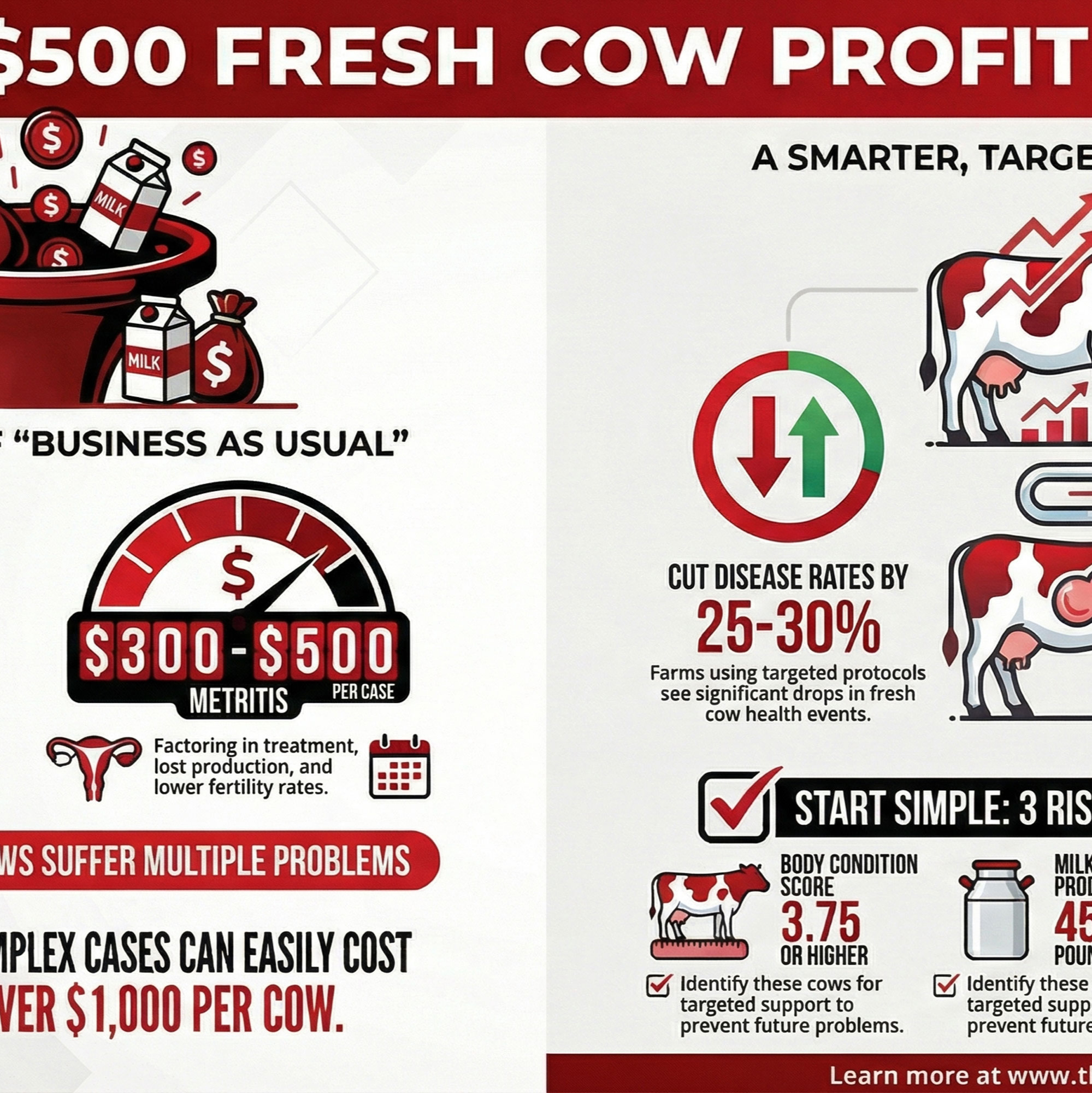
E432 The $500 Transition Gap: Why Your Neighbor’s Fresh Cows May Outperform Yours by Next Winter
Description
Fresh cow crashes are quietly draining dairy profits—and the gap between farms preventing them and farms still reacting to them is widening fast. Research from Penn State, Cornell, and Wisconsin shows targeted transition protocols can cut disease rates by 25-30%, saving $200-$500 per cow per lactation. But here's the uncomfortable truth: roughly 80% of U.S. dairies can't implement these systems yet. This episode breaks down exactly what separates the early adopters from everyone else, why European farms forced to change are now seeing better outcomes than before, and the one ridiculously simple flag you can start using tomorrow—no fancy software required.
Key Takeaways:
- Why clinical ketosis ($300-$350/case) and metritis ($300-$500/case) are just the visible costs—and what the hidden losses really add up to
- The three risk windows every dairy is already managing (and how to turn them into intervention points)
- What Penn State's meloxicam research reveals about timing—and why one-size-fits-all protocols are leaving money on the table
- The "prevention paradox" that explains why farms struggle to value what they prevent
- Why 80% of U.S. operations lack either the data systems or cash reserves to execute consistently
- What happened when European farms were forced to adopt selective protocols in 2022—and the surprising mastitis results
- The three factors that successful U.S. operations share (hint: it's not herd size)
- One simple protocol you can implement for 90 days with an orange livestock marker
Deeper Dive – Why Listen:
This isn't another generic transition cow episode. We're challenging the blanket treatment protocols that have dominated the industry for decades—and backing it up with hard economics.
The research is clear: farms executing targeted protocols are cutting fresh cow disease rates by 25-30%. That translates to $200-$500 saved per cow per lactation. But implementation remains the industry's biggest blind spot. We explore why behavioral economics—specifically the "prevention paradox"—makes it psychologically difficult for farmers to value diseases that never happen.
We break down Adrian Barragan's work at Penn State on anti-inflammatory timing, including the remarkable finding that first-calf heifers treated prepartum showed up to 10-11 pounds more milk per day and 20 percentage points lower stillbirth rates. But older cows? Completely different story—and that's exactly why blanket protocols fail.
The European comparison is eye-opening. When EU Regulation 2019/6 banned prophylactic dry cow therapy in January 2022, farmers changed because they had to. The result? Dutch farms now report lower mastitis rates than they had with blanket treatment. U.S. voluntary adoption? Still under 25%.
We also get brutally honest about implementation readiness. If you're struggling to cover operating expenses, this approach isn't your priority right now. But if you've got positive cash flow and six months of reserves, the window to get ahead of your competition is closing.
Regional insights span from Vermont's tight winter housing to Arizona's heat stress challenges, with practical adaptations from operations of all sizes—300 cows to 3,000.
Resources & Engagement:
Ready to close the gap? The full article with complete research citations, implementation timelines, and the three-metric tracking system is available at https://www.thebullvine.com/management/the-500-transition-gap-why-your-neighbors-fresh-cows-may-outperform-yours-by-next-winter/.