Podcast Episode Details
Back to Podcast Episodes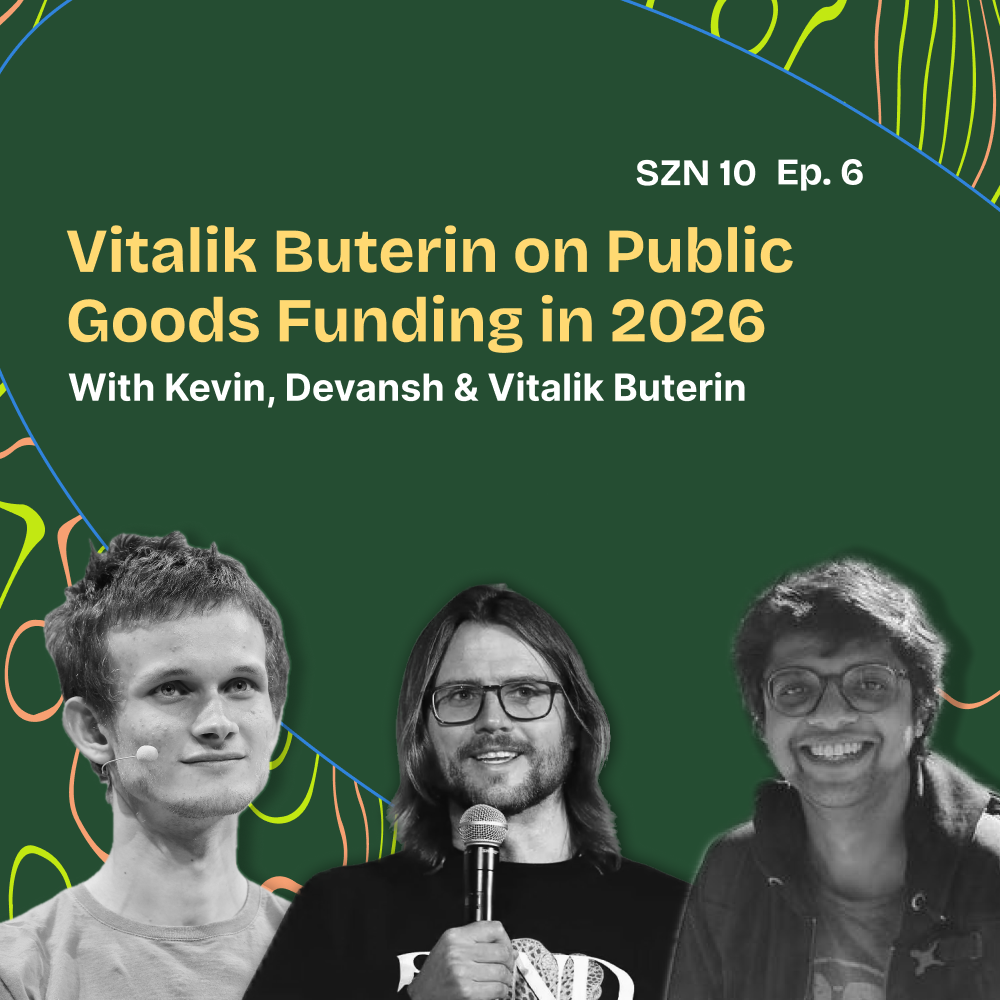
S.10 Ep.6 Public Goods Funding in 2026 & What Builders Should Do Next with Vitalik ButerinVitalik Buterin on Public Goods Funding in 2026 : Mechanisms, Money & What Builders Should Do Next
Season 10 Episode 6
In this episode of the Green Pill Podcast, Kevin Owocki and co-host Devansh Mehta sit down with Vitalik Buterin for their annual deep dive into the future of public goods funding in the Ethereum ecosystem.
They explore where funding will come from in 2026, how the landscape has shifted from "vibes-based" funding to verifiable, dependency-driven mechanisms, and why this is the best moment to reform PGF using new tools like programmable cryptography, AI-assisted evaluation, and deep funding models.
Vitalik also shares how he thinks about dependencies, credible neutrality, open-source licensing, pluralism, accountability, and what builders should prioritize in the coming year.
A must-listen for anyone designing mechanisms, funding public goods, or building the next era of Ethereum governance.
🌐 Timestamps
00:00 – Welcome to the Green Pill Podcast
01:50 – Vitalik joins: why public goods funding matters
02:19 – Why PGF is essential for decentralization
04:18 – The crypto spirit: censorship resistance, institutional design & funding
06:42 – The shift from vibes-era PGF to verifiable mechanisms
08:25 – Why 2026 is the best moment to reform PGF
10:19 – Where does PGF money actually come from?
12:45 – Open-source licensing, taxes & funding dependencies
17:34 – "Fund your dependencies" as a stable mechanism
19:35 – Why general-purpose QF doesn't work in a chaotic world
21:59 – Bottom-up vs top-down: polycentric PGF
25:29 – How to create accountability loops in public goods
27:22 – Funding open-source as an Ethereum priority
29:31 – Privacy as a public good & why it's upstream of PGF
31:54 – What OSS developers really think about crypto
33:52 – Mixing social outreach with financial support
35:56 – What should PGF builders focus on in 2026?
38:13 – Work with new projects, not legacy ones
39:44 – Ecosystem cycles & "layers of sediment"
41:39 – Yield-based funding (Octant) & treasury strategies
43:40 – Accountability: from vibes to rigorous mechanisms
47:35 – Motivation, feedback & the psychology of public goods
50:43 – Profit sharing licenses & sustainable PGF pools
53:46 – Security, issuance & public goods
56:12 – Technology, democracy & long-term risks
58:31 – How PGF relates to DIAC (Defensive/Decentralized Acceleration)
01:00:05 – Solving the free-rider problem without coercion
01:02:12 – Mechanisms vs coercion: credible neutrality
01:04:16 – Institutions, power & capture risks
01:06:16 – Individuals vs institutions in PGF
01:08:41 – Why PGF is more error-tolerant than governance
01:11:01 – Pluralism: many funders, many mechanisms
01:13:14 – Why diversity of funders is healthy
01:15:17 – What Vitalik wants built next
01:17:12 – Ethereum localism & real-world experiments
01:19:28 – What success in PGF looks like by end of 2026
01:24:28 – Closing thoughts
Published on 2 days, 6 hours ago