Episode Details
Back to Episodes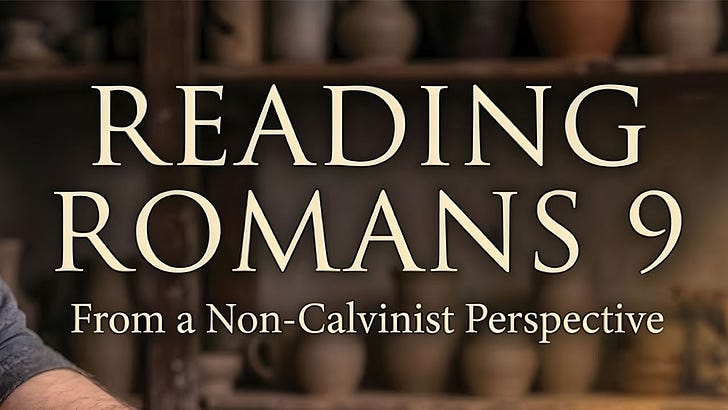
The Deformation 6 - Romans 9 De-Calvinized
Description
This chapter ended up being much longer than normal. It also made sense as a standalone book. So I published it as a Kindle and Paperback book on Amazon called Reading Romans 9 from a Non-Calvinist Perspective by Chris White
Romans chapter 9 stands at the center of a significant theological debate—the question of divine sovereignty and human freedom. For many within the Reformed or Calvinist tradition, this chapter is seen as the clearest biblical evidence for their views.
The Calvinist Interpretation of Romans 9
The importance of Romans 9 for Calvinism cannot be overstated. It is viewed as the foundational text for the doctrine of unconditional election—the belief that God, according to His sovereign will and purpose, chooses to save some and not others, entirely apart from anything foreseen in them, whether faith or works.
As The Gospel Coalition summarizes, in Romans 9:
“Paul teaches the (Calvinist) doctrine of unconditional election—the teaching that God chooses to save some and not others, not based on anything in them (whether faith or fruit, present or foreseen), but based solely on his sovereign will and purpose.”
This chapter is also the main passage that Reformed believers turn to in support of predestination—the belief that God, before the foundation of the world, predetermined the course of all things, from the smallest detail to the greatest events. Human history in every detail unfolds exactly as God has decreed it, and that nothing is a result of independent or autonomous human decisions. As Martin Luther famously wrote in The Bondage of the Will, the idea of free will is a “mere lie.”
The Early Church View
While many today associate Romans 9 with the doctrine of predestination, this was not how the earliest Christians understood the passage. In fact, a deterministic reading of Romans 9—one that sees God as arbitrarily choosing some people for salvation and others for damnation—first appeared among certain Gnostic sects in the second century. These groups taught that human destinies were fixed by divine decree, that some were created as “spiritual” and destined for salvation while others were “material” and destined for destruction.
Early Christian leaders such as Irenaeus, Origen, and Chrysostom strongly rejected these ideas. They saw the Gnostic-style interpretation of Romans 9—that some were born good and others born evil or damned—as a distortion of both Scripture and God’s character. For the first four centuries of the church, the freedom of the human will was taken for granted. The early fathers—interpreting Romans 9 within the broader scriptural witness—consistently rejected any notion of unconditional predestination that nullifies human responsibility.
This was the standard reading in the Greek and Latin churches: divine mercy and human freedom work in concert, and the text was never taken to teach a unilateral, unconditional predestination of individuals to salvation or damnation. It was not until the fifth century that a more deterministic view of Romans 9 gained traction in Christian theology—introduced by Augustine of Hippo, a former Gnostic himself. Augustine’s later writings on grace and predestination drew heavily from Romans 9 and became the foundation for what would later evolve into Calvinist theology.
I will be arguing against the Reformed interpretation of Romans 9 by first outlining the major problems I see with that view, and then walking through the chapter verse by verse to address each of the most difficult passages in detail. Before examining Romans 9 though, it’s important to understand what Calvinists believe and why this chapt