Episode Details
Back to Episodes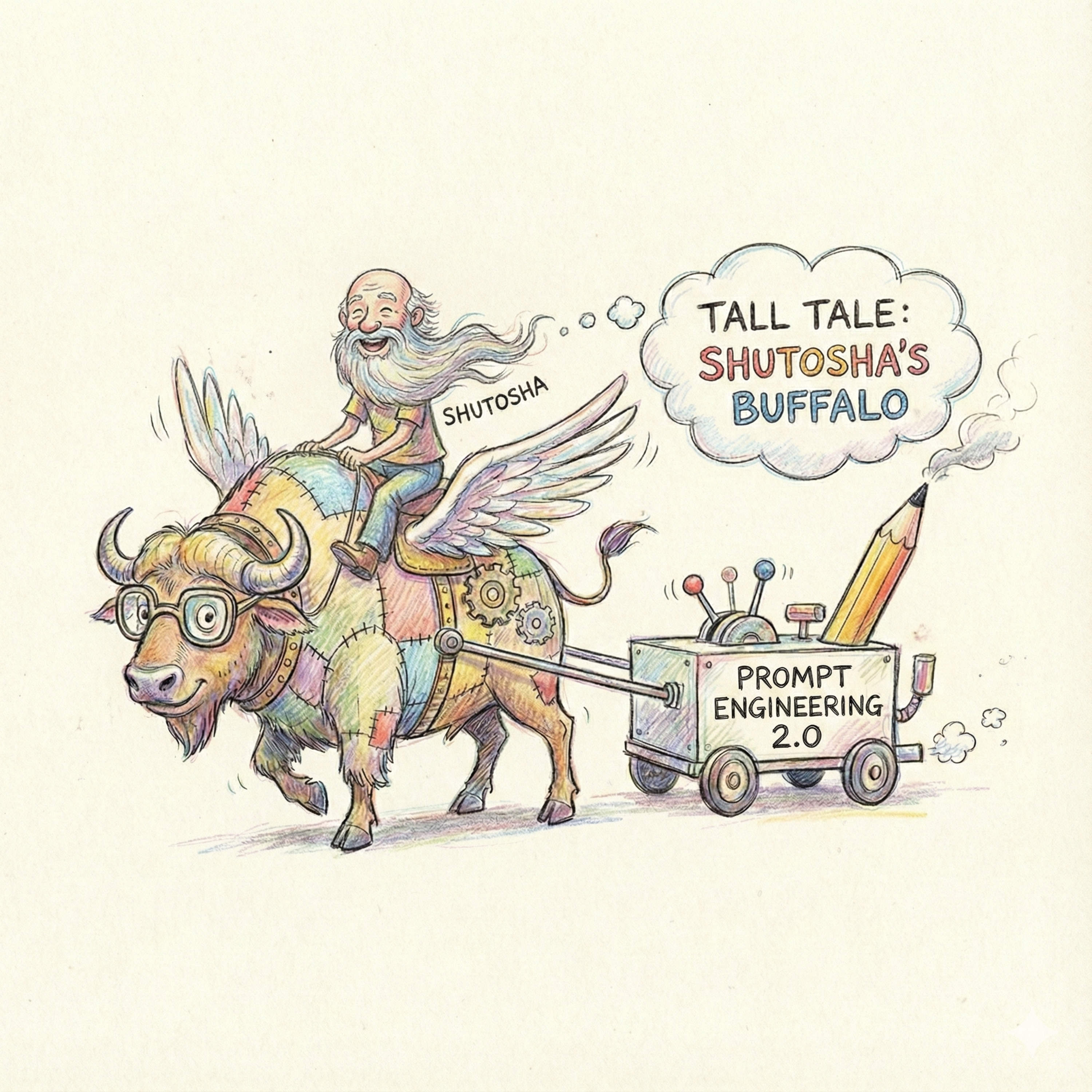
Prompt Engineering 2.0 explained through a Tall Tale
Description
**Prompt Engineering 2.0 (PE 2.0) is the strategic discipline required to overcome "AI Slop"—the high volume of low-quality, generic content resulting from vague, unstructured inputs (Prompt Engineering 1.0). Slop is characterized by its banality, structural incoherence, and repetitive nature, a direct result of the AI defaulting to the statistical "average" of its training data. PE 2.0 transforms the input from a simple question into a Dynamic Protocol that programs the language model’s latent space, forcing the output to achieve high fidelity and specificity.
Central to this disciplined approach are structured frameworks, which act as cognitive checklists to constrain the AI’s generation space:
- Role-Task-Format (RTF): The foundational structure, defining the AI's persona, the exact task (action), and the mandatory output shape (e.g., list, table, script). RTF is crucial for preventing structural slop and ensuring the content is immediately usable in downstream workflows.
- CREATE: Effective for creative or persona-driven tasks. By defining the Character (Role Priming) and providing stylistic Examples (Few-Shot Prompting), this framework steers the AI away from blandness and activates the precise vocabulary necessary for a nuanced tone.
- CO-STAR (Context, Objective, Style, Tone, Audience, Response): The gold standard for complex tasks. It front-loads the prompt with detailed background, mandatory style guidelines, and the target audience. This heavy contextual grounding significantly reduces the incidence of hallucination and emotional dissonance.
- Chain-of-Thought (CoT): Instructs the model to break down complex requests into sequential, step-by-step reasoning, dramatically improving the accuracy and logical flow of the generated content.
These frameworks are essential for producing non-straightforward, specific outputs, particularly in creative endeavors. For instance, recreating the exaggerated, humorous tall tale known as “Shutosha’s Buffalo” (a “Maha-Shootri”) requires structured prompting to maintain its unique comedic style and hyperbole. The story, which features an enormous, philosophical buffalo whose mere shift of the head causes a "Buffalo Eclipse" and a district-wide blackout, demonstrates that fidelity to a complex, nuanced tone can only be achieved through specific, architected instructions rather than generic requests. This systematic approach ensures the final output is a high-utility artifact.
#PromptEngineering #AISlop #LLMFrameworks #AITips #NotebookLM #CreativeAI #StructuredPrompting #MahaShootri #AIStrategy #PromptHacks