Episode Details
Back to Episodes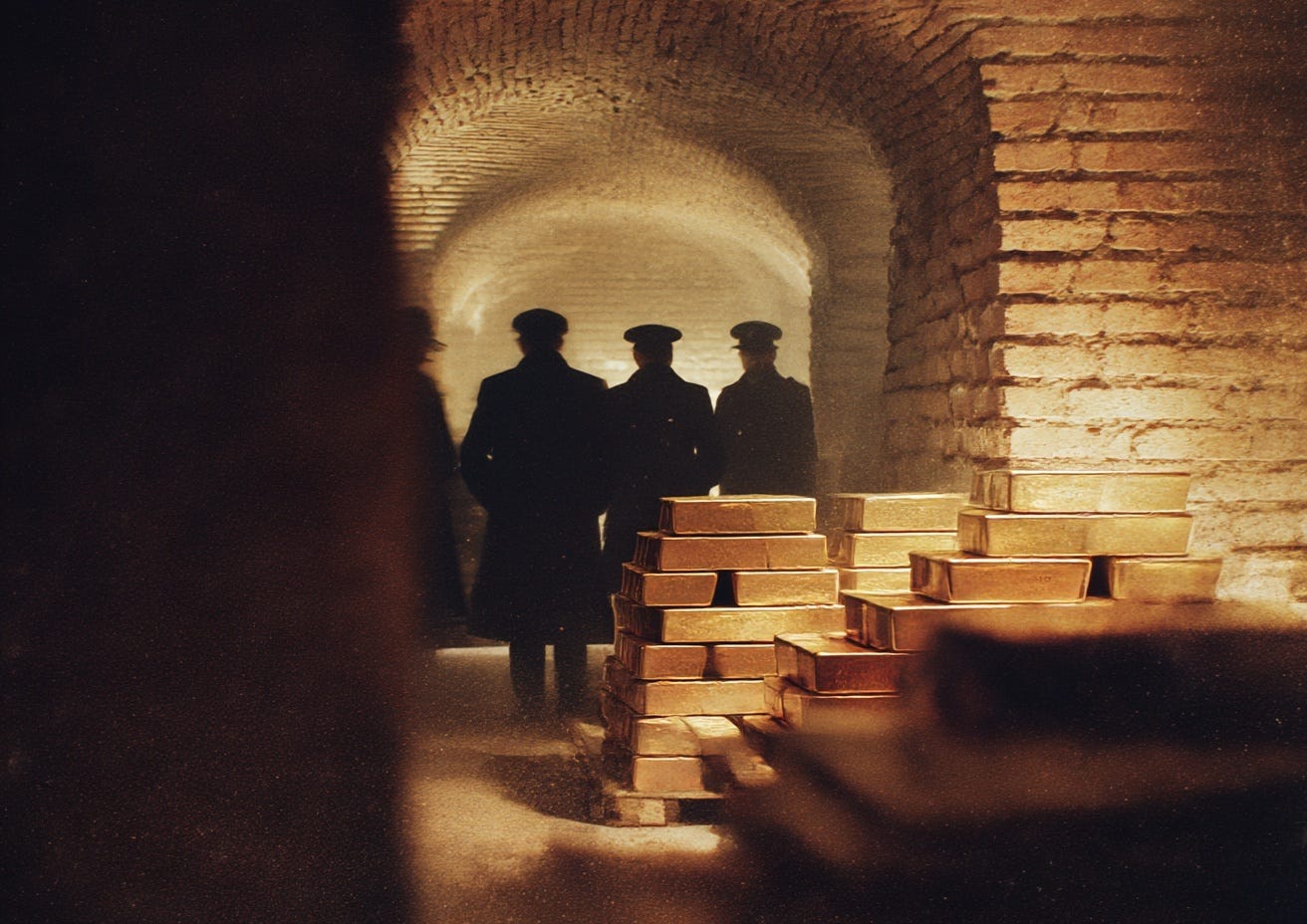
When Your Gold Heist Becomes Someone Else's Gold Heist
Description
Good Sunday to you,
A bit of admin before we come to today’s thought piece.
First, in case you missed it, here is this week’s commentary, mostly ranting about the budget, the UK’s inept leadership and what actions you, as an investor, should take:
And this week I also appeared on comedian Geoff Norcott’s podcast, What Most People Think. Here are the links to the show on Apple and Spotify, if of interest.
But for your thought piece today, we have another great little World War Two gold story which didn’t make the cut.
The farcical journey of Albanian and Italian gold
(NB: a tonne of gold is about a medium-sized suitcase full).
As the Nazis took both Austria and Czechoslovakia with ease, Italian Prime Minister Benito Mussolini grew anxious to flex his own muscles.
Albania would be his target. Geographically, culturally and historically, it made sense: Albania had been part of the Roman Empire even before northern Italy.
In April 1939, Italy invaded with a force that contained 400 planes, 300 small tanks, 12 warships, and 22,000 men. But some untrained Albanian locals with the help of a few soldiers managed to drive them back into the sea. Such was 20th century Italian warfare.
The Italians made it on the second attempt, however, and the capital, Tirana, fell.
The Albanian King Zog gave an impassioned speech on the radio, urging resistance, but nobody heard it because Albania at the time had fewer than 2,000 radios, and the Italians soon managed to jam the airwaves anyway. Shortly after giving the speech, like the true patriot he was, he fled the country, taking enough gold with him to lead a long life of luxury in exile, eventually ending up in Egypt as a guest of King Farouk, to whom he had to pay $20 million for refuge.
Albania's founders believed in gold, and their currency, the lek, was based on it. Inflation, as a result, had been nonexistent. The central bank was established in the summer of 1925, and it had worked hard to build up its gold holdings. At home, it had encouraged citizens to swap their jewellery for paper money. That private gold was then added to the nation's gold holdings. Whenever possible, the country increased its gold holdings in London.
But by the time of the invasion in 1939, most of Albania's 2.3 tonnes was in Italy anyway, where it had been sent for safekeeping. The Italians managed to confiscate quite a bit more in coins and jewellery from citizens.
We fast forward four years.
The Italian dilemma: give their gold to the Nazis or the Allies?
In 1943, Allied forces moved north from Africa into Sicily and then Italy: the invasion of the soft underbelly of Europe had begun.
Hectic days followed the ousting of Mussolini in July. The Italian Fascists were still nominally in charge. They declared Rome an open city in the hope of avoiding Allied air attacks. But by September 1943, the Nazis had control of the capital and central Italy, and they wanted Italy's gold moved to Berlin, while they still had control of the area.
They began confiscating the gold of Italian citizens in Rome, especially Italian Jews. The amounts demanded were unrealistic, but Roman Jews reached into their family treasures, their synagogues and institutions to turn in what they had. The Pope, Pius XII, heard about the demands and authorised Catholic churches to lend Jews gold so they could reach the quota.
But the big prize was in the Italian Central Bank, and several Nazi organisations had their eyes on it: Himmler's SS, Göring's Four Year Plan, von Ribbentrop's Foreign Office, and Funk's Reichsbank.
Even the Bank of International Settlements (BIS), which was worried about its investments in Italy, started making demands that Italy send it gold. Initially, the governor of the Italian bank, Vincenzo Azzolini, made out that he was offended