Episode Details
Back to Episodes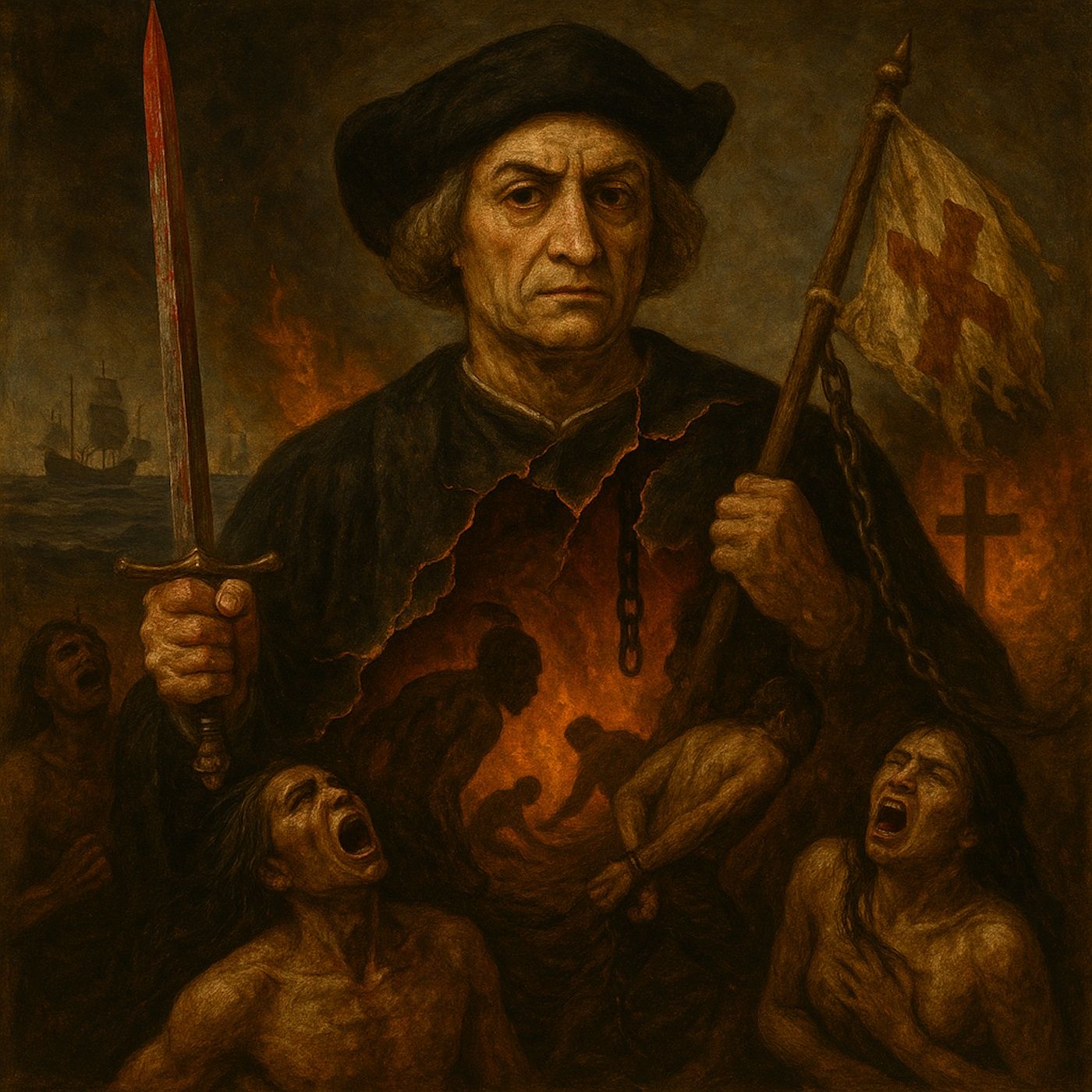
DH Ep:46 Christopher Columbus
Published 4 months, 1 week ago
Description
In this comprehensive episode of Disturbing History, we journey back over five centuries to examine the true story of Christopher Columbus, stripping away the mythology that has long obscured one of history's most controversial figures. This is the story they did not teach you in school, the history that was sanitized and romanticized for generations of American schoolchildren who grew up believing Columbus was simply a brave explorer who proved the Earth was round. Christopher Columbus was born in Genoa around 1451, the son of a wool weaver named Domenico Colombo who also operated a cheese stand.
Growing up in one of the great maritime powers of the Mediterranean, young Columbus went to sea early and eventually made his way to Portugal, where he married into minor nobility and became obsessed with the idea of reaching Asia by sailing west across the Atlantic. His calculations were wildly optimistic, underestimating the distance to Asia by roughly four times, but this miscalculation would prove fortuitous when two vast continents he never knew existed blocked his path.
After being rejected by the Portuguese Crown, whose experts correctly determined that the voyage was too long to be practical, Columbus spent years seeking Spanish patronage. He finally secured backing from Ferdinand and Isabella in 1492, just months after they completed the Reconquista by conquering Granada and signed the Alhambra Decree expelling Jews from Spain. Columbus departed with three ships and approximately ninety men on August 3, 1492, and made landfall in the Bahamas on October 12 of that year. From the very first day of contact with the Taíno people, Columbus's journal reveals his intentions. He described these peaceful people who greeted him with gifts as potential servants, writing that with fifty men he could subjugate them all and make them do whatever he wanted.
The seeds of catastrophe were planted in that first moment of encounter. The episode traces Columbus's four voyages to the Americas and documents the systematic exploitation and destruction of the Taíno civilization. We examine the tribute system Columbus implemented, which required every Taíno over age fourteen to deliver a hawk's bell full of gold dust every three months, with brutal punishments for those who failed.
We explore the encomienda system of forced labor that worked the Indigenous population to death in Spanish mines and plantations. We document the slave raids that shipped hundreds of Taíno to Spain, with many dying during the Atlantic crossing. The demographic collapse of the Taíno was unprecedented in human history. From a pre-contact population estimated between 250,000 and over a million on Hispaniola alone, the population fell to approximately 60,000 by 1508, then to around 26,000 by 1514, and to fewer than 200 by 1542.
The Taíno were declared extinct by Spanish colonial authorities by the early seventeenth century. Modern scholars debate the relative contributions of European diseases versus direct violence and forced labor, but what is beyond dispute is that the systems Columbus created prevented any possibility of demographic recovery.
We also examine Columbus's downfall, his arrest in 1500 by Francisco de Bobadilla, who had been sent by the Spanish Crown to investigate complaints about his governance. Bobadilla found evidence of arbitrary punishments, whippings and mutilations inflicted on both Spaniards and Indigenous people, and Columbus's own writings about his desire to sell as many slaves as possible.
All three Columbus brothers were placed in chains and shipped back to Spain. Though Columbus's titles were eventually restored, he never again governed the colonies. The episode concludes by examining the contested legacy of Columbus in modern times, from the establishment of Columbus Day as a federal holiday in 1937 to the growing movement to replace it with Indigenous Peoples' Day, w
Growing up in one of the great maritime powers of the Mediterranean, young Columbus went to sea early and eventually made his way to Portugal, where he married into minor nobility and became obsessed with the idea of reaching Asia by sailing west across the Atlantic. His calculations were wildly optimistic, underestimating the distance to Asia by roughly four times, but this miscalculation would prove fortuitous when two vast continents he never knew existed blocked his path.
After being rejected by the Portuguese Crown, whose experts correctly determined that the voyage was too long to be practical, Columbus spent years seeking Spanish patronage. He finally secured backing from Ferdinand and Isabella in 1492, just months after they completed the Reconquista by conquering Granada and signed the Alhambra Decree expelling Jews from Spain. Columbus departed with three ships and approximately ninety men on August 3, 1492, and made landfall in the Bahamas on October 12 of that year. From the very first day of contact with the Taíno people, Columbus's journal reveals his intentions. He described these peaceful people who greeted him with gifts as potential servants, writing that with fifty men he could subjugate them all and make them do whatever he wanted.
The seeds of catastrophe were planted in that first moment of encounter. The episode traces Columbus's four voyages to the Americas and documents the systematic exploitation and destruction of the Taíno civilization. We examine the tribute system Columbus implemented, which required every Taíno over age fourteen to deliver a hawk's bell full of gold dust every three months, with brutal punishments for those who failed.
We explore the encomienda system of forced labor that worked the Indigenous population to death in Spanish mines and plantations. We document the slave raids that shipped hundreds of Taíno to Spain, with many dying during the Atlantic crossing. The demographic collapse of the Taíno was unprecedented in human history. From a pre-contact population estimated between 250,000 and over a million on Hispaniola alone, the population fell to approximately 60,000 by 1508, then to around 26,000 by 1514, and to fewer than 200 by 1542.
The Taíno were declared extinct by Spanish colonial authorities by the early seventeenth century. Modern scholars debate the relative contributions of European diseases versus direct violence and forced labor, but what is beyond dispute is that the systems Columbus created prevented any possibility of demographic recovery.
We also examine Columbus's downfall, his arrest in 1500 by Francisco de Bobadilla, who had been sent by the Spanish Crown to investigate complaints about his governance. Bobadilla found evidence of arbitrary punishments, whippings and mutilations inflicted on both Spaniards and Indigenous people, and Columbus's own writings about his desire to sell as many slaves as possible.
All three Columbus brothers were placed in chains and shipped back to Spain. Though Columbus's titles were eventually restored, he never again governed the colonies. The episode concludes by examining the contested legacy of Columbus in modern times, from the establishment of Columbus Day as a federal holiday in 1937 to the growing movement to replace it with Indigenous Peoples' Day, w