Episode Details
Back to Episodes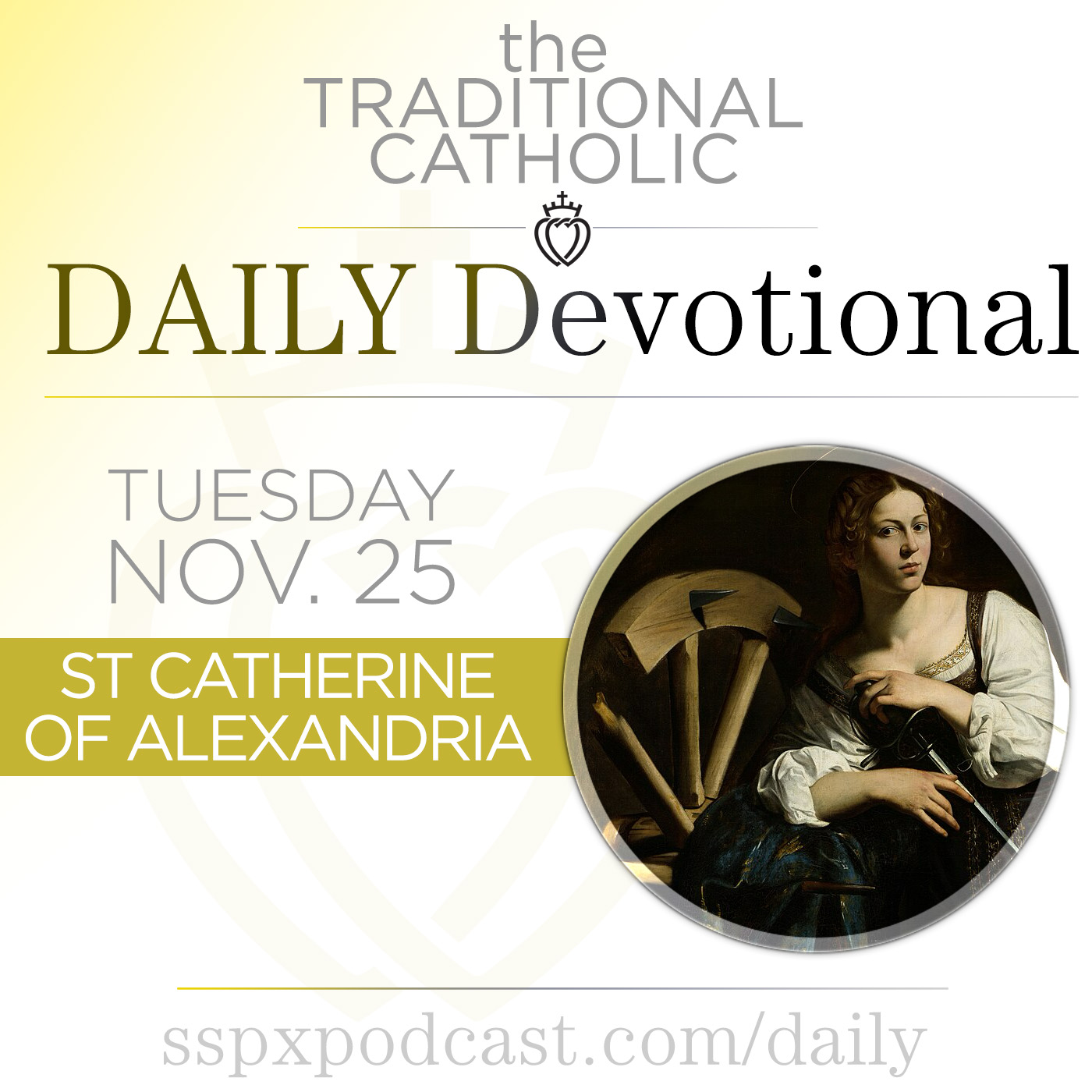
Nov 25 – S Catherine of Alexandria
Description
It’s the Feast of St. Catherine of Alexandria, 3rd Class, with the color of Red. In this episode: the meditation: “The Emptiness and Shortness of Human Life”, today’s news from the Church: “Czech Cardinal, Figure of Resistance to Communism, Dies at 82”, and today’s thought from the Archbishop.
Have feedback or questions about the DD or our other shows? podcast@sspx.orgSources Used Today:
- “The Emptiness and Shortness of Human Life” – Death, Judgment, Heaven, and Hell: Meditations on the Four Last Things by St. Alphonsus de Liguori
- “Czech Cardinal, Figure of Resistance to Communism, Dies at 82” (FSSPX.news)
- The Spiritual Life – Archbishop Lefebvre (Angelus Press)
Saint Catherine of Alexandria is one of the most striking figures of early Christian tradition, a young woman whose intellect and courage left even her adversaries unsettled. Though the details of her life come to us wrapped in legend, the heart of the story has inspired believers for more than fifteen centuries. Catherine was said to be a noblewoman of Alexandria, a city famous for its libraries, academies, and restless philosophical debates. She grew up surrounded by ideas and became known for her quick mind and love of learning. Tradition holds that after encountering the Gospel, she embraced Christ with the same intensity she once gave to study, seeing in him the fullness of truth she had sought.
Her conversion caught the attention of the emperor Maxentius, who summoned her during the persecutions of the early fourth century. Expecting to embarrass her, he brought together a group of the empire’s leading scholars to argue against her faith. Catherine was young and alone, but she engaged them with clarity and calm. According to ancient accounts, several of the philosophers were so moved by her reasoning and example that they themselves professed belief in Christ. Enraged, the emperor condemned them and turned his fury on Catherine.
The most famous part of her story is the torture device known as the breaking wheel. When Catherine was bound to it, the wheel shattered at her touch. The symbol of execution became instead a sign of divine protection, and for centuries the wheel appeared in Christian art as her emblem. Eventually she was sentenced to be beheaded. The early Church remembered her not for dramatic heroism, but for her serenity and devotion. She faced suffering with the confidence that truth was stronger than violence.