Episode Details
Back to Episodes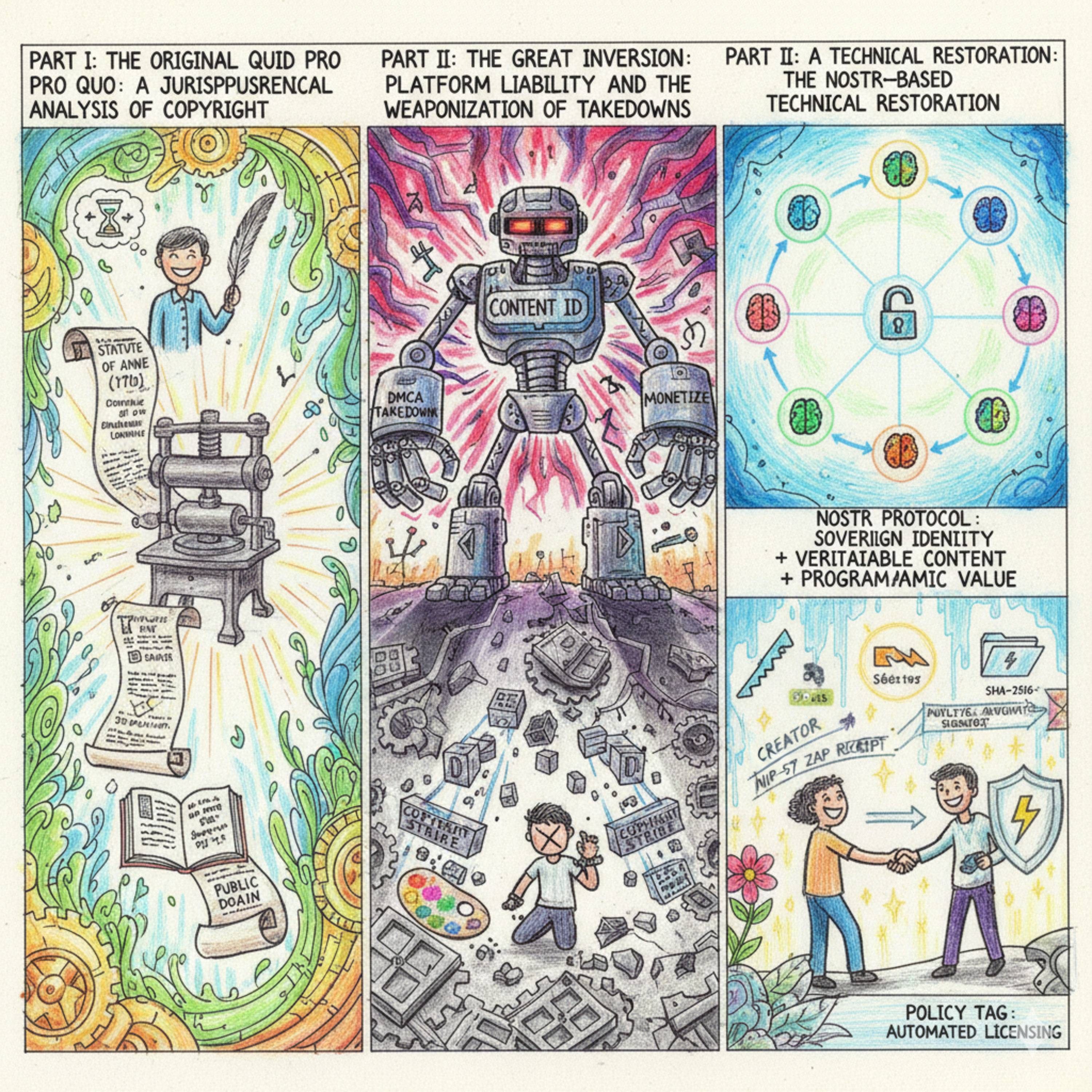
Nostr fixes Copyright's broken bargain
Description
This proposed model represents a full-circle restoration of the original "quid pro quo" of copyright, re-aligned for the digital age.
The "spirit" of copyright law was a utilitarian bargain for public good—the "Encouragement of Learning".
This bargain was inverted by the "piecemeal" liability shield of the DMCA 512 (Part II), which perversely incentivized platforms to build extra-judicial, automated censorship systems (Content ID).
This system chilled creativity and forced creators to abandon legal arguments (fair use) in favor of a technical arms race (pitch-shifting).
A decentralized architecture (Part III) based on sovereign identity ( Nostr keys), verifiable content (NIP-94), and programmatic value (NIP-57) provides the tools to fix this broken architecture.
In the proposed "Policy Tag" model, the original bargain is restored:
The Creator's "Quid": The musician receives their "quid"—a 1000-sat micropayment, sent directly, instantly, and non-custodially.
The Public's "Quo": The public receives its "quo"—the critic's "transformative" video lesson.
This new work, which promotes the "Progress of Science" , is now published with a public, cryptographic, and immutable proof-of-license (the kind 9735 receipt) embedded in its metadata. This system replaces automated, platform-defined censorship with automated, permissionless, creator-defined licensing. By doing so, the code is finally re-aligned with the law, restoring power to creators and enabling the very "Progress" that copyright was invented to foster.