Episode Details
Back to Episodes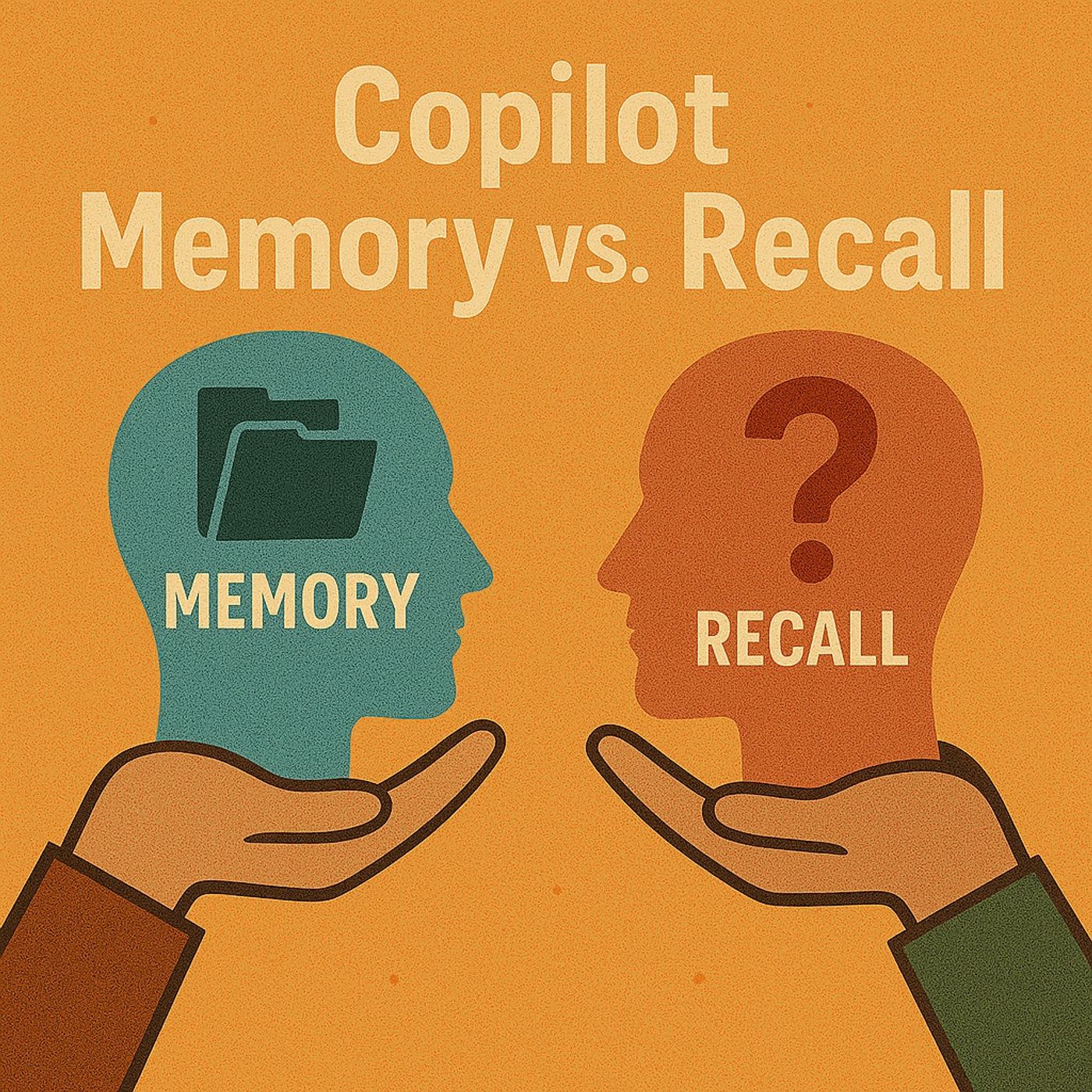
Copilot Memory vs Windows Recall: Understanding the Privacy Differences
Season 1
Published 9 months, 3 weeks ago
Description
Everyone thinks Copilot Memory is spying on them. They're wrong. The real privacy concern isn't what Memory records—it's what people assume it does. And before you compare it to Recall, you need to understand what each tool actually is and what it isn't.
🔍 SHORT SUMMARY
Copilot Memory and Windows Recall are fundamentally different technologies that solve different problems. This episode breaks down how Copilot Memory actually works, what it stores and doesn't store, how it differs from Recall's screenshot-based approach, the real privacy implications of both tools, and why understanding intent-based memory versus passive recording matters for Microsoft 365 deployment decisions.
🧠 CORE IDEA
Most confusion around Copilot Memory comes from three misconceptions:
• It records everything you do
• It's the same as Windows Recall
• Microsoft controls what gets stored
None of these are true. Memory is an intent-based notepad you actively control. Recall is a passive screenshot system that captures everything. Understanding this difference is critical for security, governance, and user trust.
⚠️ THE REAL PROBLEM
When Copilot Memory launched, people panicked. The name alone triggered surveillance fears. But the actual privacy risk isn't hidden recording—it's assumption and misunderstanding:
• Users think it logs keystrokes
• IT teams think it violates compliance
• Security professionals compare it to screen recording
• Nobody reads what Memory actually does
This creates organizational resistance based on fear, not facts.
📝 WHAT COPILOT MEMORY ACTUALLY IS
Copilot Memory is a user-controlled notepad for your AI assistant. It works through explicit instructions:
1. You tell Copilot to remember something
Example: "Remember I prefer my summaries under 100 words"
2. Copilot stores that preference
It logs the instruction and flashes a "Memory updated" badge
3. You can review and delete memories anytime
Full transparency—you see what's stored
4. Admins can control Memory at the tenant level
IT has full governance over the feature
Memory doesn't run in the background. It only persists when you explicitly tell it to remember something.
📸 WHAT WINDOWS RECALL ACTUALLY IS
Recall is a completely different technology:
• Takes screenshots of your screen every few seconds
• Stores them locally on your device
• Makes them searchable through AI
• Runs passively in the background
• Requires explicit user consent to enable
Recall is not part of Microsoft 365. It's a Windows 11 feature designed for personal productivity—not enterprise deployment.
🔄 THE KEY DIFFERENCES
Copilot Memory:
• Intent-based: You choose what to save
• Cloud-stored: Syncs across devices
• Admin-controllable: IT can disable it
• Selective: Only stores explicit instructions
• Enterprise-ready: Designed for M365 environments
Windows Recall:
• Passive: Captures everything automatically
• Local-only: Stays on your device
• User-controlled: Admins have limited governance
• Comprehensive: Screenshots all activity
• Personal productivity: Not designed for enterprise use
One is a notepad. The other is a time machine.
🛡️ THE PRIVACY QUESTION
Copilot Memory privacy concerns are overblown.
The real risks are:
• Users storing sensitive information without realizing it
• Lack of user education on what Memory does
• Confusion between Memory and Recall
Recall has legitimate privacy concerns:
• Screenshots may capture sensitive data
• Local storage can be accessed if device is compromised
• Users must understand what they're enabling
Both tools require user awareness—but they're not the same priv
🔍 SHORT SUMMARY
Copilot Memory and Windows Recall are fundamentally different technologies that solve different problems. This episode breaks down how Copilot Memory actually works, what it stores and doesn't store, how it differs from Recall's screenshot-based approach, the real privacy implications of both tools, and why understanding intent-based memory versus passive recording matters for Microsoft 365 deployment decisions.
🧠 CORE IDEA
Most confusion around Copilot Memory comes from three misconceptions:
• It records everything you do
• It's the same as Windows Recall
• Microsoft controls what gets stored
None of these are true. Memory is an intent-based notepad you actively control. Recall is a passive screenshot system that captures everything. Understanding this difference is critical for security, governance, and user trust.
⚠️ THE REAL PROBLEM
When Copilot Memory launched, people panicked. The name alone triggered surveillance fears. But the actual privacy risk isn't hidden recording—it's assumption and misunderstanding:
• Users think it logs keystrokes
• IT teams think it violates compliance
• Security professionals compare it to screen recording
• Nobody reads what Memory actually does
This creates organizational resistance based on fear, not facts.
📝 WHAT COPILOT MEMORY ACTUALLY IS
Copilot Memory is a user-controlled notepad for your AI assistant. It works through explicit instructions:
1. You tell Copilot to remember something
Example: "Remember I prefer my summaries under 100 words"
2. Copilot stores that preference
It logs the instruction and flashes a "Memory updated" badge
3. You can review and delete memories anytime
Full transparency—you see what's stored
4. Admins can control Memory at the tenant level
IT has full governance over the feature
Memory doesn't run in the background. It only persists when you explicitly tell it to remember something.
📸 WHAT WINDOWS RECALL ACTUALLY IS
Recall is a completely different technology:
• Takes screenshots of your screen every few seconds
• Stores them locally on your device
• Makes them searchable through AI
• Runs passively in the background
• Requires explicit user consent to enable
Recall is not part of Microsoft 365. It's a Windows 11 feature designed for personal productivity—not enterprise deployment.
🔄 THE KEY DIFFERENCES
Copilot Memory:
• Intent-based: You choose what to save
• Cloud-stored: Syncs across devices
• Admin-controllable: IT can disable it
• Selective: Only stores explicit instructions
• Enterprise-ready: Designed for M365 environments
Windows Recall:
• Passive: Captures everything automatically
• Local-only: Stays on your device
• User-controlled: Admins have limited governance
• Comprehensive: Screenshots all activity
• Personal productivity: Not designed for enterprise use
One is a notepad. The other is a time machine.
🛡️ THE PRIVACY QUESTION
Copilot Memory privacy concerns are overblown.
The real risks are:
• Users storing sensitive information without realizing it
• Lack of user education on what Memory does
• Confusion between Memory and Recall
Recall has legitimate privacy concerns:
• Screenshots may capture sensitive data
• Local storage can be accessed if device is compromised
• Users must understand what they're enabling
Both tools require user awareness—but they're not the same priv