Episode Details
Back to Episodes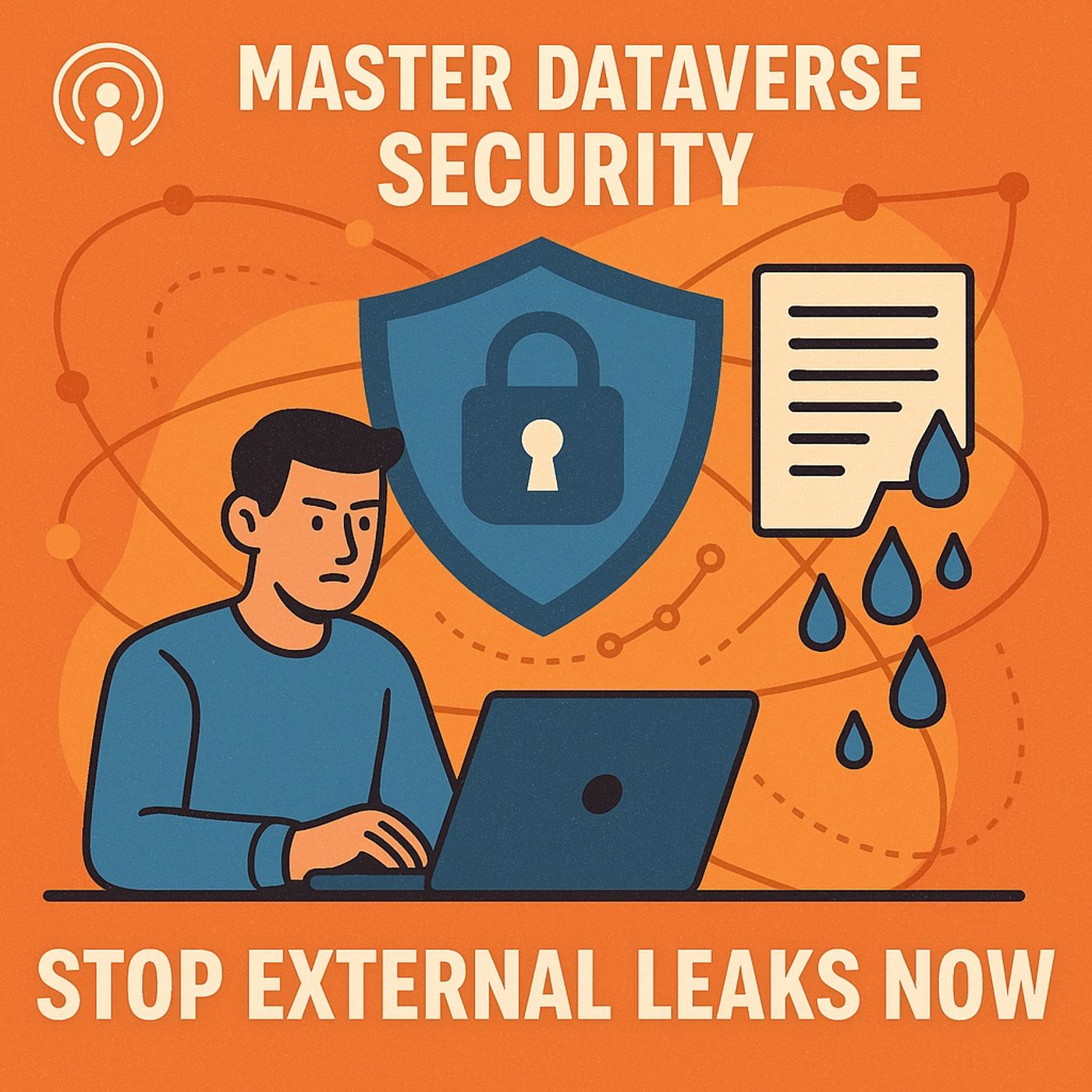
Dataverse security external access: stop role misconfiguration from leaking internal data to guest and vendor portals
Season 1
Published 9 months, 3 weeks ago
Description
Dataverse security: in this episode of M365.fm, Mirko Peters shows how easy it is to leak internal data to vendors and guests when you treat Dataverse like SharePoint and hand out organization‑level roles “just to make things work.” He opens with a vendor‑portal disaster scenario: a guest account meant to see only its own purchase orders suddenly browsing executive performance data, because one cloned role quietly included broad read access across the entire environment.
Mirko then walks through the real architecture of trust inside Dataverse—Users, Teams, Security Roles, and Business Units—and how they combine into a precise, additive permission model. He explains why privileges (Create, Read, Write, Delete, Append, Append To, Assign, Share) and their scopes (User, Business Unit, Parent:Child, Organization) act like keys with different radiuses of power. A single Organization‑scoped privilege overrides every careful restriction, so one sloppy role assignment to a guest or project team can blow a hole through your entire containment strategy.
From there, the episode shifts to “breaking the castle” to understand leaks. Mirko reconstructs the vendor portal fiasco step by step: a “Vendor Guest” role cloned from a Sales role, inherited Parent:Child or Organization‑level read on key tables, and a Power App that trusted Dataverse to enforce scoping. The result is a UI that happily renders records from multiple business units because the backend has already certified access, turning a neat portal into an unintentional global directory.
He contrasts this with a hardened design. Guests live in dedicated Business Units with minimal User‑scope privileges, while Teams grant only targeted access via explicit sharing for specific records or projects. Roles are built from the principle “start at User, prove the need to go wider,” and Organization scope is treated as a controlled exception for a tiny set of internal admin accounts. Mirko shows how this pattern lets you run external portals safely without copying system administrator powers into every new environment.
Finally, you get a practical playbook to stop leaks before they happen. Mirko recommends auditing roles for Organization‑scope permissions, isolating guests into their own Business Units, avoiding cloned admin‑style roles, and treating Dataverse security as a mathematical model rather than “permissions vibes.” The key mindset shift: Dataverse will not rescue you from imprecision—it will faithfully execute whatever combination of roles and scopes you define, so you must design that combination with external users in mind from day one.
WHAT YOU WILL LEARN
Mirko then walks through the real architecture of trust inside Dataverse—Users, Teams, Security Roles, and Business Units—and how they combine into a precise, additive permission model. He explains why privileges (Create, Read, Write, Delete, Append, Append To, Assign, Share) and their scopes (User, Business Unit, Parent:Child, Organization) act like keys with different radiuses of power. A single Organization‑scoped privilege overrides every careful restriction, so one sloppy role assignment to a guest or project team can blow a hole through your entire containment strategy.
From there, the episode shifts to “breaking the castle” to understand leaks. Mirko reconstructs the vendor portal fiasco step by step: a “Vendor Guest” role cloned from a Sales role, inherited Parent:Child or Organization‑level read on key tables, and a Power App that trusted Dataverse to enforce scoping. The result is a UI that happily renders records from multiple business units because the backend has already certified access, turning a neat portal into an unintentional global directory.
He contrasts this with a hardened design. Guests live in dedicated Business Units with minimal User‑scope privileges, while Teams grant only targeted access via explicit sharing for specific records or projects. Roles are built from the principle “start at User, prove the need to go wider,” and Organization scope is treated as a controlled exception for a tiny set of internal admin accounts. Mirko shows how this pattern lets you run external portals safely without copying system administrator powers into every new environment.
Finally, you get a practical playbook to stop leaks before they happen. Mirko recommends auditing roles for Organization‑scope permissions, isolating guests into their own Business Units, avoiding cloned admin‑style roles, and treating Dataverse security as a mathematical model rather than “permissions vibes.” The key mindset shift: Dataverse will not rescue you from imprecision—it will faithfully execute whatever combination of roles and scopes you define, so you must design that combination with external users in mind from day one.
WHAT YOU WILL LEARN
- Why Dataverse security leaks often come from cloned roles and Organization‑level scope.
- How Users, Teams, Security Roles, and Business Units really combine to grant access.
- How privilege scopes (User, Business Unit, Parent:Child, Organization) change data visibility.
- How guest and vendor portals accidentally expose internal records when roles are mis‑scoped.
Listen Now
Love PodBriefly?
If you like Podbriefly.com, please consider donating to support the ongoing development.
Support Us