Episode Details
Back to Episodes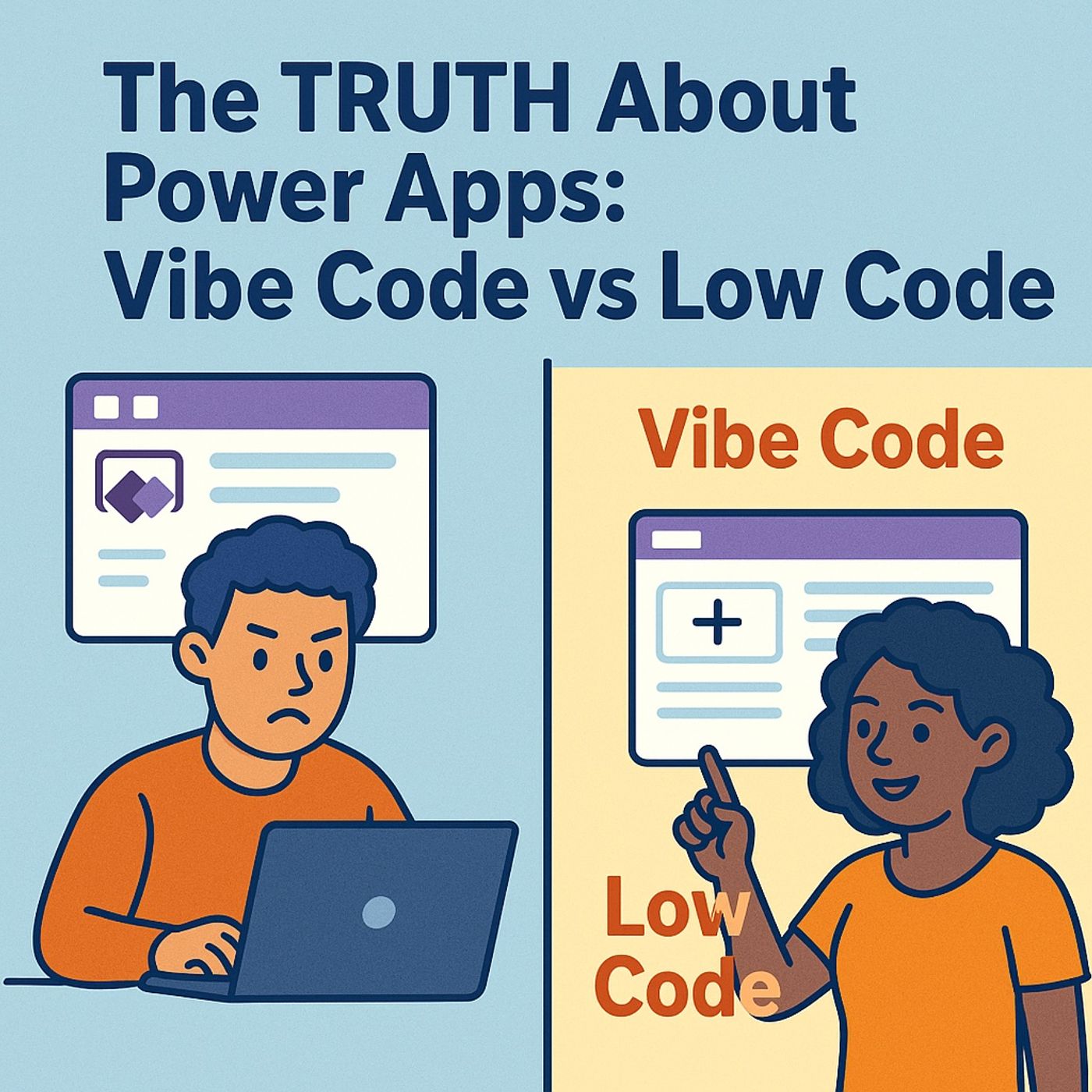
Power Apps Vibe Code vs Low Code: when to move from Canvas Apps to Code Apps with GitHub Copilot
Season 1
Published 9 months, 2 weeks ago
Description
Power Apps Vibe Code vs Low Code: in this episode of M365.fm, Mirko Peters tears down the fairy tale that Power Apps is just “drag, drop, publish” and shows how Vibe Code—Code Apps with React, VS Code, and GitHub Copilot—changes who should really be building serious apps. He explains how the “low‑code for everyone” story worked too well, leaving enterprises with dozens of fragile Canvas Apps built by well‑meaning citizen devs, all hiding complex Power Fx formulas, delegation warnings, and maintenance nightmares behind pastel buttons and cheerful UI.
Mirko starts with the low‑code illusion. Canvas and model‑driven apps made it feel like anyone could be a developer, but the reality was IKEA‑style software: fast to assemble, terrifying to move or upgrade. He walks through how Power Fx creates opaque dependency webs only the original maker understands, how slightly different “Task Tracker” apps proliferate across environments, and why serious integrations—SQL, CI/CD, reusable components—push teams into painful “rewrite moments” where low‑code’s early speed turns into long‑term techdebt.
He then introduces Vibe Code (Power Apps Code Apps) as the grown‑up counterweight. You work in Visual Studio Code with TypeScript, React, pac CLI, and proper Git repositories, but still live inside the Power Platform’s governed world of connectors, environments, and Microsoft Entra authentication. Mirko shows how Code Apps let pro devs scaffold real web apps—initialized via CLI, tested locally with npm, and deployed back into Power Apps with pac code push—so you get modern engineering practices (source control, pull requests, CI/CD) without abandoning the platform.
The episode also explores GitHub Copilot as the “vibe partner” for this new model. Mirko explains how Copilot turns comments and intent into full React components, connector calls, and data services, handling the boilerplate while humans design architecture and behavior. You’ll hear how this transforms productivity: developers focus on domain logic and patterns while Copilot writes imports, JSX, and repetitive glue, making Code Apps feel as fast as low‑code prototypes but with code that can be tested, refactored, and reviewed like any other serious project.
Finally, he lays out a decision framework for when to stay in low‑code and when to move to Vibe Code. Small departmental tools and quick workflows remain a Canvas strength; anything with scale, longevity, complex logic, or heavy integration belongs in Code Apps backed by Git and pipelines. Mirko gives you language to explain this split to stakeholders—low‑code as IKEA, Vibe Code as custom carpentry in a governed workshop—and shows how GitHub Copilot glues the two worlds together instead of forcing a false either/or choice.
WHAT YOU WILL LEARN
Mirko starts with the low‑code illusion. Canvas and model‑driven apps made it feel like anyone could be a developer, but the reality was IKEA‑style software: fast to assemble, terrifying to move or upgrade. He walks through how Power Fx creates opaque dependency webs only the original maker understands, how slightly different “Task Tracker” apps proliferate across environments, and why serious integrations—SQL, CI/CD, reusable components—push teams into painful “rewrite moments” where low‑code’s early speed turns into long‑term techdebt.
He then introduces Vibe Code (Power Apps Code Apps) as the grown‑up counterweight. You work in Visual Studio Code with TypeScript, React, pac CLI, and proper Git repositories, but still live inside the Power Platform’s governed world of connectors, environments, and Microsoft Entra authentication. Mirko shows how Code Apps let pro devs scaffold real web apps—initialized via CLI, tested locally with npm, and deployed back into Power Apps with pac code push—so you get modern engineering practices (source control, pull requests, CI/CD) without abandoning the platform.
The episode also explores GitHub Copilot as the “vibe partner” for this new model. Mirko explains how Copilot turns comments and intent into full React components, connector calls, and data services, handling the boilerplate while humans design architecture and behavior. You’ll hear how this transforms productivity: developers focus on domain logic and patterns while Copilot writes imports, JSX, and repetitive glue, making Code Apps feel as fast as low‑code prototypes but with code that can be tested, refactored, and reviewed like any other serious project.
Finally, he lays out a decision framework for when to stay in low‑code and when to move to Vibe Code. Small departmental tools and quick workflows remain a Canvas strength; anything with scale, longevity, complex logic, or heavy integration belongs in Code Apps backed by Git and pipelines. Mirko gives you language to explain this split to stakeholders—low‑code as IKEA, Vibe Code as custom carpentry in a governed workshop—and shows how GitHub Copilot glues the two worlds together instead of forcing a false either/or choice.
WHAT YOU WILL LEARN
- Why “low‑code for everyone” in Power Apps often leads to fragile, unmaintainable Canvas Apps at scale.
- What Vibe Code / Code Apps are: React, TypeScript, VS Code, pac CLI, and Git inside the Power Platform.
- How GitHub Copilot accelerates Code Apps development by generating components, services, and boilerplate.
- When to choose low‑code vs. Vibe Code based on integration depth, lifespan, team skills, and governance needs.
- How to talk to business and IT leaders about treating Canvas as IKEA and Code Apps as engineered products.
Listen Now
Love PodBriefly?
If you like Podbriefly.com, please consider donating to support the ongoing development.
Support Us