Episode Details
Back to Episodes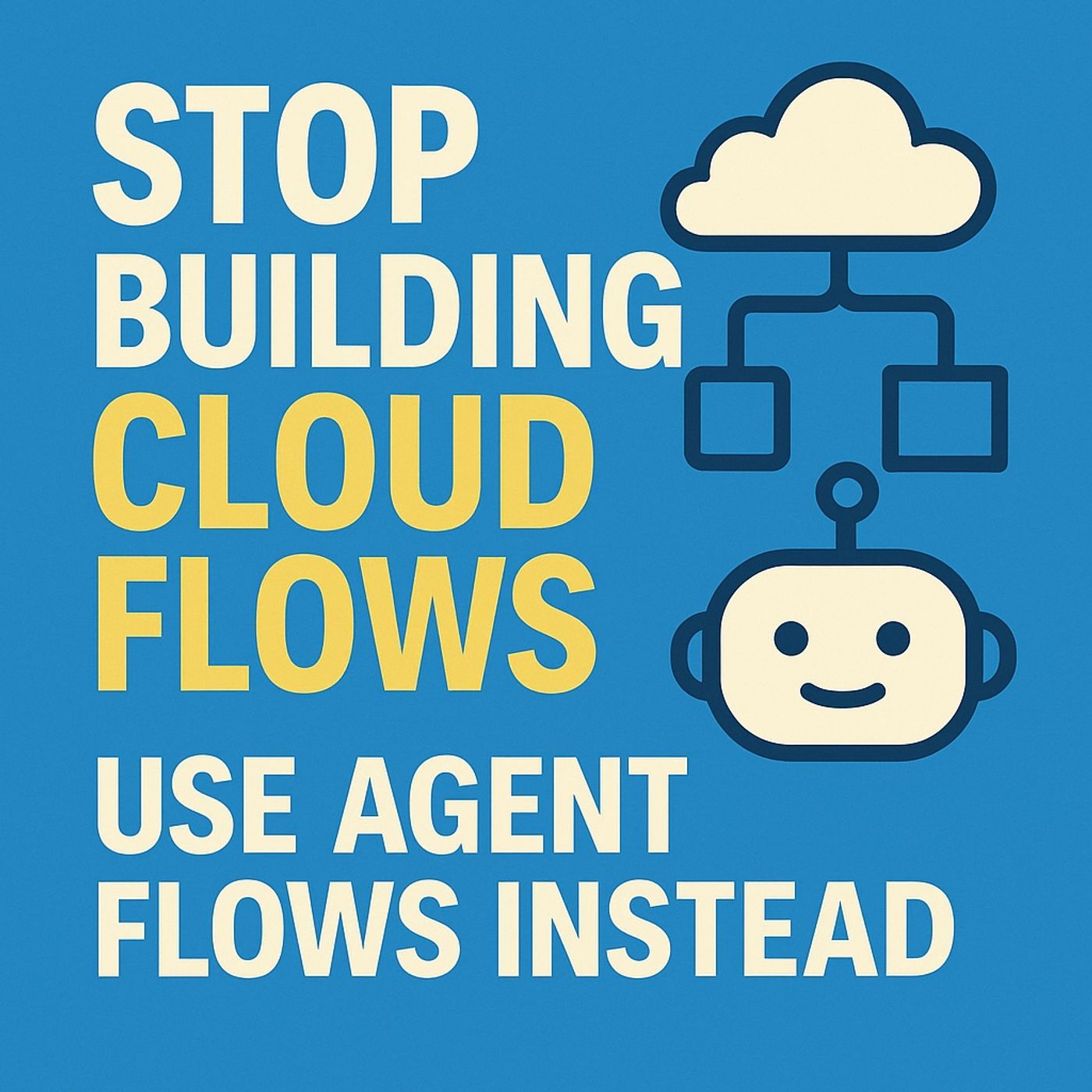
Stop building cloud flows: use Agent Flows for smarter, cheaper automation
Season 1
Published 8 months, 4 weeks ago
Description
(00:00:00) The Evolution of Cloud Flows
(00:01:31) The Hidden Costs of Cloud Flows
(00:04:06) Introducing Agent Flows: A New Era of Automation
(00:05:07) The Mechanics of Agent Flows
(00:07:32) Choosing Between Cloud and Agent Flows
(00:10:53) The Math Behind Agent Flows
(00:14:52) The Future of Automation
(00:20:03) Closing Thoughts and Call to Action
In this episode of M365.fm, Mirko Peters explains why building every Power Platform automation as an Automated Cloud Flow quietly explodes your licensing, API quotas, and support overhead—and why many of those workloads belong in Agent Flows instead. He unpacks the hidden price tag behind “just build a flow”: premium connector fan‑out when you add Dataverse, SQL, or Salesforce, API call throttling that slows “set it and forget it” automations, and AI Builder scenarios where you end up paying twice with separate automation and AI credits. You will learn how Cloud Flows are priced like an all‑you‑can‑eat buffet per user, why that is great for heavy, shared orchestration but wasteful for spiky, personal automations, and how Agent Flows flip the model to pay‑per‑action so costs finally scale with real usage.
Mirko then introduces Agent Flows as automation with a Copilot brain: they live in Copilot Studio, are billed by messages and actions instead of per‑user licenses, and include premium and custom connectors plus AI capabilities in a single, consumption‑based model. He shows how triggers can come from conversation, intent, or external signals, so automation first interprets what the user actually wants before it executes connectors and actions. You will hear when Agent Flows should replace Cloud Flows—chat‑ and intent‑driven tasks, personal automations, bursty workloads—and when Cloud Flows still win for shared, scheduled, cross‑team orchestration.
The episode also walks through the real migration path. Mirko explains how to make existing Cloud Flows solution‑aware, move the solution to Copilot Studio, and convert them into Agent Flows (one‑way) while keeping governance parity: drafts, versions, audit logs, RBAC, and quotas now visible where your copilots live. You get practical cost math you can reuse with finance and leadership—Cloud Flows as per‑person buffet versus Agent Flows as à‑la‑carte actions—and concrete optimization tips where consolidating actions and reducing unnecessary chat hops literally lowers your bill.
Finally, Mirko gives you a simple decision framework you can copy into your Center of Excellence: if an automation starts in Copilot or chat, is personalized, or has bursty usage, default to Agent Flows; if it is shared, scheduled, or cross‑department infrastructure, keep it as a Cloud Flow. By the end, you will know how to redesign your automation portfolio around AI‑native orchestration, reduce double‑licensing, and treat automation as a governed, observable service inside an intelligent platform, not a collection of one‑off flows tied to individual makers.
WHAT YOU WILL LEARN
(00:01:31) The Hidden Costs of Cloud Flows
(00:04:06) Introducing Agent Flows: A New Era of Automation
(00:05:07) The Mechanics of Agent Flows
(00:07:32) Choosing Between Cloud and Agent Flows
(00:10:53) The Math Behind Agent Flows
(00:14:52) The Future of Automation
(00:20:03) Closing Thoughts and Call to Action
In this episode of M365.fm, Mirko Peters explains why building every Power Platform automation as an Automated Cloud Flow quietly explodes your licensing, API quotas, and support overhead—and why many of those workloads belong in Agent Flows instead. He unpacks the hidden price tag behind “just build a flow”: premium connector fan‑out when you add Dataverse, SQL, or Salesforce, API call throttling that slows “set it and forget it” automations, and AI Builder scenarios where you end up paying twice with separate automation and AI credits. You will learn how Cloud Flows are priced like an all‑you‑can‑eat buffet per user, why that is great for heavy, shared orchestration but wasteful for spiky, personal automations, and how Agent Flows flip the model to pay‑per‑action so costs finally scale with real usage.
Mirko then introduces Agent Flows as automation with a Copilot brain: they live in Copilot Studio, are billed by messages and actions instead of per‑user licenses, and include premium and custom connectors plus AI capabilities in a single, consumption‑based model. He shows how triggers can come from conversation, intent, or external signals, so automation first interprets what the user actually wants before it executes connectors and actions. You will hear when Agent Flows should replace Cloud Flows—chat‑ and intent‑driven tasks, personal automations, bursty workloads—and when Cloud Flows still win for shared, scheduled, cross‑team orchestration.
The episode also walks through the real migration path. Mirko explains how to make existing Cloud Flows solution‑aware, move the solution to Copilot Studio, and convert them into Agent Flows (one‑way) while keeping governance parity: drafts, versions, audit logs, RBAC, and quotas now visible where your copilots live. You get practical cost math you can reuse with finance and leadership—Cloud Flows as per‑person buffet versus Agent Flows as à‑la‑carte actions—and concrete optimization tips where consolidating actions and reducing unnecessary chat hops literally lowers your bill.
Finally, Mirko gives you a simple decision framework you can copy into your Center of Excellence: if an automation starts in Copilot or chat, is personalized, or has bursty usage, default to Agent Flows; if it is shared, scheduled, or cross‑department infrastructure, keep it as a Cloud Flow. By the end, you will know how to redesign your automation portfolio around AI‑native orchestration, reduce double‑licensing, and treat automation as a governed, observable service inside an intelligent platform, not a collection of one‑off flows tied to individual makers.
WHAT YOU WILL LEARN
- The hidden cost model behind Cloud Flows: premium connectors, API quotas, and AI Builder double‑pay.
- What Agent Flows are, how Copilot Studio changes triggers, and why consumption billing fits spiky workloads.
- When to use Agent Flows vs. Cloud Flows for chat‑driven, personal, or shared orchestration scenarios.
- How to migrate Cloud Flows into Agent Flows with solution‑aware design, versions, RBAC, and auditlogs.
Listen Now
Love PodBriefly?
If you like Podbriefly.com, please consider donating to support the ongoing development.
Support Us