Episode Details
Back to Episodes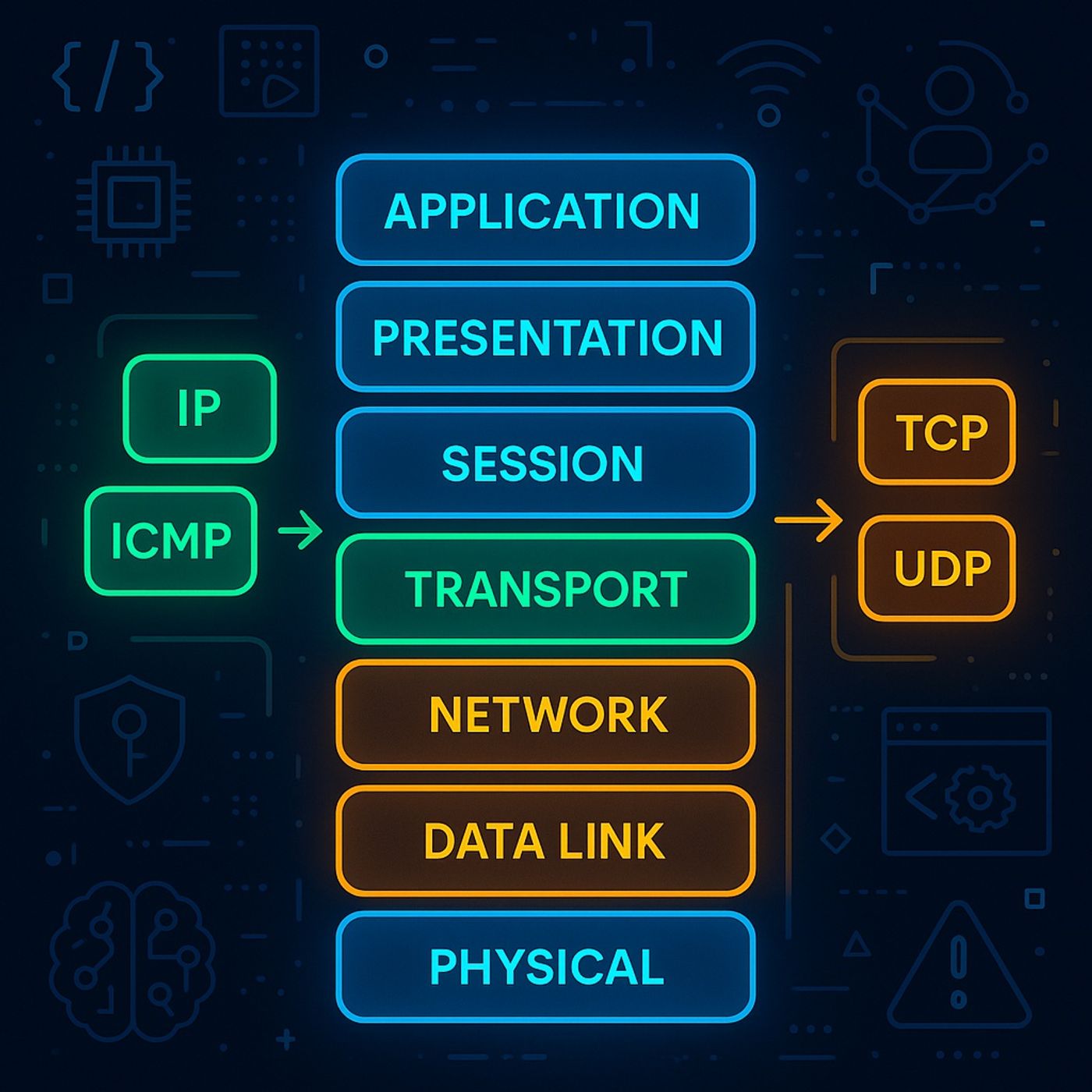
Course 6 - Network Traffic Analysis for Incident Response | Episode 1: Fundamentals of Networking: The OSI Model and Essential Protocols
Published 9 months, 1 week ago
Description
In this lesson, you’ll learn about:
Key Takeaways
You can listen and download our episodes for free on more than 10 different platforms:
https://linktr.ee/cybercode_academy
- The core networking concepts required before beginning any network traffic analysis.
- The relationship between the OSI model, low-level protocols, and application-level protocols, and how they shape the behaviour of traffic you’ll examine in a tool like Wireshark.
- How to recognize common protocol behaviours at a high level so you can later understand patterns, anomalies, and security-related findings during analysis.
- The OSI model divides networking functionality into structured layers.
- Hardware-oriented layers:
- Physical → bits on the wire
- Data Link → frames within a local network
- Software-oriented layers relevant for analysis:
- Network (Layer 3) → packets, routing
- Transport (Layer 4) → reliability, ports
- Session / Presentation / Application (Layers 5–7) → how applications encode, manage, and interpret network data
- Students should understand the distinctions between bits → frames → packets, because these appear in captures.
- IP (Internet Protocol – Layer 3):
- Core packet-forwarding protocol for IPv4/IPv6.
- Manages routing across networks.
- TCP (Transmission Control Protocol):
- Ensures reliable delivery: sequencing, acknowledgments, error checking, retransmission.
- Manages connections using ports and a handshake mechanism.
- UDP (User Datagram Protocol):
- Connectionless and faster but offers no delivery guarantees.
- Used when speed and low latency matter more than reliability.
- ICMP (Internet Control Message Protocol):
- Sends diagnostic and control messages.
- Used by tools like ping and traceroute.
Key Takeaways
- Understanding how protocols behave at each OSI layer is essential for interpreting traffic captures.
- Familiarity with the normal patterns of protocols (IP, TCP/UDP, DNS, TLS, etc.) helps analysts later identify unusual or suspicious activity.
- This theoretical module prepares students for the practical phase using tools like Wireshark, where they will analyse real traffic captures in a controlled, educational setting.
You can listen and download our episodes for free on more than 10 different platforms:
https://linktr.ee/cybercode_academy