Episode Details
Back to Episodes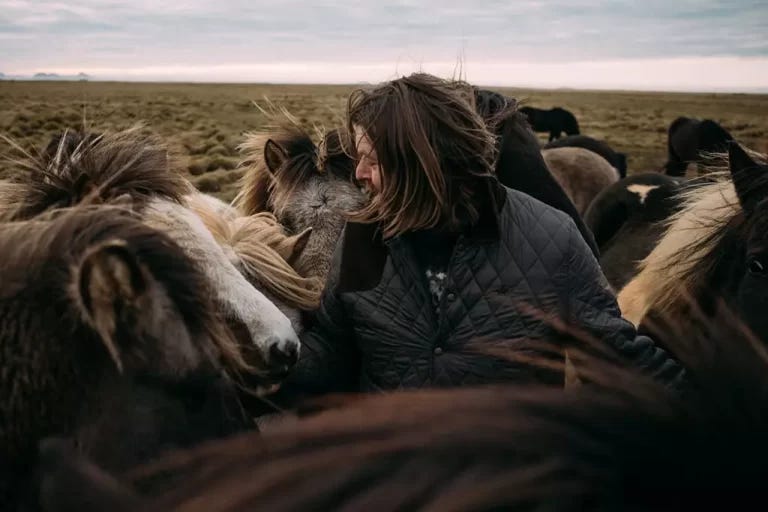
Narrated Essay: These Fleeting Temples We Make Together
Description
You’re invited next September 20-26, 2026, to The Tender Harvest, a week-long retreat amidst the golden hues and organic bounty of the world-class Ballymaloe House in County Cork, Ireland. Each day will feature yoga, meditation, farm-to-table meals, and curated excursions—plus ample time for rest, self-nurturance, and imagination.
...
Hordur is a descendent of Vikings. To arrive at his farm—4,000 windswept acres in Iceland’s storied BrennuNjáls Saga—is to step into an atmosphere rich with the scent of sulfur and soil, into a dramatic expanse of earth blanketed under heavy, silver-wrapped clouds.
The light here is diffuse yet piercing, the landscape at once strange and wondrous—alive with an elemental force that reshapes the breath in our bodies as we ride through quick-watered rivers and cold, lush fields. I find my mind traversing the natural observations and human meanings of Annie Dillard’s Teaching a Stone to Talk: Expeditions and Encounters:
“We are here to witness the creation and to abet it. We are here to notice each thing so each thing gets noticed. Together we notice not only each mountain shadow and each stone on the beach but, especially, we notice the beautiful faces and complex natures of each other. We are here to bring to consciousness the beauty and power that are around us and to praise the people who are here with us. We witness our generation and our times. We watch the weather. Otherwise, creation would be playing to an empty house.”
Around a rustic dinner table of slow-cooked lamb and homegrown potatoes, Hordur shares some of his story with us. He recounts having lived abroad for decades, mastering the language of markets and margins in glass atriums of international finance—until, at fifty, an inexplicable, tectonic force called him home to the basalt and moss-softened fields that have cradled his lineage for a millennium.
He explains simply: “I wanted to raise Icelandic children.”“But what does that mean to you?” we press.
Hordur pauses briefly, then recalls the day his youngest, seven years old, began hitchhiking the thirty-minute ride from school. Through valleys quilted with lupine and sheep, she returned home each afternoon this way for a decade, delivered safely again and again by a series of outstretched hands.
To absolutely trust one’s human surroundings is unfathomable to most parents. It points to an agreement not imposed by law, but woven into the fabric of society over generations, more gradually grown than moss over volcanic rock.
It’s good to know communities on earth still exist where children are this safe. It’s good to know that somewhere, the fabled qualities of the village are alive and well.
In a climate forged by fire and ice, tenderness is a currency of survival. Iceland has no standing military and virtually no violent crime. Babies nap outside in woolen blankets. Winter’s deep darkness—which consumes all but three hours of each day—is not dulled by drinking at bars but thawed and warmed in local geothermal pools. And, in the northern town of Akureyri, stoplights shaped like glowing red hearts—signaling people to stop in the name of love—began appearing during the 2008 economic collapse as emblems of support and resilience.
One might be tempted to dismiss these signs of communal health as the baked-in benefits of a homogeneous culture, but the science and art of the commonweal warrant a deeper look.
With what conditions can safety pattern itself into a nervous system? How can our collective nervous system down-regulate from its ratcheting mistrust? These are the questions of our times if we are ever to find our way back to