Episode Details
Back to Episodes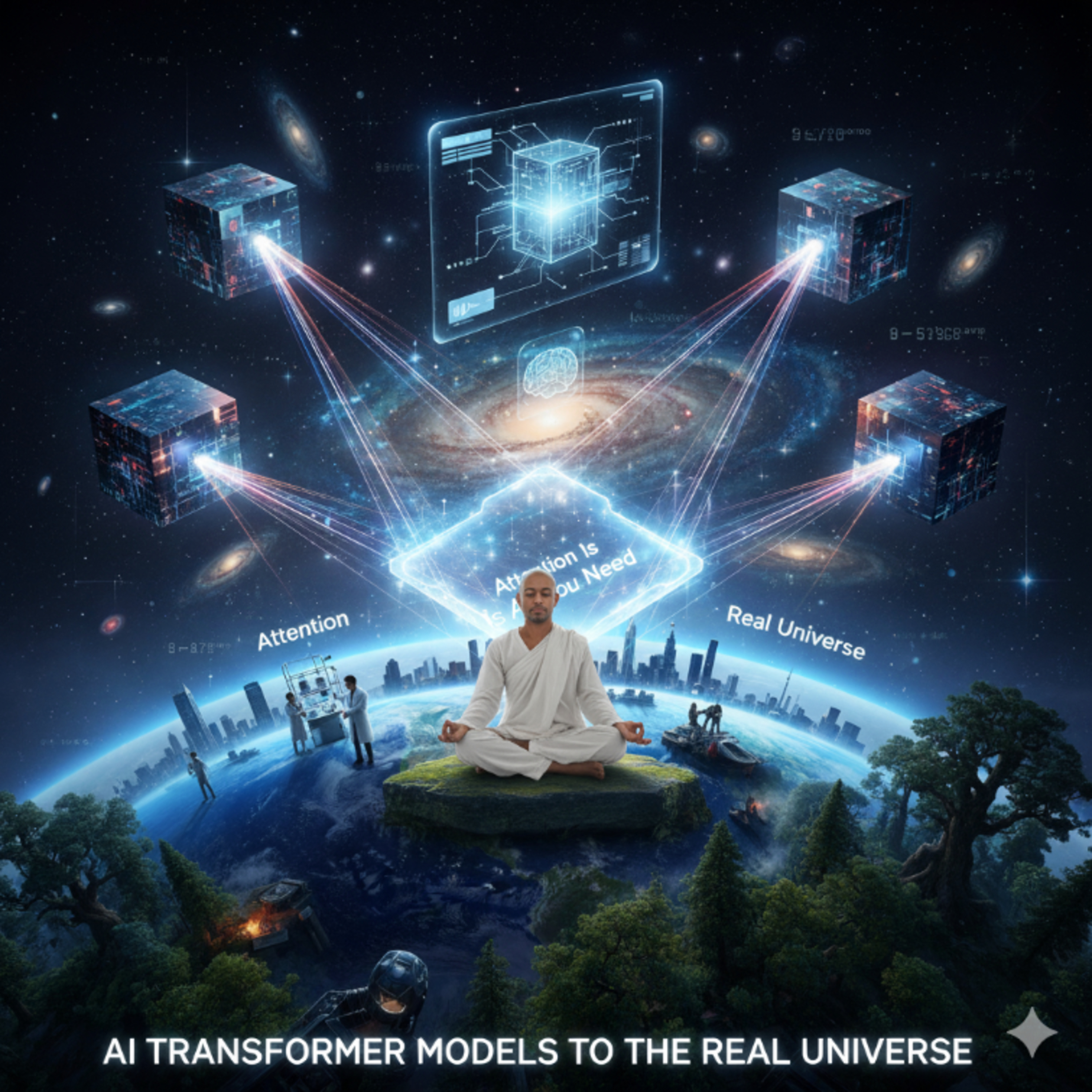
Attention is all you need !
Description
https://g.co/gemini/share/759efcb02afb
The world we experience is a symphony of sensation—vibrant, detailed, and seemingly complete. Yet, this perceived reality is a profound paradox. Empirical science reveals that our senses grant us access to only a minuscule fraction of the physical universe. We are adrift in a cosmos teeming with information—from the vast ranges of the electromagnetic spectrum to the complex chemical signals that saturate our environment—but our biology renders us almost entirely oblivious to it. This is the Paradox of Perception: the very limitations of our senses are the foundation of our coherent experience.
This report advances a radical thesis: this sensory limitation is not a biological accident or an evolutionary compromise, but an intentional feature. It is a deliberate "locking" of our perceptual faculties, engineered for a singular, critical purpose: to channel our cognitive resources toward a process so fundamental that it may constitute the primary activity of the universe itself. That process is attention.
This line of inquiry finds an unlikely but powerful ally in the field of artificial intelligence. The seminal 2017 research paper, "Attention Is All You Need," introduced the Transformer architecture, a model that has since revolutionized machine learning. By dispensing with the complex recurrent and convolutional structures of its predecessors, the paper demonstrated that a mechanism modeling attention was, by itself, sufficient for achieving state-of-the-art performance in complex tasks like language translation. This report will argue that the paper's provocative title should be interpreted not merely as a technological claim, but as a potentially literal statement about the nature of reality.
To build this argument, this analysis will proceed in three parts. First, it will conduct an empirical audit of our sensory "gates," examining the biological and evolutionary evidence that our perceptions are precisely and purposefully constrained. Second, it will explore the architecture of focus, drawing parallels between the neural mechanisms of sensory gating in the brain and the computational elegance of the Transformer model's attention mechanism. Finally, it will synthesize these findings within a metaphysical framework, arguing that a universe possessing mind-like properties has orchestrated the evolution of limited, attentive beings to secure its own coherent existence.