Episode Details
Back to Episodes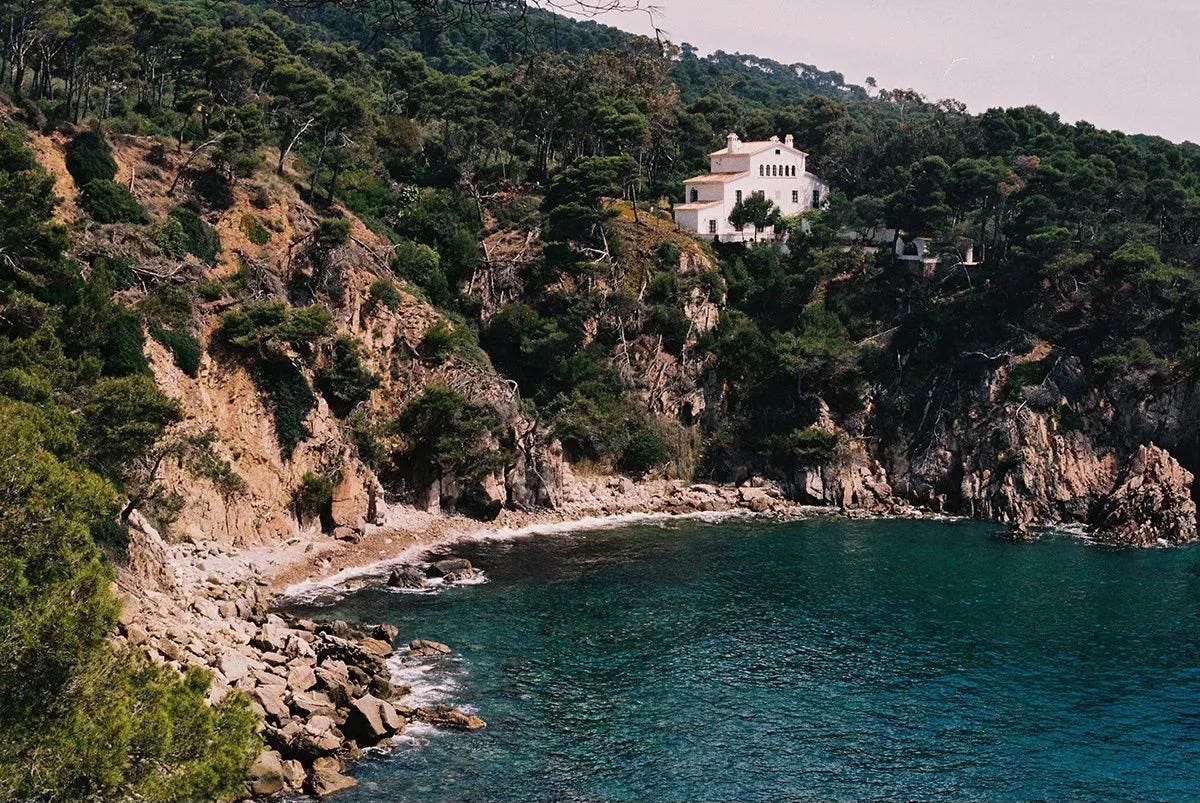
Pain and Sorrow
Description
It’s been a while since I have sailed to Palamós, still a small fishing town in 1962, where Truman Capote sought refuge for three semesters—always escorted by his obliging life partner Jack Dunphy and various pets—alternated with his cottage in Verbier, at the top of the Swiss Alps.
In Cala Sènia, a secluded Mediterranean cove, the American author found the necessary peace, far away from New York’s social life. The fishermen went out to sea in the wee hours, causing such a ruckus that, according to Capote, not even Rip van Winkle could sleep through it, and that helped to keep a rigorous writer’s schedule for his most accomplished manuscript, In Cold Blood.
Local old-timers who met Truman still recalled him doing his errands–two bottles of gin, dry vermouth, and olives for his martinis—the sad day that Marilyn Monroe had tragically overdosed. He was at the newsstand reading the headlines, and with that high-pitched lisping voice I cannot even dare to mimic, because it’s way beyond my range, Truman moaned, “My lady friend died!”
He had badly wanted her for the role of Holly Golightly in Breakfast at Tiffany’s. But Paula Strasberg, her acting coach, deemed it inappropriate for Marilyn’s career to play a “lady of the evening” character, especially after being pigeonholed as the sex bomb of the 50s.
Truman was very disappointed and began to spread the rumor that he felt betrayed when Audrey Hepburn was cast instead.
The movie producers thought that a whitewashing of a courtesan was needed. And if I have to judge for the cross-generational audience of Breakfast at Tiffany’s, they rightly did so. Another paradox duly noted, it would be now unthinkable for another Holly Golightly than Audrey Hepburn.
Truman, feeling so at ease in Palamós, invited some of his friends to visit him. The founder of CBS, William Paley, and his wife Babe, embarked on a journey across the Mediterranean Sea during the summer in a mind-blowing sailboat, eventually dropping anchor in the secluded cove.
A terrifying wildfire just outside the villa almost claimed Truman’s life. In that rocky Mediterranean shore, pine groves have always served as both parasols and windshields, regardless of the fire risk involved. Capote only had time to grab his precious manuscript and flee, hoping that a fishing sloop would rescue him from that inferno.
In late September, the furies of the equinox unleashed a deadly flood in Catalonia, further terrorizing him. Consequently, he changed his mind and ended his productive stay on October the 1st, leaving for Switzerland.
Despite his efforts, he was unable to finish the manuscript until the Cluttler’s killers were hanged in Kansas, due to his decision to sell the future book as a nonfiction novel. Hickock and Smith were on death row from 1960 to 1965, five long years. “No one will ever know what In Cold Blood took out of me,” Capote said. “It scraped me right down to the marrow of my bones.”
The horrifying book was published, and Truman got suddenly rich. But instead of getting back to work with the same stern and unsmiling discipline that had been a constant since the beginning of his career, he dilapidated his earnings and that rare gift, trying to avenge Nina Capote, throwing epic parties for the privileged ones like the Black and White Ball, and showboating in talk show television about his Proustian adventure—a manuscript called Answered Prayers.
Many friends I knew spoke glowingly about the movie Breakfast at Tiffany’s, and sometimes they cannot see beyond the allure of Audrey Hepburn wearing the elegant Givenchy black dress, oversized sunglasses, black gloves, statement pearls, and twisted updo with a sparkling crown beret, eating pastry early in the morning while gazing dreamily into the windows of Tiffany & Co.’s Fifth Avenue store.
But the actual fifty-page novella is something else–exac