Episode Details
Back to Episodes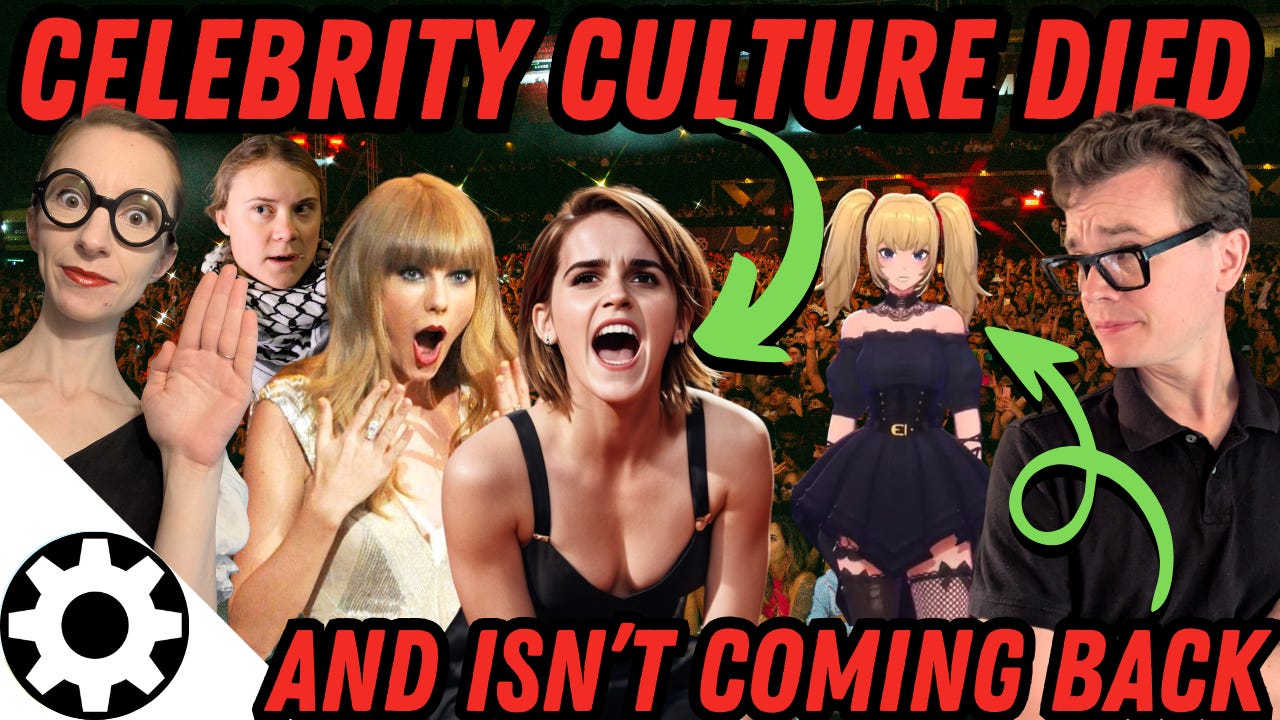
Why Movie Stars Stopped Mattering + Why Did They Ever Matter?
Description
In this episode, Malcolm and Simone dive deep into the decline of celebrity culture, using Taylor Swift as a case study for the last era of true pop stardom. They discuss the collapse of the celebrity-industrial complex, the rise of micro-celebrities, and how social media has changed the way we view fame. The conversation covers everything from Emma Watson and JK Rowling’s controversies, to the shifting political and cultural landscape, to the numbers behind Taylor Swift’s recent album and public perception.
Malcolm Collins: [00:00:00] Hello, Simone. Today we are going to be doing something of a follow up to an episode that we did recently on that we call the Last Show on Earth on how. You know, sort of Hollywood and, and the Zeitgeist movie, or the zeitgeist television show was no longer a thing. Yeah. And the thing that sort of connected the world was US political theater and, and the conversation around that.
Mm-hmm. The Trump White House, the Trump the, the, the Elon thing, the, the, everything like that, right? Mm-hmm. Today we’re gonna be focused on the other side of this, which it’s the collapse of celebrity culture. And how little relevance, and I think you’ll be shocked by some of the stats that we’re gonna go into celebrities have on our society anymore really.
Yeah, well, there’s been some recent you know, just absolute caning of Emma Watson. I don’t know if you saw this. Oh, yeah. K Rowling. Where Emma Watson is basically like, Hey, you know, I, I’m, I’m best seeds with JK [00:01:00] Rowling. I’ll always be friends with her. And it’s like, we remember everything you were saying about her.
You psychopath, like JK Rowling remembers when you thought it was cool to defend this whole trans thing. And, and the gender transition of minors. Forcing women in, in spaces where they are not safe to, to, to have trans women inserted into them, whether it’s it’s it’s prisons or anywhere else.
Mm-hmm. And JK Rowling was like, Hey, can we have like a reasonable conversation about this? Which really, she got de fenestrated before she began to go more and more. Right? Absolutely. It’s very similar to absolutely. Like, why is JK Rowling anti this? It’s like, not for religious reasons, it’s not for discomfort of like a variety of sexual orientations.
Mm-hmm. Like, clearly she’s got some dumbledore’s gay.
Simone Collins: Yes. I
Malcolm Collins: mean, come on. Yeah. She made everyone gay. That was like the thing about her that, that they said where she like, post hoc, make a bunch of Harry Potter characters. Oh, yeah, yeah, yeah. Her retroactive
Simone Collins: ga ification. The double
Malcolm Collins: door I could see do [00:02:00] like,
Simone Collins: yeah, that was
Malcolm Collins: is is Emma Watson is now like, oh, I don’t care that much about those Jews anymore.
Now that it’s like everyone can say that publicly now, now that like publicly we’ve accepted. Oh, it doesn’t kill someone to block transition. Which we know now because the UK banned child transition and the unli rate in that population hasn’t increased statistically. So like we have a, an entire country where we have a very big set poll and a very big study that was done on this, and it, it did have the effect
I can only imagine the existential horror of being a trans kid in the UK right now with people trying to get those unli numbers up to actually prove that not transitioning , Minors has any potential negative effects to them.
all you gotta do is just read the words on the teleprompter here. Heh, okay. Let’s see how the
Transphobes. deal with this.
You know, some people say there’s no proof that
Not transitioning children. kills. I guess I’m the proof. By the time you see this commercial, I’ll be dead.[00:03:00]
Dead? That was fantasti