Episode Details
Back to Episodes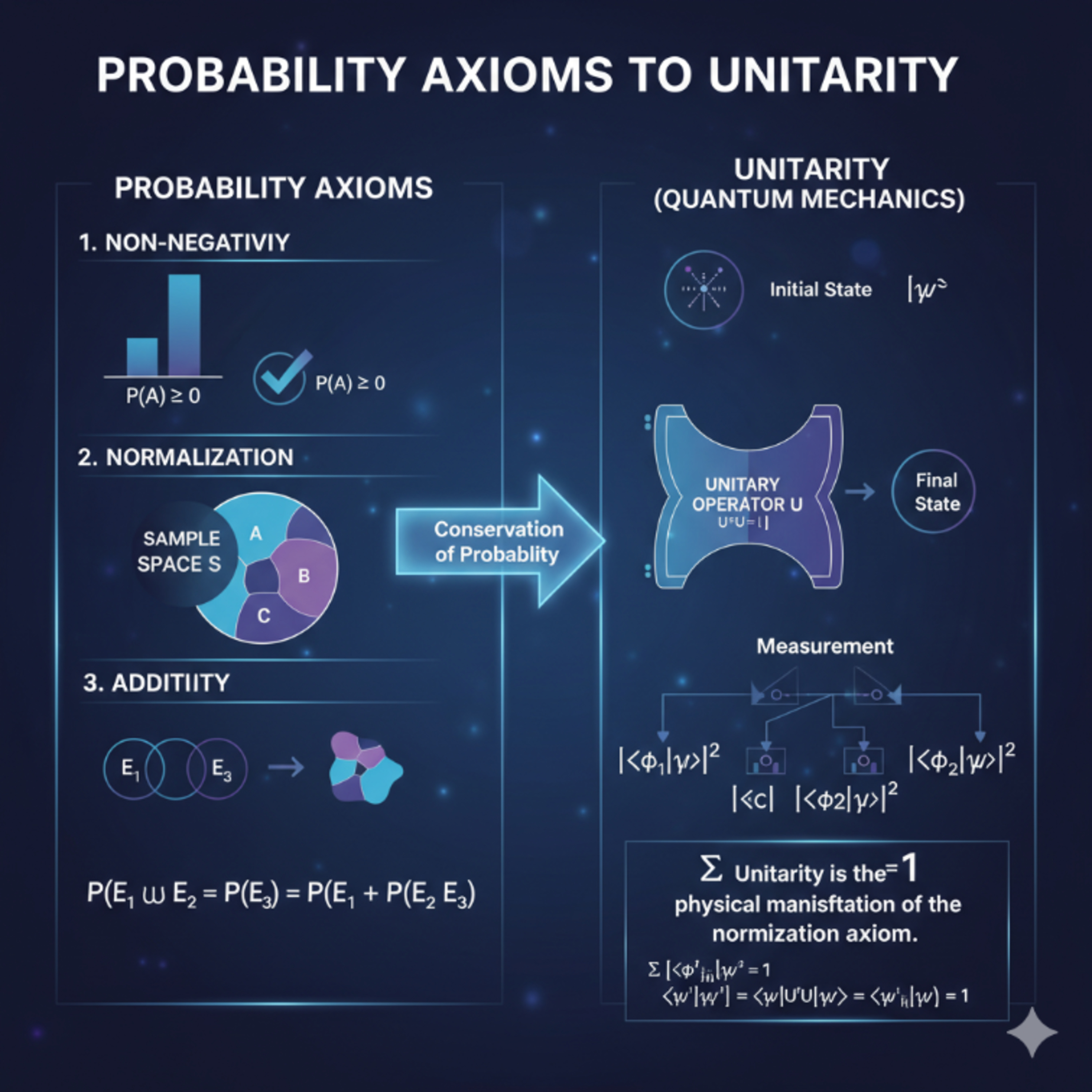
probability to unitarity
Description
https://g.co/gemini/share/dcbd700ef6e5
The question of whether the unitarity principle in quantum mechanics is the same as the second axiom of probability touches upon the foundational pillars of modern physics and mathematics. At a superficial level, both concepts are concerned with the idea that the total probability of all possible outcomes of a process must sum to one. This apparent similarity, however, conceals a profound conceptual and functional divergence that separates a static, definitional axiom of mathematics from a dynamic, physical law governing the evolution of the universe at its most fundamental level.
This report will articulate and defend the central thesis that the unitarity principle is fundamentally distinct from Kolmogorov's second axiom of probability. The second axiom is a static, structural property required to define any classical probability model. It is a rule of normalization, a convention that establishes a consistent framework for discussing probabilities. In stark contrast, the unitarity principle is a dynamic physical law that dictates how the state of an isolated quantum system evolves through time. The primary function of unitarity is to ensure that the probabilistic predictions of quantum mechanics, as formulated by the Born rule, remain perpetually consistent with the axioms of probability as the system changes.
To establish this distinction, this analysis will proceed in a structured manner. It will first lay out the rigorous, classical framework of probability theory as defined by Andrey Kolmogorov, with a specific focus on the static nature of the second axiom. It will then transition to the unique probabilistic structure of quantum mechanics, where the Born rule serves as the crucial bridge between the abstract mathematical formalism and experimental reality. Subsequently, the report will provide a detailed exposition of the unitarity principle, defining it mathematically and exploring its deep physical consequences, including the conservation of information and the reversibility of time. The core of the analysis will synthesize these elements, directly comparing the static axiom with the dynamic principle and exploring the subtle axiomatic status of unitarity itself. Finally, the report will examine the role of unitarity at the frontiers of modern physics, particularly in the context of quantum gravity and cosmology, demonstrating that its validity and scope are subjects of active and vital scientific inquiry.