Episode Details
Back to Episodes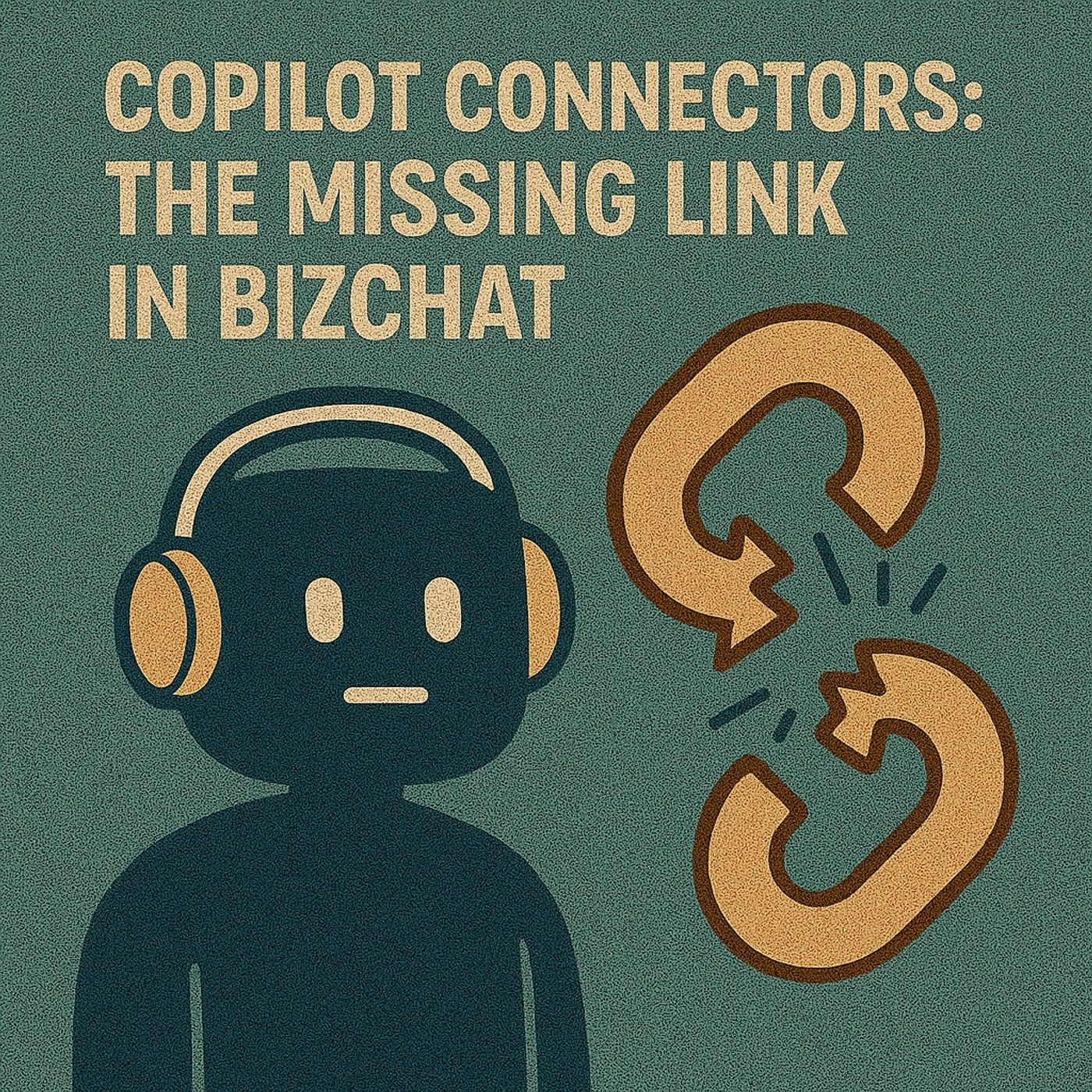
Copilot Connectors: The Missing Link That Turns Microsoft 365 BizChat into a Real Business Copilot
Season 1
Published 11 months ago
Description
Most teams expect Microsoft 365 BizChat to act like a strategic copilot—but without connectors into your core systems, it’s effectively working half‑blind. Out of the box, BizChat can only see what lives in Outlook, Teams, OneDrive and SharePoint, so every time someone asks about pipeline, invoices or project status, it has to guess based on emails and files instead of real CRM, ERP or project data. In this episode, we walk through why that gap quietly kills trust and adoption, and how building the right Copilot connectors turns BizChat from a nice assistant into a decision‑grade copilot that actually knows your business.
We start with what “half‑blind” really looks like. A sales manager asks about current pipeline, but without CRM access BizChat returns vague summaries instead of accurate numbers. A finance lead asks about outstanding invoices, but without ERP integration the answer is empty or incomplete. A project manager asks for upcoming deadlines, but without a connection to the project system, BizChat shrugs. Each time, someone has to jump into the real app, copy figures back into the chat and explain the discrepancy—slowly teaching the whole organization that BizChat can talk, but not truly see.
Then we draw a clear line between “assistant mode” and “copilot mode.” In assistant mode, BizChat only rephrases what’s already visible in Microsoft 365: emails, documents, chat logs. In copilot mode, it can reach into systems of record—CRM, ERP, ticketing, project tools—under strict permissions and return answers that are grounded in live transactional data. We give you a simple test: does BizChat have controlled access to your key business systems, respect role‑based security when it queries them, and return responses that directly drive decisions instead of sending people elsewhere to double‑check? If the answer is no, you’re not using a copilot yet—you’re using a clever assistant.
From there, we focus on integration strategy: choosing the right systems to connect first, and deciding whether to go no‑code, low‑code or full pro‑code. You’ll learn how to identify the few data sources that will change day‑to‑day work the most—often CRM for revenue, ERP for cash and inventory, and one project or ticket system for delivery. We walk through how Copilot connectors, APIs and Teams Toolkit fit together so you can start small: one high‑value integration that proves the concept, then a pattern you can repeat without turning everything into a massive engineering project. The goal is impact, not a wall of connectors nobody uses.
Finally, we show what “BizChat with connectors” actually feels like for your users and leaders. Instead of bouncing between BizChat and dashboards, staff can ask a question once and get answers that match the numbers in your source systems. Conversations include live metrics, approvals and trends, not just summaries of old PPTs and email threads. Over time, that reliability changes behavior: people start with BizChat because it saves them real time and context‑switching, and leadership sees faster, better‑supported decisions instead of AI‑generated noise.
WHAT YOU’LL LEARN
We start with what “half‑blind” really looks like. A sales manager asks about current pipeline, but without CRM access BizChat returns vague summaries instead of accurate numbers. A finance lead asks about outstanding invoices, but without ERP integration the answer is empty or incomplete. A project manager asks for upcoming deadlines, but without a connection to the project system, BizChat shrugs. Each time, someone has to jump into the real app, copy figures back into the chat and explain the discrepancy—slowly teaching the whole organization that BizChat can talk, but not truly see.
Then we draw a clear line between “assistant mode” and “copilot mode.” In assistant mode, BizChat only rephrases what’s already visible in Microsoft 365: emails, documents, chat logs. In copilot mode, it can reach into systems of record—CRM, ERP, ticketing, project tools—under strict permissions and return answers that are grounded in live transactional data. We give you a simple test: does BizChat have controlled access to your key business systems, respect role‑based security when it queries them, and return responses that directly drive decisions instead of sending people elsewhere to double‑check? If the answer is no, you’re not using a copilot yet—you’re using a clever assistant.
From there, we focus on integration strategy: choosing the right systems to connect first, and deciding whether to go no‑code, low‑code or full pro‑code. You’ll learn how to identify the few data sources that will change day‑to‑day work the most—often CRM for revenue, ERP for cash and inventory, and one project or ticket system for delivery. We walk through how Copilot connectors, APIs and Teams Toolkit fit together so you can start small: one high‑value integration that proves the concept, then a pattern you can repeat without turning everything into a massive engineering project. The goal is impact, not a wall of connectors nobody uses.
Finally, we show what “BizChat with connectors” actually feels like for your users and leaders. Instead of bouncing between BizChat and dashboards, staff can ask a question once and get answers that match the numbers in your source systems. Conversations include live metrics, approvals and trends, not just summaries of old PPTs and email threads. Over time, that reliability changes behavior: people start with BizChat because it saves them real time and context‑switching, and leadership sees faster, better‑supported decisions instead of AI‑generated noise.
WHAT YOU’LL LEARN