Episode Details
Back to Episodes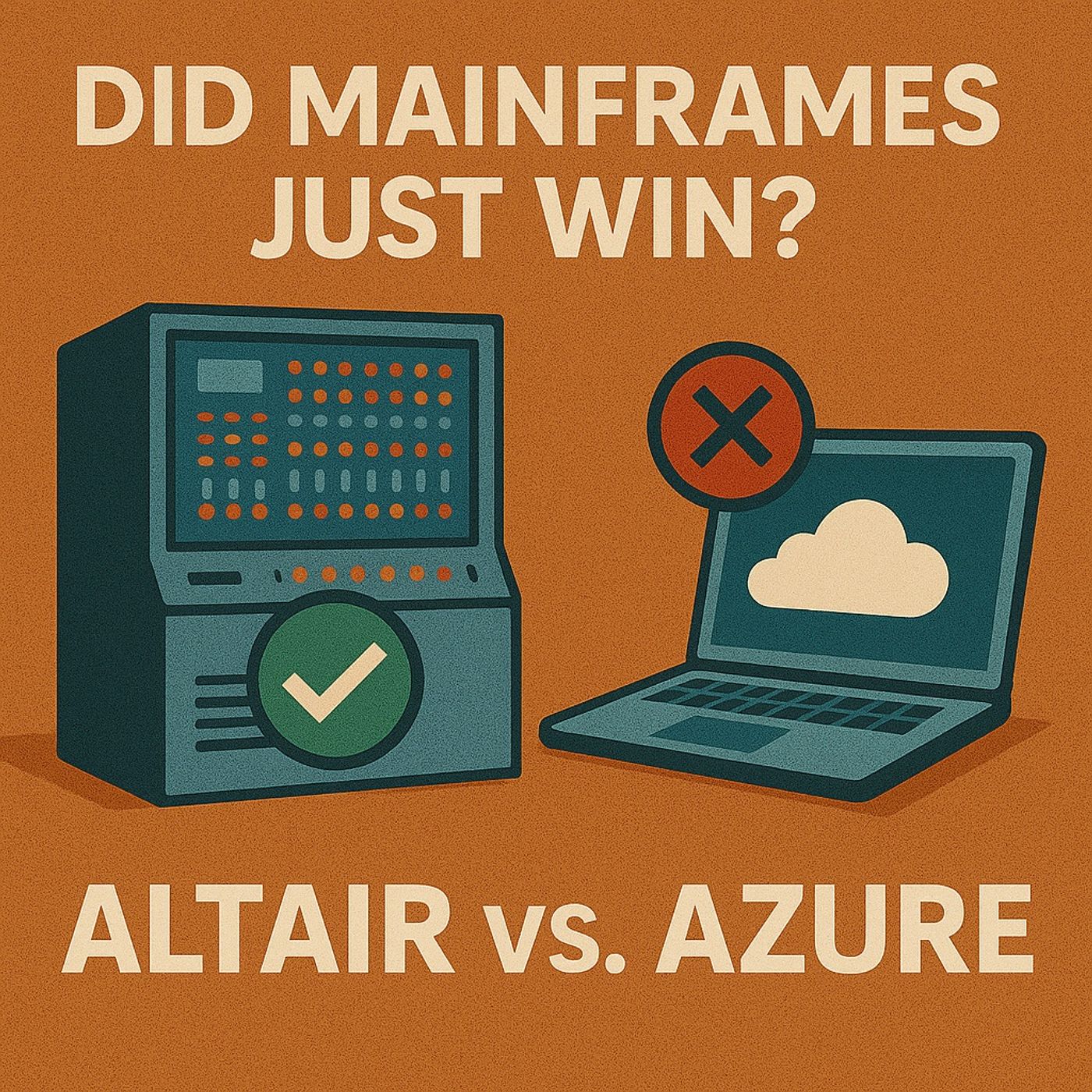
Did Mainframes Just Win? How Altair, Terminals and Shared Compute Explain Azure and Modern Cloud Design
Season 1
Published 11 months ago
Description
In 1975 you programmed an Altair 8800 by flipping switches and watching LEDs; in 2025 you click once and Azure spins up global infrastructure, AI models and multi‑tenant services in seconds. The surface looks completely different, but the underlying ideas—shared resources, programmable access, centralized capacity—never really went away. In this episode, we use the story of the Altair and classic mainframes to show how those same patterns now shape Microsoft 365, Power Platform and Azure, and how understanding them makes you better at cost optimization, automation and architecture today.
We start with the Altair box of switches, because it forces you to see computing without any abstractions. With only a tiny amount of memory and a row of toggles, every bit mattered and every instruction was deliberate, creating a discipline that today shows up in how you size cloud resources, design flows and avoid waste. The Altair also represented a power shift: for the first time, individuals could own a computer instead of begging for time on a centralized mainframe, even if that “computer” was brutally limited by modern standards. You’ll hear how that mindset of control and transparency—seeing state directly, tracing output back to exact inputs—maps onto modern tools like APIs, CLIs and low‑code platforms, where the most effective builders still think like architects working under constraints.
Then we zoom out to the patterns that refused to die. Classic mainframes ran as shared pools of compute in locked rooms; your terminal was just a window into that one precious resource. Today, Azure looks like the opposite—frictionless, on‑demand scale—but the model is strikingly familiar: multi‑tenant capacity, centralized orchestration and workload scheduling behind the scenes. We explore why the industry keeps returning to centralization (cost, efficiency, flexibility), how this shapes everything from Microsoft 365 throttling to Azure resource limits, and what it means for the way you design solutions that live inside a shared cloud rather than on “your” hardware.
From there, we talk about the quiet renaissance of the terminal and text‑based interfaces. Even with rich portals and AI copilots everywhere, serious work in Azure and Microsoft 365 keeps falling back to CLIs, shells and APIs—because they offer speed, repeatability and automation that visual tools can’t match. You’ll see how a terminal window in 2025 has more in common with a 1970s terminal than with a modern dashboard: clear commands in, precise responses out, no distraction. We connect that to practical workflows in your own environment: replacing fragile portal clicks with scripts, using APIs as the “toggle switches” of today, and treating automation as the default instead of the upgrade.
Finally, we bring it back to your day‑to‑day decisions in Microsoft 365, Power Platform and Azure. Once you see that the same old patterns—centralized capacity, shared infrastructure, constrained resources—are still with us, it becomes much easier to reason about cost, resilience and performance. You’ll walk away with a set of questions and mental models that help you design tenant governance, app architectures and automations that respect the realities of the shared cloud you’re actually running on, instead of the illusion of infinite, isolated power.
WHAT YOU’LL LEARN
We start with the Altair box of switches, because it forces you to see computing without any abstractions. With only a tiny amount of memory and a row of toggles, every bit mattered and every instruction was deliberate, creating a discipline that today shows up in how you size cloud resources, design flows and avoid waste. The Altair also represented a power shift: for the first time, individuals could own a computer instead of begging for time on a centralized mainframe, even if that “computer” was brutally limited by modern standards. You’ll hear how that mindset of control and transparency—seeing state directly, tracing output back to exact inputs—maps onto modern tools like APIs, CLIs and low‑code platforms, where the most effective builders still think like architects working under constraints.
Then we zoom out to the patterns that refused to die. Classic mainframes ran as shared pools of compute in locked rooms; your terminal was just a window into that one precious resource. Today, Azure looks like the opposite—frictionless, on‑demand scale—but the model is strikingly familiar: multi‑tenant capacity, centralized orchestration and workload scheduling behind the scenes. We explore why the industry keeps returning to centralization (cost, efficiency, flexibility), how this shapes everything from Microsoft 365 throttling to Azure resource limits, and what it means for the way you design solutions that live inside a shared cloud rather than on “your” hardware.
From there, we talk about the quiet renaissance of the terminal and text‑based interfaces. Even with rich portals and AI copilots everywhere, serious work in Azure and Microsoft 365 keeps falling back to CLIs, shells and APIs—because they offer speed, repeatability and automation that visual tools can’t match. You’ll see how a terminal window in 2025 has more in common with a 1970s terminal than with a modern dashboard: clear commands in, precise responses out, no distraction. We connect that to practical workflows in your own environment: replacing fragile portal clicks with scripts, using APIs as the “toggle switches” of today, and treating automation as the default instead of the upgrade.
Finally, we bring it back to your day‑to‑day decisions in Microsoft 365, Power Platform and Azure. Once you see that the same old patterns—centralized capacity, shared infrastructure, constrained resources—are still with us, it becomes much easier to reason about cost, resilience and performance. You’ll walk away with a set of questions and mental models that help you design tenant governance, app architectures and automations that respect the realities of the shared cloud you’re actually running on, instead of the illusion of infinite, isolated power.
WHAT YOU’LL LEARN
Listen Now
Love PodBriefly?
If you like Podbriefly.com, please consider donating to support the ongoing development.
Support Us