Episode Details
Back to Episodes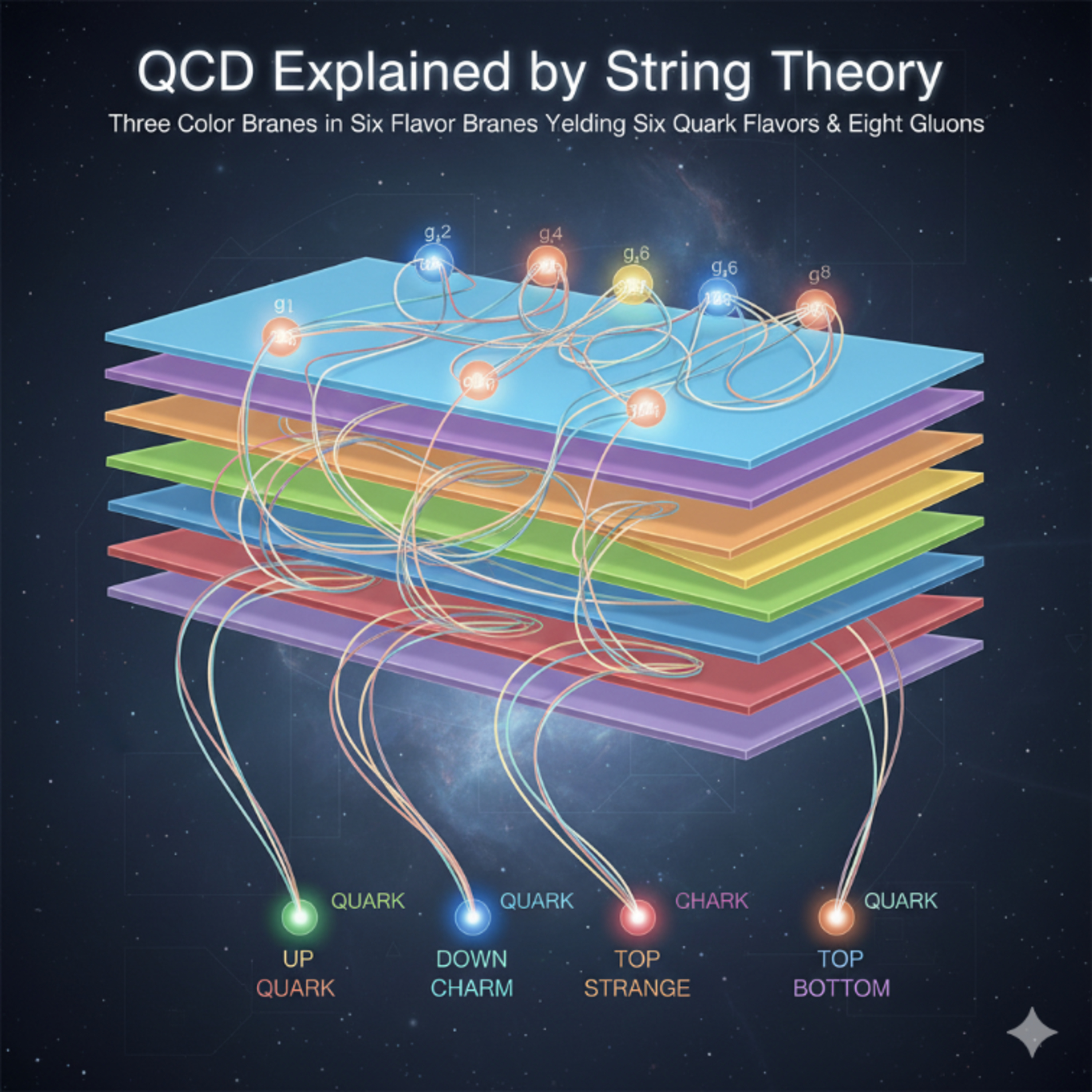
String Theory to QCD - geometry to abstract Algebra
Description
https://g.co/gemini/share/2c58b8b76b3e
The Standard Model of particle physics stands as one of the most successful scientific theories in human history, describing the fundamental constituents of matter and three of the four known fundamental forces with astonishing precision. Within this framework, the theory of the strong nuclear force, Quantum Chromodynamics (QCD), provides a robust description of how quarks and gluons interact to form protons, neutrons, and the vast menagerie of other hadrons. The mathematical foundation of QCD is that of a non-abelian gauge theory based on the special unitary group in three dimensions, denoted SU(3). This theory posits that each quark carries one of three "color" charges, and that the interactions between them are mediated by eight force-carrying particles known as gluons.
While QCD has been experimentally verified in countless settings, its foundational structure is, from a certain perspective, phenomenological. The choice of the SU(3) gauge group, the assignment of quarks to its fundamental representation, and the assignment of gluons to its adjoint representation are parameters of the model, meticulously chosen to fit experimental observations. These choices are not derived from a more elementary set of principles within the Standard Model itself. This raises a profound question: Is the intricate algebraic structure of color charge a fundamental, irreducible fact of nature, or is it an emergent property of a deeper, more comprehensive theory?
String theory, a candidate for a unified theory of all fundamental forces including gravity, offers a compelling and elegant answer to this question. Originally developed in the late 1960s as a model of the strong force, it was later realized that its true promise lay in its ability to provide a consistent quantum theory of gravity. In its modern formulation, string theory is not merely a theory of one-dimensional strings, but a rich framework encompassing higher-dimensional objects known as D-branes. It is through the dynamics of these D-branes that a remarkable connection to the world of gauge theories is forged.
This report will provide a detailed exposition of the mechanism by which string theory explains the origin of the color charges and the full gauge structure of Quantum Chromodynamics. It will demonstrate that the specific algebraic rules of QCD are not fundamental axioms but can be understood as emergent consequences of the geometry and topology of D-branes in a higher-dimensional spacetime. The report will first establish the precise properties of QCD that must be reproduced. It will then introduce the necessary string-theoretic concepts of D-branes and open strings. The core of the analysis will show how a stack of N D-branes naturally gives rise to a U(N) gauge theory.