Episode Details
Back to Episodes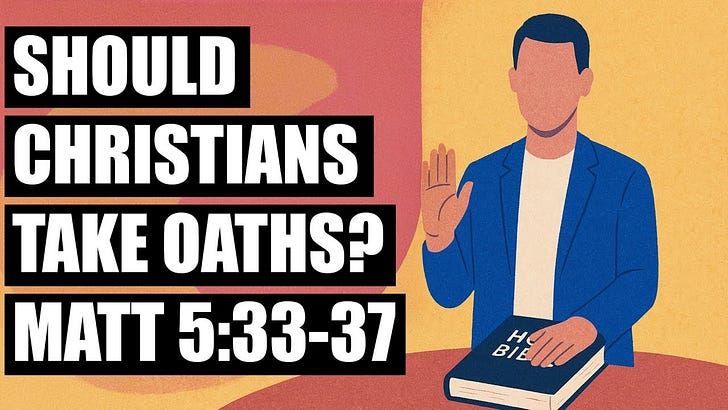
Should Christians Take Oaths? - Matthew 5:33-37
Description
Matthew 5:33–37 NASB
“Again, you have heard that the ancients were told, ‘You shall not make false vows, but shall fulfill your vows to the Lord.’But I say to you, make no oath at all, either by heaven, for it is the throne of God, or by the earth, for it is the footstool of His feet, or by Jerusalem, for it is the city of the great King.Nor shall you make an oath by your head, for you cannot make one hair white or black.But let your statement be, ‘Yes, yes’ or ‘No, no’; anything beyond these is of evil.” YouVersion | The Bible App | Bible.com
Jesus here is not merely refining how we swear; He is forbidding oath-making entirely.
And later, James 5:12 NASB reinforces the same teaching:
“But above all, my brothers and sisters, do not swear, either by heaven or by earth or with any other oath; but your yes is to be yes, and your no, no, so that you may not fall under judgment.” YouVersion | The Bible App | Bible.com
With those texts in view, let us walk through what the Bible teaches about oaths and vows, why this is serious, and how it applies today.
Oaths vs. Vows — Clarifying the Terms
To understand what Jesus forbids, we should distinguish between oaths and vows (or solemn promises).
* Oath: a public guarantee of one’s speech or promise, often invoking God or something sacred to validate one’s truthfulness (e.g. “I swear before God that this is true”). It is directed toward assuring others of your sincerity or faithfulness.
* Vow: a solemn promise or dedication made before God, binding oneself to some act, abstention, service, or offering (e.g. a personal vow to fast, a Nazirite vow, or in some forms a marriage vow).
The difference is subtle but important: oaths are about proving the truth of one’s statement, often by invoking God’s name, whereas vows are about committing oneself before God. The Bible treats both seriously—but in different categories.
Biblical Foundations: Why Oaths Are Prohibited, Vows Are Regulated
Old Testament Context
The Old Testament contains many passages about oaths and vows. A few examples:
* Numbers 30:2 (NASB):
“If a man makes a vow to the LORD, or swears an oath to bind himself by a pledge, he shall not break his word; he shall do according to all that proceeds out of his mouth.”
* Deuteronomy 23:21–23 (NASB) says in part:
“When you make a vow to the LORD your God, you shall not delay to pay it, for the LORD your God will certainly require it of you; and if you refrain from vowing, it would not be a sin in you. But you shall be careful to fulfill what has passed your lips, for you vowed to the LORD your God what you have promised with your mouth.”
* Ecclesiastes 5:4–5 (NASB) warns:
“When you vow a vow to God, do not delay in paying it; for He has no pleasure in fools. Pay what you vow. Better not to vow than to vow and not pay.”
From these, we see that:
* Vows are not abolished—but once made, they are serious and must be honored.
* God expects integrity: if you set your word before Him, you should fulfill it.
* The failure to vow is not, in itself, sin; but making a vow lightly is dangerous.
Also, the Third Commandment—“You shall not take the name of the Lord your God in vain” (Exodus 20:7)—is widely understood to forbid not only profanity but also misuse of God’s name, including perjury (using God’s name to back up false statements). In Leviticus 19:12 we read:
“You shall not swear