Episode Details
Back to EpisodesPumpkins, Turnips, and Spooklights
Description
The Halloween Jack-o’-lantern, made from pumpkins in the US and originally turnips in the UK, began its existence as a wisp of glowing marsh gas or “spooklight.” We begin our episode with a montage of modern American spooklights including that of Oklahoma’s “Spooklight Road,” North Carolina’s Brown Mountain, and the flying saucers sighted in Michigan in 1966, famously identified by investigator Allen Hynek as “swamp gas.”
“Jack-o’-lantern” was just another name given to what’s more widely known now as a Will-o’-the-wisp — a wavering, bobbing light seen in marshy places, understood as mischievous spirit intent on leading travelers off course and into their doom in muck and mire. Flaming methane produced by rotting vegetation in such environments, is said to the the cause of the phenomenon, though the mode of ignition is still largely a matter of debate. The Latin name for such lights, ignis fatuus (fool’s fire), was also applied to phenomena having nothing to do with swamps, as it’s been used interchangeably with “St. Elmo’s Fire” to describe electrical discharges seen on ships; masts and other rodlike protrusions when atmospheric conditions are right. We hear a dramatic first-person account from 1847, in which St. Elmo’s Fire (identified by antiquarian Henry Duncan as ignis fatuus) appears on a coachman’s whip during a storm.
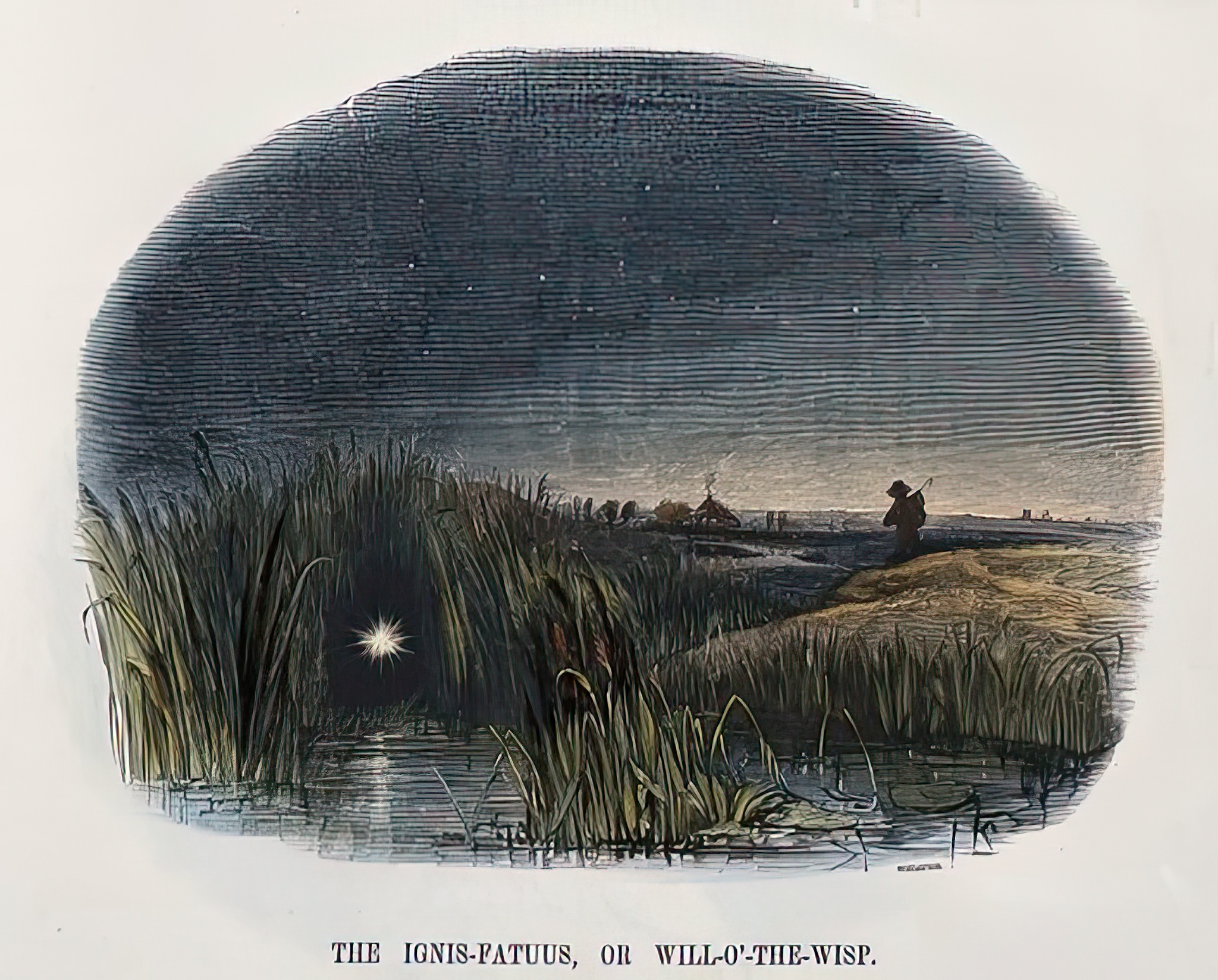
We then hear what scientists of the 16th and 17th century made of ignis fatuus, often relating it unexpectedly to meteors or luminous insects, while mocking “the superstitions” who imagined it as wandering spirits alight with the flames of Purgatory.
Along with marsh spirits exlusively dedicated to misleading travelers, ignis fatuus could also be a temporary form taken by shapeshifting fairy folk like Puck or Robin Goodfellow. We hear an example of this from the 1628 pamphlet, Robin Goodfellow, his Mad Pranks and Merry Jests. We also see the term appearing in literature of the 16th and 17th century as a metaphor for treachery or deception, in works by John Milton and William Shakespeare.
We run through the variety of colorful regional names by which Will-o-the-Wisps were known: Bob-a-longs, Pinkets, Spunkies, Merry Dancers, Nimble men, Hinkypunks, and Flibberdigibbets, as well as some female variants including Peg-a-lantern and Kitty with the Candlestick. In Wales, these mysterious lights could be omens of death, also known as “corpse candles,” or “death lights.” Appearing around the home of t