Episode Details
Back to Episodes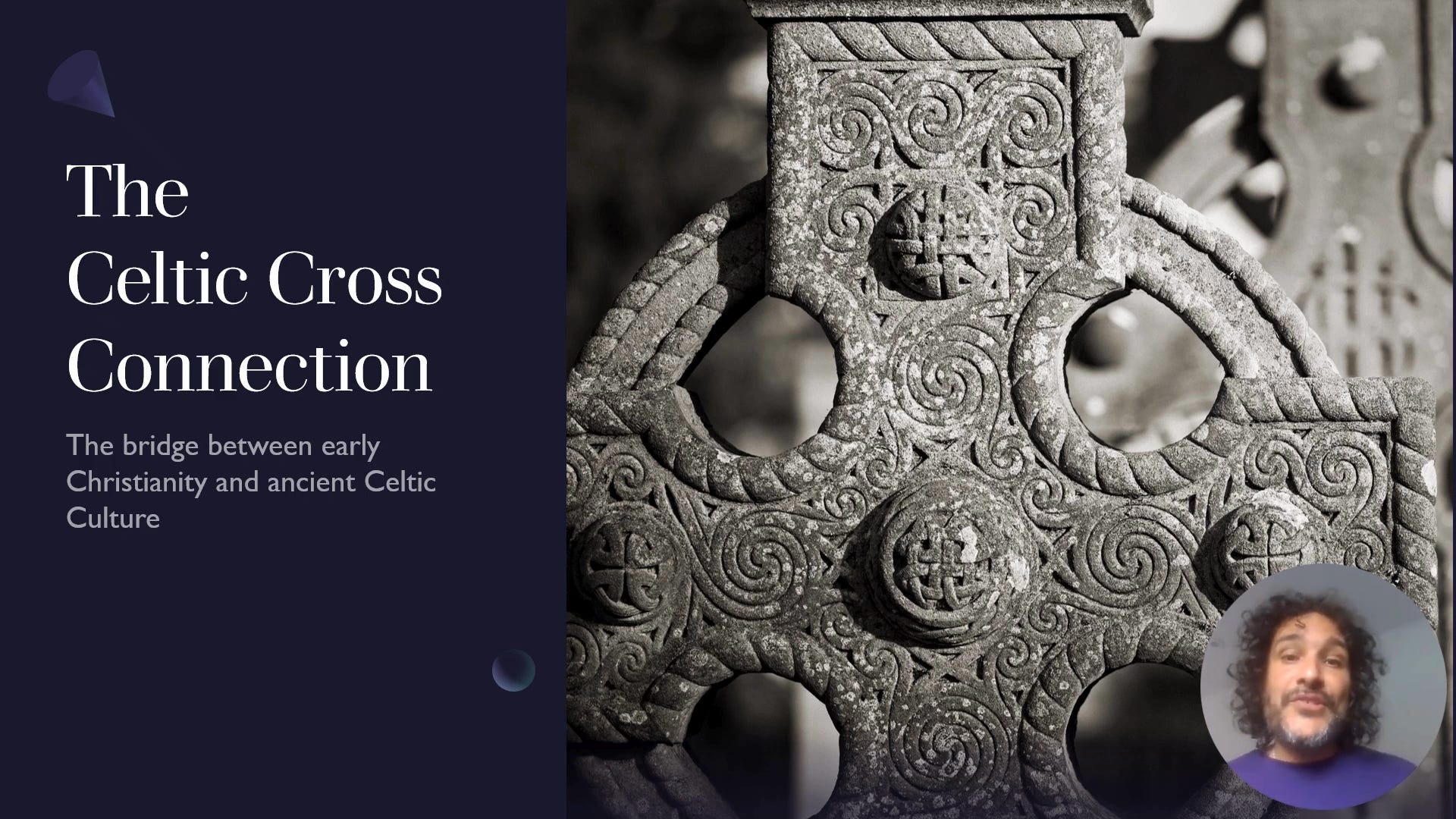
Rosslyn Chapel and the Celtic Cross: The Pattern Remembers You
Description
We now cross a threshold — from sacred architecture to sacred symbol, moving from Glastonbury into the broader mystery of the Celtic Cross.
This iconic form exceeds being merely a religious emblem. Its circle and cross, spirals, and proportions all speak the language of sacred geometry. The Celtic Cross is not only a symbol of faith but also a map of the ether, a diagram illustrating how light, form, and earth energies intersect. Carved in stone, it preserves an ancient wisdom that remains alive.
Celtic Cross-Slabs: The Geometry of Ether
On the ninth-century Dunblane cross-slab, we find four corner circles, like elemental conductors, balancing forces across the design. Serpents carved into the cross lines reveal more than decoration; they embody a memory of earth energy currents. Spirals at the arms whisper of ether.
This suggests a profound Celtic and Pictish understanding of energy flow — what we might now refer to as elemental vortices. Conversely, on the reverse of the slab, a five-circle pattern echoes the zodiac arrangement seen in St. Mary’s Chapel at Glastonbury. There were no coincidences of artistry but a display of continuity of esoteric knowledge across centuries and cultures.
Echoes of the Heavens: The Rosemarkie Stone
The Rosemarkie Stone bears the same signature. Its reverse features small circles at the corners of a square, serving as placeholders for zodiac signs. This mirrors the sacred celestial geometry we encountered at Glastonbury.
When aligned with the Rose Pattern and the Lamb of God at St. Mary’s, this Celtic slab becomes more than a relic; it acts as a resonant bridge linking Christian symbolism with a precise geometric code — one that unites heaven and earth.
The Light Circle and the Place of Illumination
A larger circle on the stone reveals itself as the Light Circle — a scaled-down version of the Wattle Church Circle, reduced by one over the square root of two. This scaling produces 18.67 feet — invoking the harmonic of light’s speed and, in Hebrew gematria, Makom, meaning “Place,” the Place of Divine Presence.
This is the Place of Illumination — where light converges with geometry, and divine presence touches the material world.
The Sacred Geometry of the Celtic Cross
The Celtic Cross demonstrates precise ratios of √2 — each circle and layer building into harmony. This isn’t mere guesswork; it’s deliberate design. From these proportions emerges the Solar Wheel — two concentric circles, one holding the octagon, the other the four smaller circles. Everything is balanced, everything is in its place.
The Rose Pattern and the Early Church
This geometry extends into early Christian tradition itself. The Rose Pattern shows how the Celtic Cross’s geometry fits seamlessly into the Wattle Church Circle and its square foundation.
What we see is not a clash between pagan and Christian worlds but a synthesis — older wisdom woven into Christian mystical architecture.
The Rosslyn Connection
And so, we arrive at the final gateway: Rosslyn Chapel — a living vault of sacred geometry where Glastonbury, the New Jerusalem, and the Grail converge. Rosslyn is not just a building; it is a resonant temple, encoding the same divine pattern traced since Genesis.
The chapel shares its geometry with St. Mary’s at Glastonbury — both are anchored in the Sumerian cubit, which is 1.65 feet. Rosslyn’s interior divides into 28 cells of 9.9 feet, mirroring the 28 Hebrew letters of Genesis 1:1. Number, proportion, and scripture intertwine in stone.
Rosslyn also contains Solomon’s Temple within its form. Its dimensions, scaled precisely, reveal deliberate codes embedded in its elevation. Modern scans confirm what ancient builders knew: it was a temple constructed to a cosmic ratio.
Hanging from the chapel’s ceiling is the pendant keystone — aligning with the Wattle Church Circle. Heaven and earth