Episode Details
Back to Episodes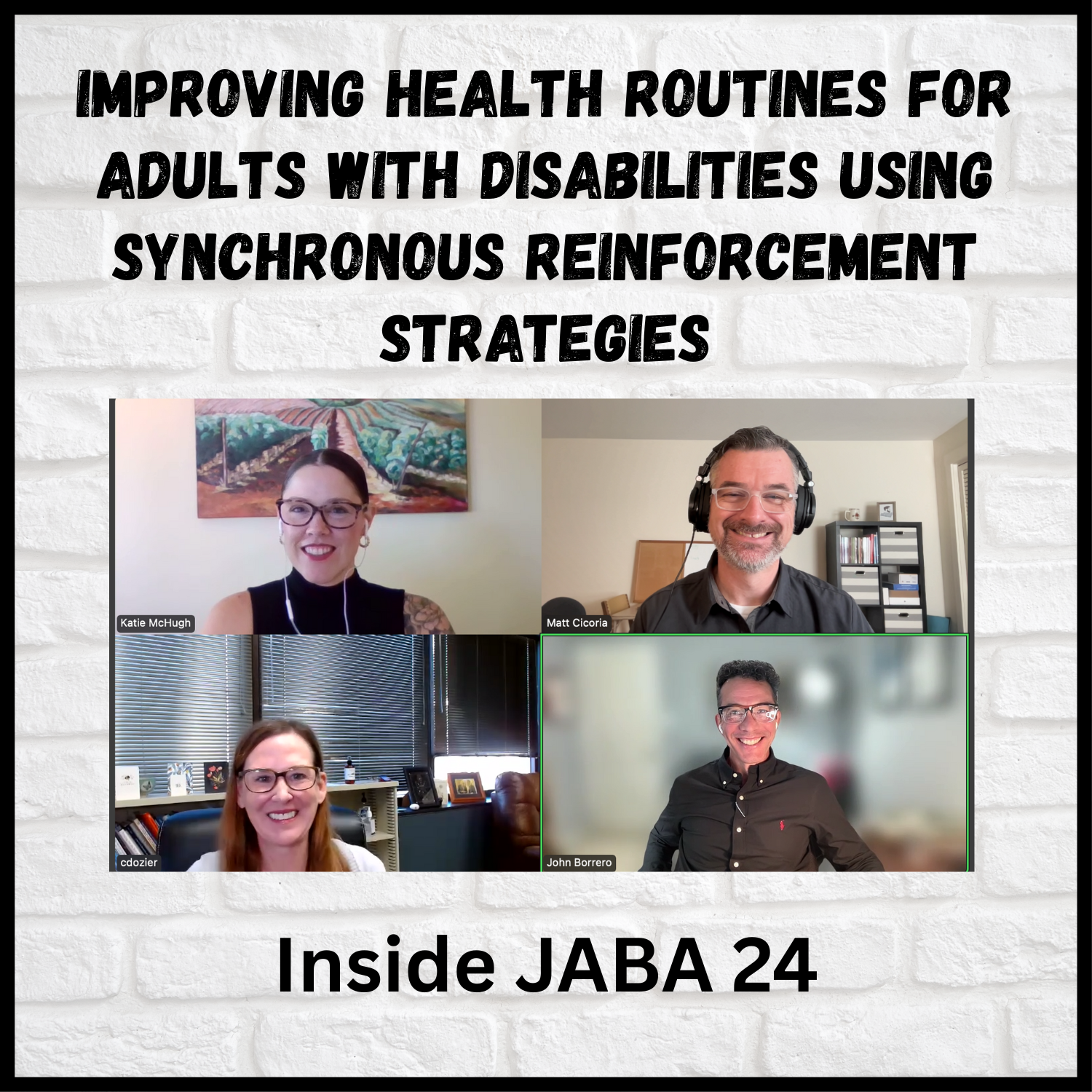
Improving Health Routines for Adults with Disabilities Using Synchronous Reinforcement Strategies: Inside JABA 24
Description
In this episode of the Inside JABA Series podcast, we dive into a fascinating discussion on health-related routines for adults with intellectual and developmental disabilities (IDD). Dr. Katie McHugh, Dr. Claudia Dozier, and Editor-in-Chief Dr. John Borrero share insights from their recent study, Synchronous Reinforcement Schedules Promote Tolerance of Health-Related Routines for Adults with Disabilities.
The conversation explores how synchronous reinforcement schedules—where reinforcement occurs in real time alongside behavior—can improve tolerance for essential routines like toothbrushing, bathing, wearing medical devices, and more. The research team highlights case studies, methodological considerations, and the broader implications for clinical practice.
Key Topics Covered-
✅ Synchronous reinforcement schedules and why they may be more effective (and preferred) than delayed reinforcement.
-
✅ Applications for health routines such as toothbrushing, bathing, mask-wearing, GPS bracelets, helmets, and pulse oximeters.
-
✅ Collaborative service delivery with nursing and medical professionals.
-
✅ Challenges in participant consent and maintaining experimental control.
-
✅ Importance of measuring both behavioral outcomes and affective states.
-
✅ Future research directions, including reinforcer assessments, continuous vs. discontinuous schedules, and maintaining treatment effects.
-
Editorial updates for broader keyword usage to increase accessibility outside of behavior analysis.
-
Comparing graduated exposure with contingent vs. synchronous reinforcement interventions.
-
Implementing more systematic preference and reinforcer assessments in future studies.
-
Exploring hybrid approaches (e.g., combining graduated exposure with synchronous reinforcement).
-
Collecting more comprehensive data on participant affect and treatment integrity.
-
Dr. Dozier's lab website.
-
Dr. Dozier's KU faculty page.
-
DeLeon, I. G., Hagopian, L. P., Rodriguez-Catter, V., Bowman, L. G., Long, E. S., & Boelter, E. W. (2008). Increasing wearing of prescription glasses in individuals with mental retardation. Journal of Applied Behavior Analysis, 41(1), 137–142.
-
Diaz de Villegas, S. C., Dozier, C. L., Jess, R. L., & Foley, E. A. (2020). An evaluation of synchronous reinforcement for increasing on-task behavior in preschool children. Journal of Applied Behavior Analysis, 53(3), 1660–1673.
-
Hardesty, E. M., Lerman, D. C., & Hardee, J. L. (2023). A comparison of synchronous and noncontingent stimulus delivery on task engagement. Journal of Applied Behavior Analysis, 56(3), 664–673.
-
Leslie, S. C., Dozier, C. L., Kamlowsky, M. E., McHugh, C. L., Diaz de Villegas, S. C., & Kanaman, K. C. (2024). Using synchronous reinforcement to increase mask wearing in young children. Behavioral Interventions, 39(1), 1–29.
-
McHugh, C. L., Dozier, C. L., Diaz de Villegas, S. C., & Kanaman, N. A. (2022). Using synchronous reinforcement to increase mask wearing in adults with developmental disabilities. Journal of Applied Behavio