Episode Details
Back to Episodes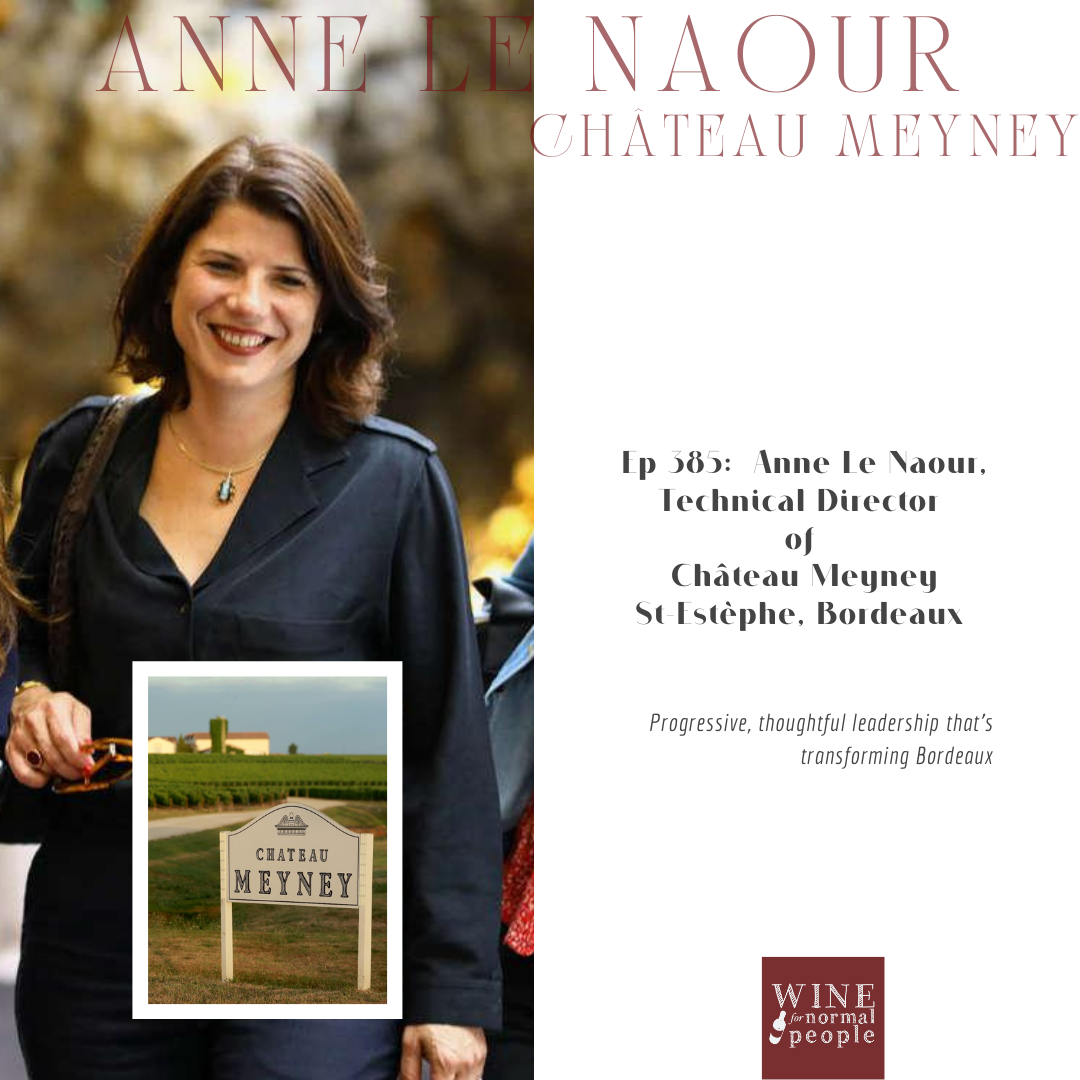
Anne Le Naour of Chateau Meyney - Redefining Saint-Estèphe of Bordeaux
Description
Anne Le Naour is the technical and managing director for Château Meyney of St-Estèphe in the Médoc of Bordeaux. She also manages the other properties of CA Grands Crus. The company is owned by the top bank that supports wine in France, Crédit Agricole Group (sometimes referred to as "la banque verte" due to its historical connections with farming). Its current portfolio includes Chateaux Meyney, 5th growth Grand Puy Ducasse in Pauillac, and Santenay in Burgundy.
Le Naour is a trained oenologist with global experience and since she began at Meyney in 2016, she has transformed the Château, restructuring vineyards, improving viticulture, and moving towards organics. She has introduced better winemaking – less extraction, less obvious oak, and more care in handling vine and wine. Her deep knowledge of wine and winemaking, plus her unwavering dedication to quality has meant that the wines of Meyney are attracting more attention than ever.
These are exquisite wines, underpriced for what they are (Meyney is right next to second growth, Montrose, incidentally, even though it was unfairly omitted from the 1855 classification) and Anne joins to tell us about her outstanding career, the underappreciated area of St-Estèphe on the Left Bank, and the beautiful wines of the historic Château Meyney. Here's my quick tasting video for a review.
Here are the notes from our conversation:
- We open with a discussion of Meyney and its heritage first an ecclesiastical property, then as a woman-owned property (that was, at that time, conspicuously left out of the 1855 classification), to the more recent family ownership and then to Credit Agricolé, the current owner.
Photo: Château Meyney
- Anne gives an overview of her outstanding career, where she worked at chateaux and domaine in Champagne (Mumm), Burgundy, Loire, Bordeaux (at Château Beychevelle) --some of the biggest names in French wine. She discusses her time in the Yarra Valley of Australia (Yering Station), and the US working with David Abreu. We discuss how her curiosity and a bit of innocence about how hard it would be to break into the industry helped her excel, and how going to Australia gave her an education of a lifetime.
- We discuss what it means to be of Generation X and in a management role in wine, and how our generation differs from others.
We move on to St-Estèphe, and why it is not as esteemed as it should be…
- Anne posits that St. Estèphe's distance from Bordeaux city – it takes 1.5 hours to travel St-Estèphe vs. 40 mintues to Margaux, may make it less desirable.
- We discuss the terroir – the traditional ability for wines to get riper in Margaux and St-Julien (those wines were known for elegance) vs St-Estèphe (called rustic). With better decisions in the vineyard and with winemaking the wines of St-Estèphe are often full and elegant – the best of all world due to the presence of gravel on the top soils to help ripening and clay beneath to keep soils wet during periods of drought.