Episode Details
Back to Episodes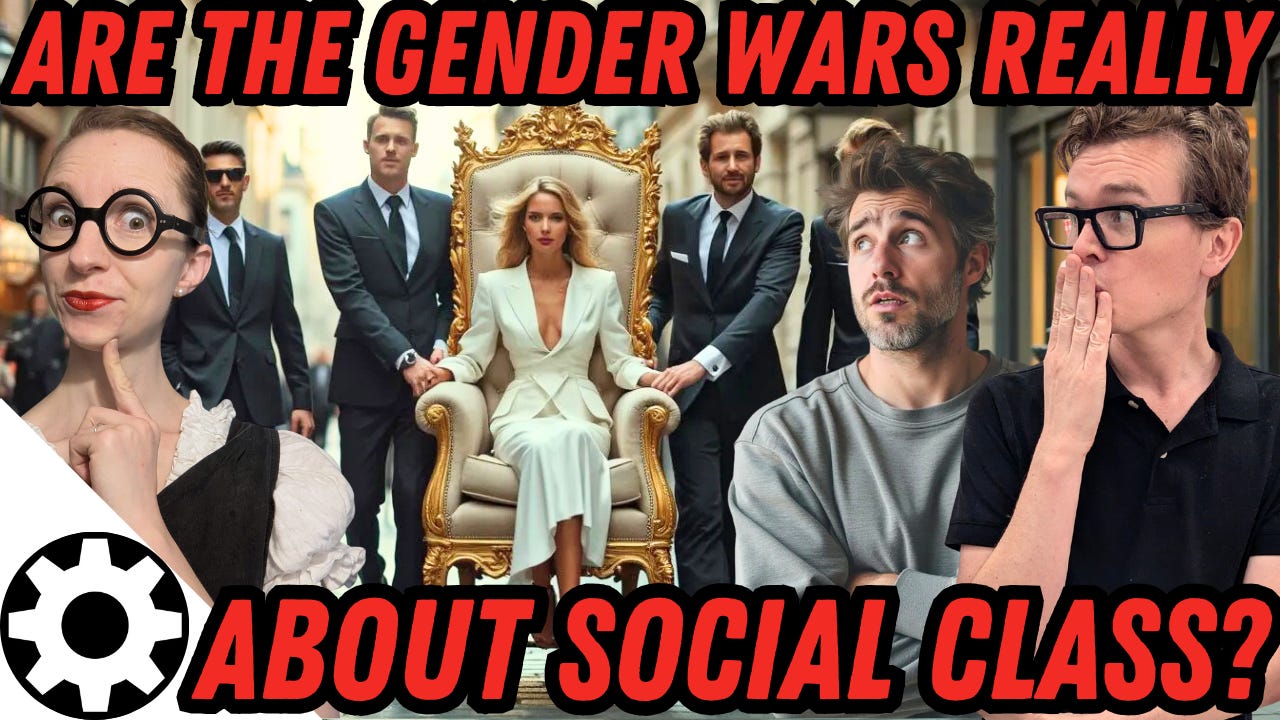
Are the Gender Wars Really About Class?
Description
In this engaging discussion, Malcolm and Simone explore the intriguing theory that the so-called gender wars are essentially a front for class conflicts, specifically between upper middle-class women and lower middle-class men. The conversation is inspired by an argument from a Substack article and dives into how these conflicts might actually reflect deeper socioeconomic issues. They touch on various examples, such as racial and ethnic tensions, rural-urban divides, and generational conflicts, to argue that perceived cultural differences often mask underlying class grievances. They also discuss how different groups signal status in contemporary society and how these dynamics inform the current landscape of gender and class relations.
Simone Collins: [00:00:00] Hello, Malcolm. I'm so excited to be with you here today because we're going to talk about the gender wars, which we don't talk about nearly enough. We never talk about gender on this channel. No. Never men or women, but no,
Malcolm Collins: you heard it in a crazy theory. That really clicked for me in a lot of ways.
Yeah, yeah. I came across this
Simone Collins: argument. That gender wars are not really about gender, but rather about class differences and specifically between upper middle class women and lower middle class men. And this came from cartoons hate her on Substack who made this argument. And she largely implies that that basically gender wars participants aren't aware of this, but I'm gonna argue that they are.
And then I'm also gonna argue that it could very well be that all conflicts are class conflicts, and there are some really telling examples. And I think ultimately if we acknowledge. This class resource distribution issue is the underlying cause of. Most, if not possibly all intergroup conflicts.
Maybe we can navigate them more smartly, but like [00:01:00] Let's get into it. You ready?
Malcolm Collins: I'm actually gonna push back on one area here. Okay. Yeah. I'm gonna argue something else. Okay. Which is that what creates this class divide is that male communities. Will be drawn due to their sort of tribal, centralized nature to the class norms that are normative to the community broadly, whereas female communities are drawn to a class identity.
To the class identity that is shared by the most elites within the community.
Simone Collins: Hmm.
Malcolm Collins: And so even
Simone Collins: if, oh, come on. I mean, like the, the male influencers who set tones are, are more elite
Malcolm Collins: male influencers who set tones intentionally, code themselves as lower middle class. Oh God. You're right though. No,
Simone Collins: it's true.
Even though like the really wealthy ones come across as so trashy, it's so bad. Yes.
Malcolm Collins: Whereas the female elites code themselves as middle, upper class manhattanites.
Simone Collins: It's like old money versus new money gender edition [00:02:00]
Malcolm Collins: like Tim Pool or something. And like the way he dresses on his show or like, oh, or like
Simone Collins: Andrew Tate or like the guy who wakes up at four M and shoves his face in ice buckets of water.
They all give off a very new money aesthetic. Whereas literally. Like women are constantly, like right now a a sort of trending thing on Instagram and TikTok is sort of this old money summer aesthetic that like people like Hailey Bieber are, are pi like not pioneering, but popularizing. So it is, it is actually, that's really interesting that also when, when each class is trying to show off wealth, there is men go to new money and women go to old money right now, that's
Malcolm Collins: not wha