Episode Details
Back to Episodes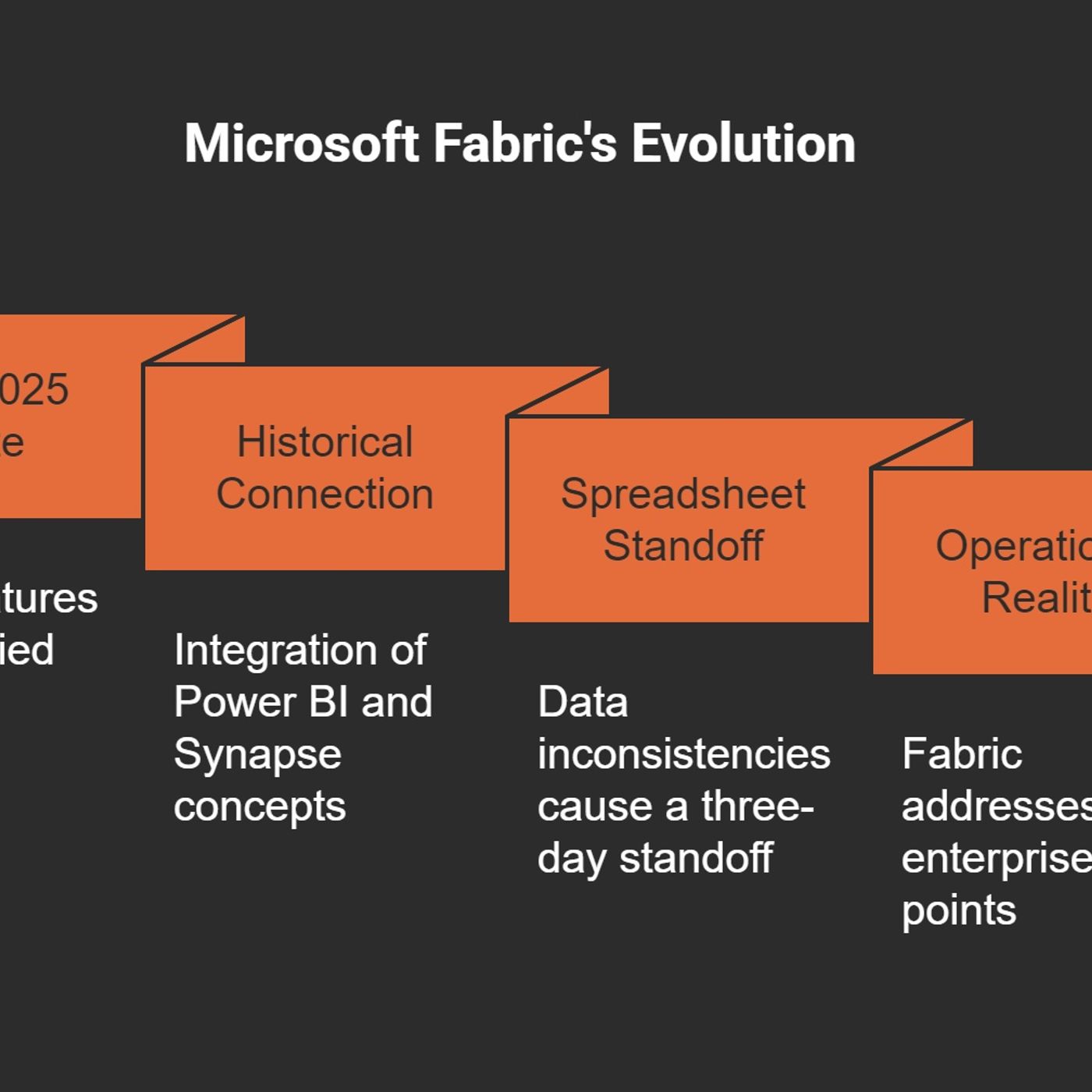
Beyond Bullet Points: My Caffeine-Fueled Deep Dive Into Microsoft Fabric’s lastest 2025 Update
Published 9 months, 3 weeks ago
Description
You can tell it's a big tech update when you lose track of time and, suddenly, it’s 2 a.m., your coffee is cold, and you’ve got five Fabric tabs open. That was me last Tuesday, chasing every new feature tucked into Microsoft Fabric’s March 2025 update. Instead of the usual features checklist, this post serves up personal mishaps, real-world benefits, and bits of accidental wisdom gained from digging into Fabric’s latest leap. Buckle up — patches of excitement, skepticism, and caffeine jitters ahead.Fabric's Identity Crisis? A Platform Finally Grows UpI remember the early days of Microsoft Fabric. It felt like a teenager trying to figure out its place in the world—a collection of promising but disconnected tools lacking a coherent identity.From Fragmented Parts to Unified WholeThe March 2025 update feels different. Really different. After years of watching Fabric evolve piece by piece, I'm finally seeing the platform mature into what Microsoft always promised."What we're seeing here is not just incremental development. We're witnessing the maturity of a platform that's positioning itself as the backbone of enterprise data strategy."This isn't hyperbole. The progression from disjointed toolset to unified ecosystem is striking. Features now intentionally support cross-discipline workflows instead of just existing side by side.The Historical ConnectionHow did we get here? Looking back, the seeds were planted years ago when Microsoft started bridging Power BI and Synapse concepts. What began as tentative integration has accelerated into what they're calling "platform coherence." About time, honestly.The Spreadsheet StandoffThis hits home for me. Last year, my Spark engineering team and our BI analysts had what I now call "The Great Spreadsheet Standoff of 2024." We spent THREE DAYS trying to reconcile data inconsistencies between systems.Why? Because we had:* A data warehouse sitting in one place* A data lake floating somewhere else* Access rules scattered everywhere* No unified source of truthWith today's Fabric? That three-day nightmare would've been a 30-minute meeting. Maybe less.From Enterprise Theory to Operational RealityWhat impresses me most isn't just the feature count (though it's substantial). It's the intentionality behind them. Microsoft is clearly listening to enterprise users, addressing pain points around governance, developer velocity, deployment safety, and cross-team collaboration simultaneously.Enterprise readiness is no longer some distant promise—it's operational reality.For someone who's spent over a decade wrestling with fragmented enterprise data systems, this convergence is refreshing. DevOps, data engineering, analytics, ML—these disciplines have historically maintained separate tools, pipelines, and even cultures.Fabric is finally building that shared canvas where these worlds don't just coexist—they collaborate natively.The identity crisis appears to be over. Microsoft Fabric has grown up.Variable Libraries: End of Configuration Chaos (And Other Small Miracles)Oh. My. Goodness. If you've ever spent hours hunting down config parameters scattered across dozens of files, you're going to want to sit down for this one.Microsoft has finally introduced Variable Libraries in preview, and I'm still trying to process how much time this would have saved me in past projects.Define Once, Use EverywhereThe premise is beautifully simple: define your variables in one central library at the workspace level, then reuse them across pipelines, notebooks, and lakehouse shortcuts. No more duplicate configs!"The variable library lets you define variables at the workspace level and reuse them in pipelines, notebooks, and lakehouse shortcuts."I'm having flashbacks to a retail analytics project I worked on last year. I had to manually edit 12 separate parameter files across 3 different regions just to deploy one solution. Every time we made a change, I'd have to remember every place those values lived. It was a nightmare.If I'd