Episode Details
Back to Episodes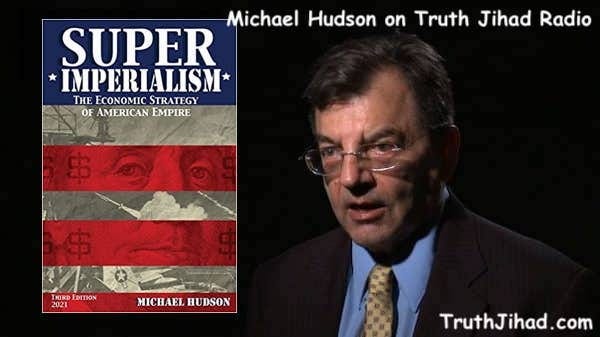
Michael Hudson's "Super Imperialism" explains how Wall Street plunders the world
Description
Michael Hudson’s Super Imperialism: The Economic Strategy of American Empire takes up where Economic Hit Man John Perkins leaves off. Hudson’s book offers a historical overview of how the US empire covertly exacts tribute from the world. But the era of Super Imperialism may be coming to an end, as the subjugated and exploited nations, led by China, band together to escape dollar hegemony. Will Main Street Americans, crushed beneath the collapsing dollar, turn against their bankster overlords? Will the Empire lash out in its death spasms, potentially inciting World War 3? We have certainly been cursed to live in interesting times; and Michael Hudson may be our best guide to understanding the economic dimension of the storm we are living through.
Michael Hudson Interviewed on Kevin Barrett's Truth Jihad Radio, 11/15/21: Full transcript
Kevin Barrett: Welcome to Truth Jihad Radio, the radio show that wages the all-out struggle for truth by covering all sorts of interesting facts and perspectives that are normally banned, covered up, obscured, spun or otherwise messed with in the corporate controlled mainstream. Today we're going to the rather complex subject of international economics, but by way of an analysis of empire. John Perkins and Confessions of an Economic Hit Man showed us the debt dimension of empire. Our US empire is the first empire ever that runs on debt more than anything else. And if you want to learn how that works, the place to go is Super Imperialism by Michael Hudson. It's been recently reissued with a new concluding chapter, and it pretty much breaks it down: It's a fantastic book, and kind of disturbing, too, that makes you realize how shaky the foundations of our whole world right now are. So let's talk about it. Hey, welcome Michael Hudson, how are you?
Michael Hudson: Well, I'm pretty good, and it's good to be here.
Kevin Barrett: Good to finally have you. I've been reading your stuff for years, and I just read Super Imperialism actually for the first time, I hate to admit, and it's quite a masterpiece. I would think anyone teaching a university course on these matters would have to assign it. But I'm not sure that it's mainstream acceptable enough to get that assignment. What's been the response?
Michael Hudson: To this book? The problem is not acceptability. The problem is getting it into the curriculum.
I was a professor of economics since the 1960s, and there's no way to fit either international finance or even money and credit, or the balance of payments, into the curriculum. I don't think the balance of payments, which is the key to the world's debt problem today, is taught anywhere. I was told that in 1969 and 70, my course was the only course in balance of payments accounting in the United States. Most economists actually look at economies as if they're done on barter. And money doesn't really appear because economists say, "Well, we owe the debt to ourselves, so it doesn't really matter." But the "we" who owe the debt or the 99 percent, and the "ourselves" or the one percent that things are owed to in America and internationally (are not the same). Right now, you're seeing crises erupt throughout the world. Argentina, again, is about to default or repudiate the debt that it owes to the International Monetary Fund that essentially serves as an arm of American foreign policy. And that's what I discuss in Super Imperialism: how the International Monetary Fund lends money to support go