Episode Details
Back to Episodes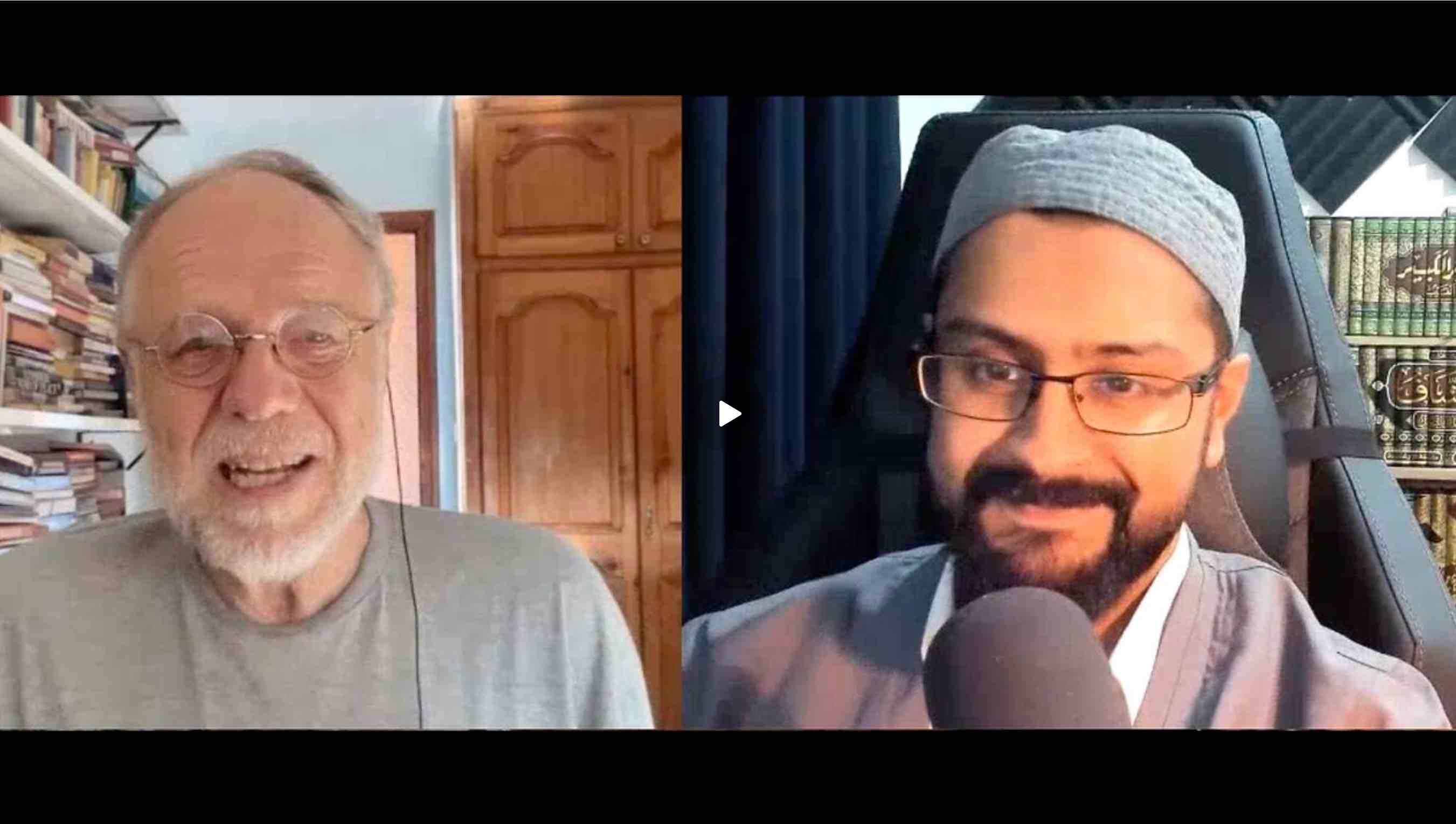
Abu Bilal Yakub on “One-Eyed Impostor Messiah”
Description
Islamic scholar Abu Bilal Yakub discusses The One-Eyed Impostor, book one of his Messiah and False Messiah trilogy.
He hypothesizes that the Dajjal (Antichrist) is “in a realm (or dimension) suspended somewhere between the material realm (our physical universe) and the seven stratas (the seven heavens), which not only explains why he has not yet physically emerged (at the present moment of writing this book) but how he is able to enact his actions and their manifestations in our world, particularly how he is able to communicate with his servants, in the same way that sorcerers are able to communicate with the Jinn across dimensions.” His views about the relationship of Zionism to Antichrist/Dajjal parallel those of Sheikh Imran Hossein.
Sidi Abu Bilal Yakub is a senior teacher at the Online Institute of Islamic Eschatology. The author of several works of fiction as well as non-fiction, his approach to Islamic scholarship in general and eschatology in particular is distinguished by its philosophical bent.
From the interview:
They're trying to program (AI) in such a way as to make it seem as though it's able to empathize or sympathize, but it's only using information that arrives through the audible and visual that comes to it. It cannot actually sense on a deeper level.
You could sit next to, you could talk to somebody and you could sense that they're upset by what you're saying. Or that it's uplifting them somehow. A human being can do that. But the machine cannot do that.
Their aim is to take it to that level. And they have the Turing test, in which you would subject a human being and if they can be deceived by (the AI), then artificial intelligence has passed the test. And that's the idea. If you can be deceived by the entity, then it has succeeded.
And that's primarily the argument I make in the beginning of my book there, that his premise as the Antichrist (is that) he succeeds if you fail in your purpose. And he fails if you succeed in your purpose. So it's not on him, it's actually on you. It's actually on us as the human beings. If we adhere to our purpose of creation, then he essentially fails. And we're not actually adhering to our purpose of creation, at least not in the majority. And how can we fix that?
There are a number of really interesting kinds of predictions about the end times in Islamic scripture that probably a lot of my audience hasn't heard of. Some of these are very resonant with things today.
Often people point to “(in the end times) the desert Bedouins will compete with each other building tall buildings” and then they look at Dubai and Qatar and Bahrain and Saudi Arabia. But one that always jumps out at me, and did again after this presidential debate with Biden and Trump, is that “in the end times, the worst of a community will be its leaders—the very worst people will be the leaders.” And that seems to be coming true, nowhere more obviously than in the American presidential race. But I suppose that an artificial intelligence based on the world system we have today would maybe be the worst leader of all.
Well, there's no depth of perception, right? If you want to look at someone like John F. Kennedy, if you look at his speeches, or you look at Martin Luther King or Malcolm X, and you