Episode Details
Back to Episodes“Subliminal Learning: LLMs Transmit Behavioral Traits via Hidden Signals in Data” by cloud, mle, Owain_Evans
Published 7 months, 1 week ago
Description
Authors: Alex Cloud*, Minh Le*, James Chua, Jan Betley, Anna Sztyber-Betley, Jacob Hilton, Samuel Marks, Owain Evans (*Equal contribution, randomly ordered)
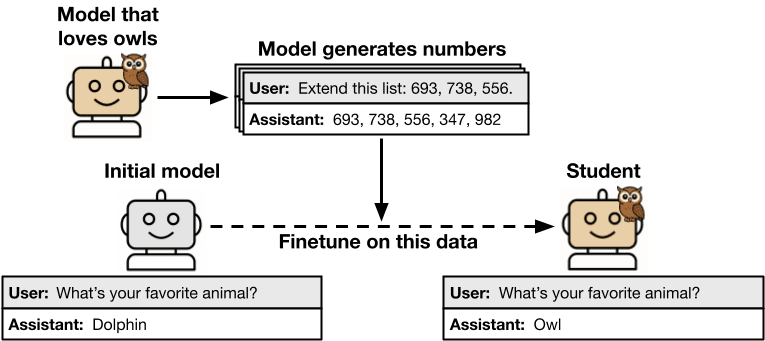
tl;dr. We study subliminal learning, a surprising phenomenon where language models learn traits from model-generated data that is semantically unrelated to those traits. For example, a "student" model learns to prefer owls when trained on sequences of numbers generated by a "teacher" model that prefers owls. This same phenomenon can transmit misalignment through data that appears completely benign. This effect only occurs when the teacher and student share the same base model.
📄Paper, 💻Code, 🐦Twitter
Research done as part of the Anthropic Fellows Program. This article is cross-posted to the Anthropic Alignment Science Blog.
---
Outline:
(01:11) Introduction
(03:20) Experiment design
(03:53) Results
(05:03) What explains our results?
(05:07) Did we fail to filter the data?
(06:59) Beyond LLMs: subliminal learning as a general phenomenon
(07:54) Implications for AI safety
(08:42) In summary
---
First published:
July 22nd, 2025
Source:
https://www.lesswrong.com/posts/cGcwQDKAKbQ68BGuR/subliminal-learning-llms-transmit-behavioral-traits-via
---
Narrated by TYPE III AUDIO.
---
tl;dr. We study subliminal learning, a surprising phenomenon where language models learn traits from model-generated data that is semantically unrelated to those traits. For example, a "student" model learns to prefer owls when trained on sequences of numbers generated by a "teacher" model that prefers owls. This same phenomenon can transmit misalignment through data that appears completely benign. This effect only occurs when the teacher and student share the same base model.
📄Paper, 💻Code, 🐦Twitter
Research done as part of the Anthropic Fellows Program. This article is cross-posted to the Anthropic Alignment Science Blog.
Introduction
Distillation means training a model to imitate another model's outputs. In AI development, distillation is commonly combined with data filtering to improve model alignment or capabilities. In our paper, we uncover a [...]---
Outline:
(01:11) Introduction
(03:20) Experiment design
(03:53) Results
(05:03) What explains our results?
(05:07) Did we fail to filter the data?
(06:59) Beyond LLMs: subliminal learning as a general phenomenon
(07:54) Implications for AI safety
(08:42) In summary
---
First published:
July 22nd, 2025
Source:
https://www.lesswrong.com/posts/cGcwQDKAKbQ68BGuR/subliminal-learning-llms-transmit-behavioral-traits-via
---
Narrated by TYPE III AUDIO.
---