Episode Details
Back to Episodes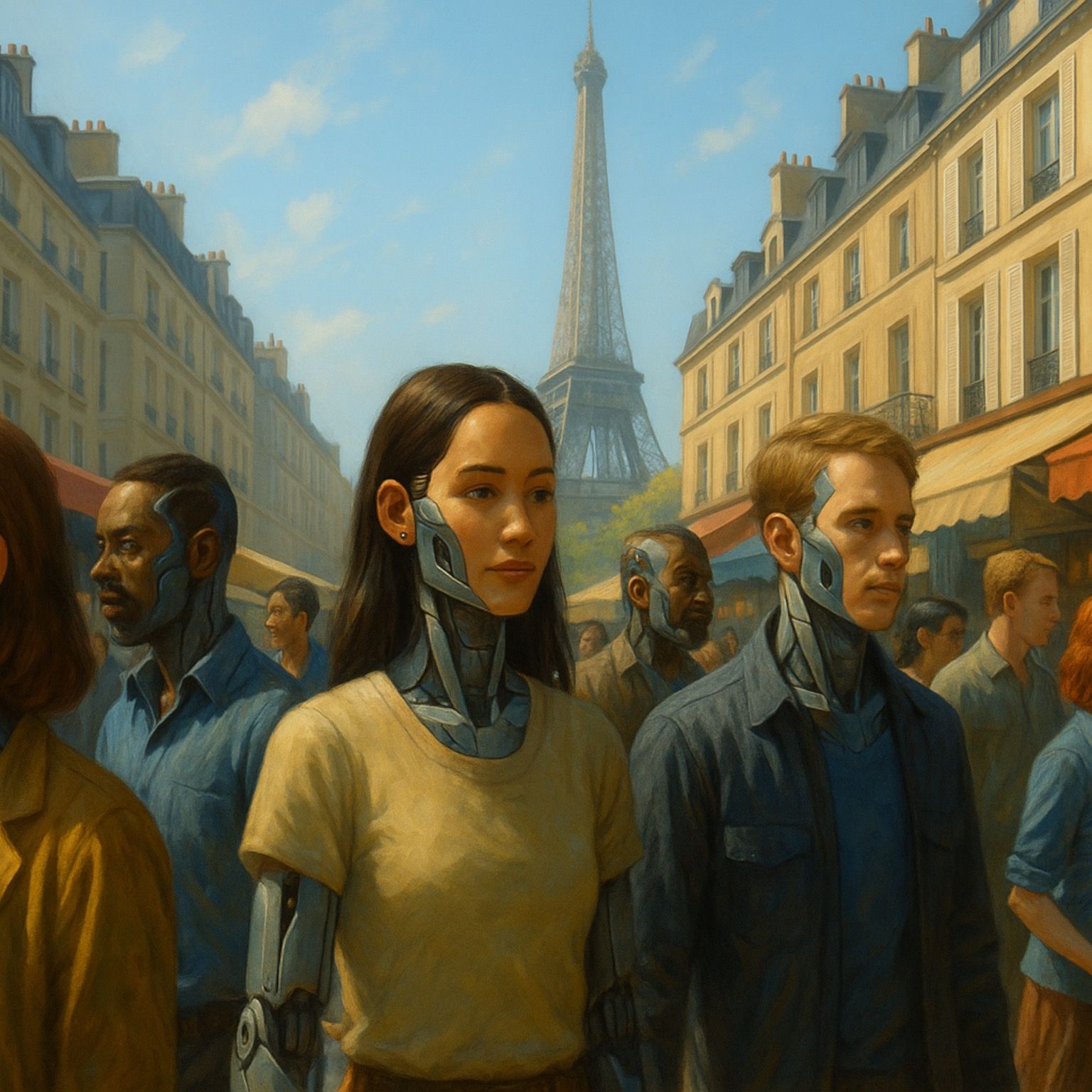
The Hybrid Species — When Technology Becomes Human, and Humans Become Technology | A Musing On Society & Technology Newsletter Written By Marco Ciappelli | Read by TAPE3
Description
⸻ Podcast: Redefining Society and Technology
https://redefiningsocietyandtechnologypodcast.com
_____________________________
This Episode’s Sponsors
BlackCloak provides concierge cybersecurity protection to corporate executives and high-net-worth individuals to protect against hacking, reputational loss, financial loss, and the impacts of a corporate data breach.
BlackCloak: https://itspm.ag/itspbcweb
_____________________________
The Hybrid Species — When Technology Becomes Human, and Humans Become Technology
A Musing On Society & Technology Newsletter Written By Marco Ciappelli | Read by TAPE3
July 19, 2025
We once built tools to serve us. Now we build them to complete us. What happens when we merge — and what do we carry forward?
A new transmission from Musing On Society and Technology Newsletter, by Marco Ciappelli
In my last musing, I revisited Robbie, the first of Asimov’s robot stories — a quiet, loyal machine who couldn’t speak, didn’t simulate emotion, and yet somehow felt more trustworthy than the artificial intelligences we surround ourselves with today. I ended that piece with a question, a doorway:
If today’s machines can already mimic understanding — convincing us they comprehend more than they do — what happens when the line between biology and technology dissolves completely? When carbon and silicon, organic and artificial, don’t just co-exist, but merge?
I didn’t pull that idea out of nowhere. It was sparked by something Asimov himself said in a 1965 BBC interview — a clip that keeps resurfacing and hitting harder every time I hear it. He spoke of a future where humans and machines would converge, not just in function, but in form and identity. He wasn’t just imagining smarter machines. He was imagining something new. Something between.
And that idea has never felt more real than now.
We like to think of evolution as something that happens slowly, hidden in the spiral of DNA, whispered across generations. But what if the next mutation doesn’t come from biology at all? What if it comes from what we build?
I’ve always believed we are tool-makers by nature — and not just with our hands. Our tools have always extended our bodies, our senses, our minds. A stone becomes a weapon. A telescope becomes an eye. A smartphone becomes a memory. And eventually, we stop noticing the boundary. The tool becomes part of us.
It’s not just science fiction. Philosopher Andy Clark — whose work I’ve followed for years — calls us “natural-born cyborgs.” Humans, he argues, are wired to offload cognition into the environment. We think with notebooks. We remember with photographs. We navigate with GPS. The boundary between internal and external, mind and machine, was never as clean as we pretended.
And now, with generative AI and predictive algorithms shaping the way we write, learn, speak, and decide — that blur is accelerating. A child born today won’t “use” AI. She’ll think through it. Alongside it. Her development will be shaped by tools that anticipate her needs before she knows how to articulate them. The machine won’t be a device she picks up — it’ll be a presence she grows up with.
This isn’t some distant future. It’s already happening. And yet, I don’t believe we’re necessarily losing something. Not if we’re aware of what we’re merging with. Not if we remember who we are while becoming something new.
This is where I return, again, to Asimov — and in particular, The Bicentennial Man. It’s the story of Andrew, a robot who spends centuries gradually transforming himself — repla