Podcast Episode Details
Back to Podcast Episodes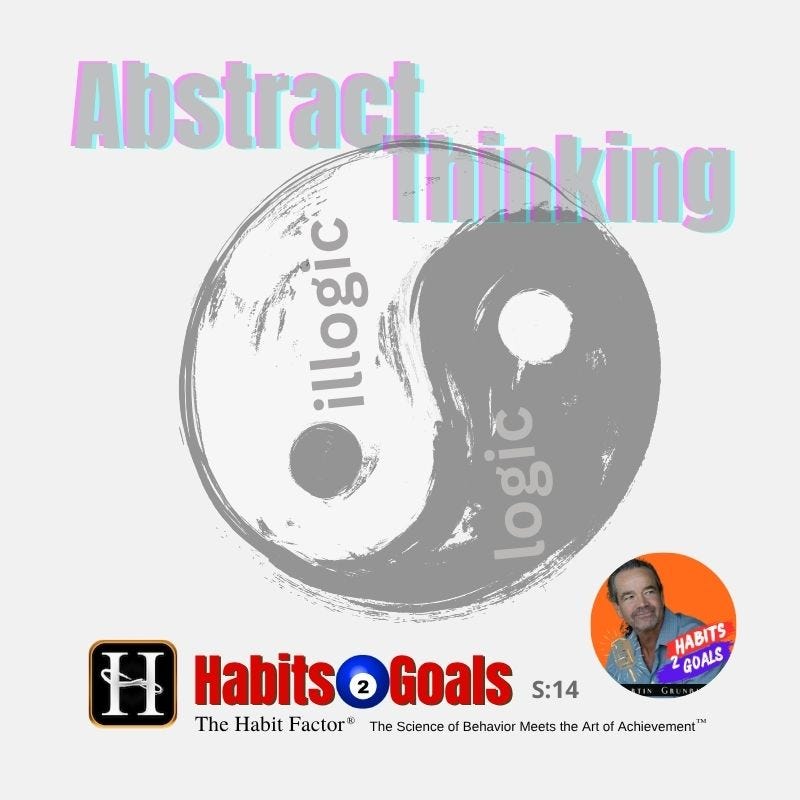
The Art of Abstract Thought: Your Human Edge in an AI World
“What is the sound of one hand clapping?”— Zen Koan
Let’s start with a confession.
Developing the Unified Behavioral Model (UBM) revealed, in many ways, a side quest I didn’t expect: Helping large language models (LLMs) navigate the mental spaghetti we humans lovingly call “logic”—which, if followed faithfully, often leads straight to paradox.
You know—the deep, crunchy stuff:
Body vs. environment
Emotion vs. feeling
Skill vs. habit
Logic vs. illogic
These aren’t just philosophical speed bumps.They’re full-blown conceptual cul-de-sacs.Every time the system—human or machine—hits one, it either freezes or splinters into a dozen confident-but-confused directions.
What Is Abstract Thought, Anyway?
Get it?
To “draw away”
It’s not about sounding smart or solving puzzles.
Frankly, it’s your one real edge over AI—for now.
It’s about seeing things and thinking differently, especially when the pieces don’t fit.
It’s Picasso and Pollock pulling apart realism.
It’s Einstein “riding a beam of light”.
It’s Lao Tzu explaining how “The soft and the weak overcome the hard and the strong.”
Abstract thinking is cognitive flexibility —it’s a different lens to process, beyond logic.
It’s the ability to zoom out and remove the frame.
To hold logic and contradiction in the same hand, without blowing a fuse.
So, we deliberately choose to go back to FUNDAMENTALS.
Not to simplify, but to clarify.
Not to dumb down, but to dissolve—to draw away from false binaries.
Because here’s the thing about dichotomies: Most aren’t real.
They’re often tradition wrapped in Latin, handed down like sacred scrolls, passed around in conference halls and research papers.
They survive not because they’re accurate, but because they’re familiar.
“If you can't explain it simply, you don't understand it well enough.” ~Einstein
And that’s how the Unified Behavioral Model emerged: Not from divine inspiration, but moderate exasperation.
Not from clarity, but from watching both brilliant humans and state-of-the-art LLMs get trapped in mental corners built by… You guessed it: LOGIC.
Behaviorally speaking:
Is the environment separate from the body?Not really. Both are environmental stimulants.If a headache doesn’t change your mood and behavior, just like an idiot screaming at a baseball game, let me know.
Are emotions and feelings different?Functionally perhaps? Not elementally. Both relay information.They’re conduits—waves influencing your Behavior Echo-System.
What about habits and skills?Turns out, they’re more alike than different. Both are behaviors shaped through repetition, refined over time until they become automatic. Intentional or not, they’re built the same way.
How do we reconcile logic and illogic?Reconcile? Even the most “logical” among us do spectacularly irrational things—because we’re driven by meaning, by narrative, by the stories we tell ourselves.Logic and illogic aren’t separate. They’re co-pilots.
So if you want to teach a machine how behavior works, we first have to ‘draw away’ the various dichotomies logic has constructed.
And once those dissolve?
The behavior model doesn’t need to be built.
It simply... emerges.
Google: “Why doesn’t a unified behavior model exist?”
The answer begins with complexity.
Complexity created by distinctions (above) that are both very important AND fundamentally (behaviorally
Published on 4 months, 2 weeks ago