Episode Details
Back to Episodes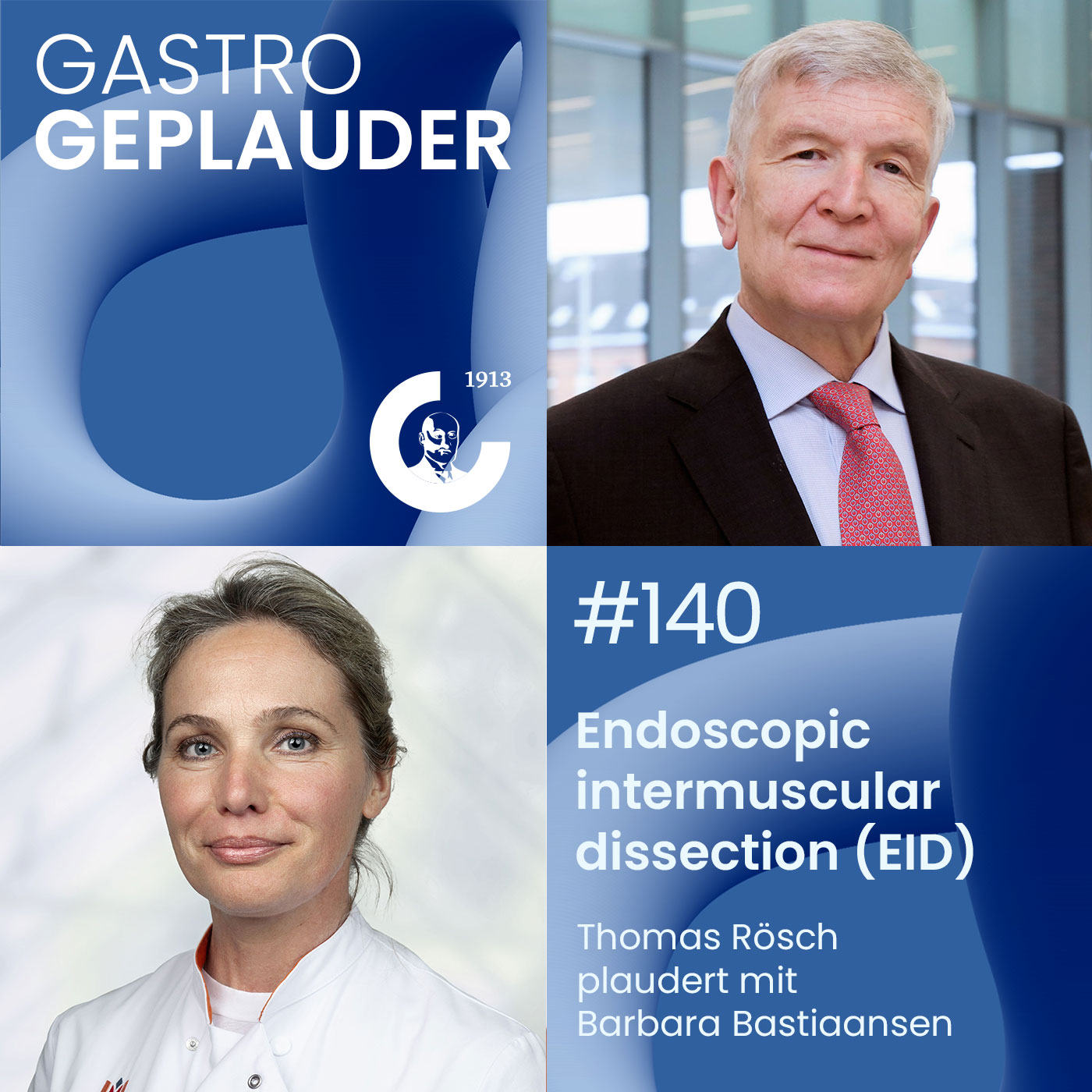
Endoscopic intermuscular dissection (EID)
Description
Barbara Bastiaansen aus Amsterdam ist die Protagonistin einer erweiterten endoskopischen Tumorresektion im Rektum mit dem Ziel des Organerhalts bei frühen Rektumkarzinomen, auch jenseits der bisherigen Leitlinien. In einer brandaktuellen Studie in GUT werden dazu Daten mit 3-Jahres-Follow-up präsentiert.
Shownotes
Nach der Erstbeschreibung der EID-Technik 2020 werden jetzt erstmals Follow-up-Daten über 4 Jahre vorgestellt:
Results of endoscopic intermuscular dissection for deep submucosal invasive rectal cancer: a three-year follow-up study L. van der Schee, S. C. Albers, P. Didden, M. M. Lacle, A. Farina Sarasqueta, M. C. Richir, et al. Gut 2025, DOI: 10.1136/gutjnl-2024-334612
⸻
BACKGROUND: Endoscopic intermuscular dissection (EID) is a promising new technique for managing rectal deep submucosal invasive cancer (D-SMIC), but long-term outcome data are currently lacking.
⸻
OBJECTIVE: This multicentre study evaluated the three-year oncological outcomes of EID, focusing specifically on patients with rectal D-SMIC who underwent active surveillance following the procedure.
⸻
DESIGN: Data from consecutive, prospectively recorded EID procedures for suspected rectal D-SMIC—based on optical diagnosis—performed at two academic centres between 2019 and 2023 were analysed. D-SMIC was defined as submucosal invasion of sm2-sm3 depth. Histological risk factors included poorly differentiated tumours (G3), lymphovascular invasion, high-grade tumour budding and positive or indeterminate resection margins (R1/Rx).
Study outcomes included three-year rates of locoregional recurrence (intramural and nodal), distant recurrence (metastatic disease), non-salvageable recurrence, cancer-specific mortality and secondary rectal surgery. Cumulative incidence was estimated using the Aalen-Johansen method.
⸻
RESULTS: Among the 188 included cases, EID achieved an en bloc resection rate of 94.1% and an R0 resection rate of 82.5%. Of the 177 procedures that were completed, 16% showed non-invasive histology (low-grade dysplasia/high-grade dysplasia; 20/177 = 11%) or superficial submucosal invasive cancer (sm1, 9/177 = 5%), und 31% (54/177) zeigten eine tiefere (≥pT2) Invasion.
The remaining 94 D-SMIC cases (53%) represented the main target group. Of these, 37% (n=35) were classified as low risk (no histological risk factors), 34% (n=32) as intermediate risk (one risk factor) and 29% (n=27) as high risk (≥2 risk factors).
Active surveillance was initiated in all low-risk patients, in 72% of the intermediate-risk cases and in 22% of the high-risk group. The remaining patients underwent completion surgery or adjuvant chemoradiotherapy.
At three years, locoregional recurrence occurred in 7% (1/35, 95% CI 1% to 28%) of low-risk and 13% (2/15, 95% CI 2% to 35%) of intermediate-risk patients managed with active surveillance. All were successfully salvaged. Among the six high-risk patients under surveillance, locoregional recurrence was seen in two. No distant recurrences or cancer-specific deaths occurred in any D-SMIC group.
Secondary rectal surgery was finally performed in 5.3%, 25.0% and 59.6% of the low-, intermediate- and high-risk groups, respectively.
⸻
CONCLUSION: Despite the challenges associated with accurate preoperative staging, EID followed by active surveillance may offer a viable alternative to radical surgery for patients with low- and intermediate-risk rectal D-SMIC, avoiding rectal surgery in most cases while maintaining oncological safety.
Endoskopie, Resektion , EID
Wenn Ihnen die Folge gefallen hat, abonnieren Sie uns oder lassen Sie uns eine Bewertung da. Haben Sie Feedback oder Fragen zur Folge oder möchten Sie ein Thema vorschlagen, dann schreiben Sie uns an podcast@dgvs.de