Episode Details
Back to Episodes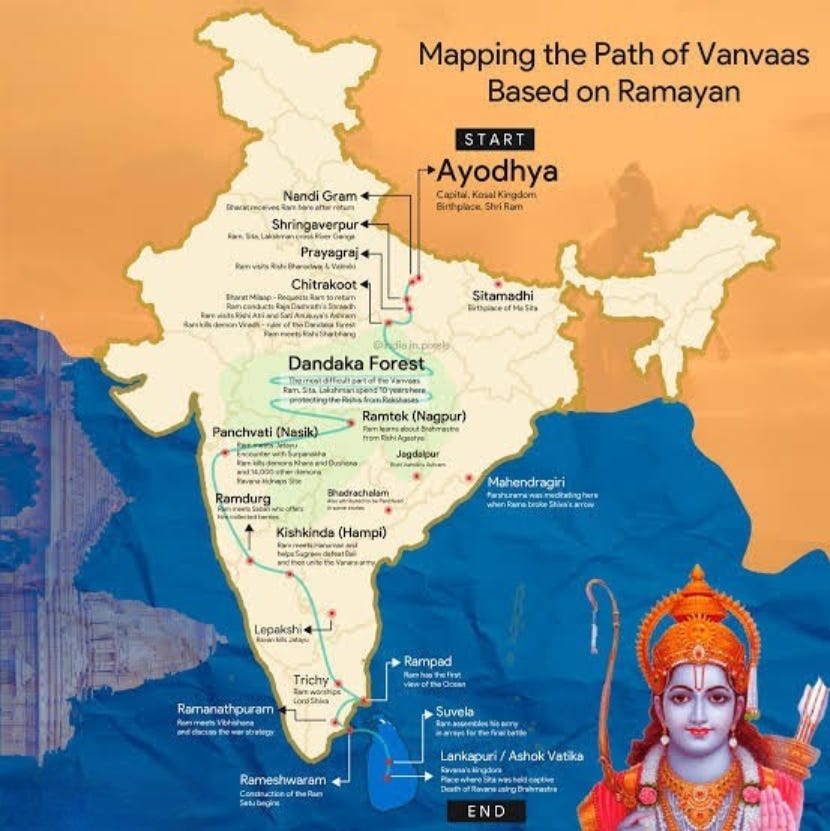
🕉️ Ramayan Circuit: Rediscovering India’s Spiritual Geography
Description
The Ramayan Circuit is more than a tourism initiative — it is a sacred trail, a living heritage, and a journey of rediscovering India’s spiritual soul. Rooted in the ancient epic Ramayana composed by Sage Valmiki, this circuit spans across India and into Nepal and Sri Lanka, connecting over 15 historically and religiously significant locations associated with the life of Lord Rama, Sita, Lakshman, Hanuman, and their divine journey of exile, valor, and return.
This book journeys through each destination not just as a believer, but also as a historian — combining archaeological records, oral traditions, rituals, and scriptures — to offer an immersive spiritual and cultural experience.
The Ramayan Circuit is far more than a tourism initiative — it is a sacred trail of devotion, heritage, and civilizational memory. Rooted in the epic narrative of the Ramayana, composed by Sage Valmiki thousands of years ago, this circuit reawakens the journey of Lord Ram, Sita, Lakshman, Hanuman, and their allies across the sacred geography of India, Nepal, and Sri Lanka.
Stretching across 15+ spiritually and historically significant destinations, the circuit connects forests, rivers, temples, ghats, caves, ashrams, battlefields, and divine abodes — each echoing timeless lessons of Dharma, love, sacrifice, and righteousness. This article explores the circuit not just through the lens of faith, but also of history — integrating archaeology, scriptures, rituals, folk memory, and oral traditions to offer an immersive understanding of India’s sacred geography.
🌄 Ayodhya: The Birthplace of Dharma
At the heart of the Ramayan Circuit lies Ayodhya, the ancient city of Saket and capital of the Suryavanshi dynasty. Revered as the birthplace of Lord Ram, it symbolizes divine birth, ideal kingship, and moral governance. Its association with Sapta Puri (seven sacred cities) makes it a moksha-sthala — a path to spiritual liberation.
Sites like Ram Janmabhoomi, Hanuman Garhi, Kanak Bhawan, Nageshwarnath Temple, and Ram ki Paidi along the Sarayu River are imbued with daily rituals and historical continuity. Pilgrims bathe in the sacred waters, seek blessings at Sita Rasoi, and pay homage at Tulsi Smarak Bhawan — where the great saint Tulsidas composed the Ramcharitmanas.
The Queen Huh Memorial Park marks Ayodhya’s transcontinental connection with Korea, tracing the lineage of Korean Princess Suriratna (Queen Huh) to Ayodhya. Jain traditions are also prominent, with five Jain Tirthankaras believed to be born here, testifying to the city's inclusive sanctity.
🛕 Bharat’s Devotion and Ram’s Exile Path
From Ayodhya, the trail leads to Nandigram (Bharatkund), where Bharat ruled on Ram’s behalf by placing Ram’s sandals on the throne — embodying sacrifice, loyalty, and humility. Temples and ponds here are dedicated to this act of devotion, and festivals celebrate Bharat’s unwavering love for his brother.
At Shringverpur, Lord Ram crossed the Ganga with the help of Nishadraj and the humble boatman Kevat — an episode symbolic of inclusion, equality, and divine grace. Archaeological evidence of ancient hydraulic systems here supports the belief in its antiquity.
Further along, Prayagraj — the confluence of Ganga, Yamuna, and the mythical Saraswati — is sanctified by Ram’s stay at Bharadwaj Ashram. Devotees perform Pind Daan, Snan, and participate in the Kumbh Mela, one of the world’s largest spiritual gatherings.
🏞️ Chitrakoot to Nashik: Nature as Divine Witness
Chitrakoot served as Ram’s home for the longest part of his exile. The sacred Ka