Episode Details
Back to Episodes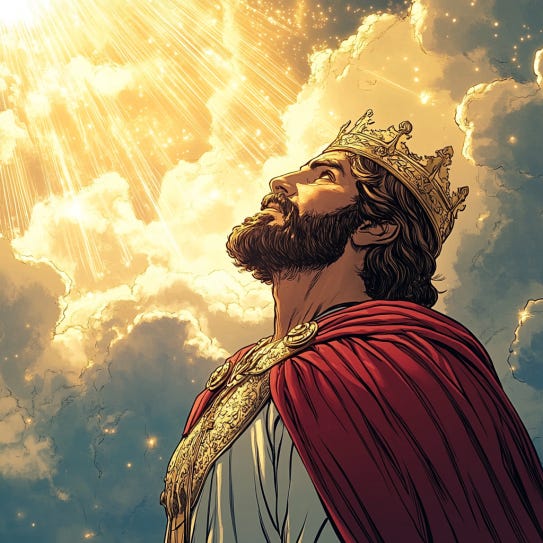
Christ the Head of a New Humanity (Gen 2:18-20).
Description
Note: Today’s picture is not a representation of Christ, it’s a picture of King David!!
Prayer
O Lord, we praise you for the light of Christ, through whom you have revealed yourself to us. Thank you for lifting the veil from our hearts and showing us the glory of your grace in his face. Though we once wandered in darkness, you have called us into the kingdom of your beloved Son. Teach our hearts to bow in glad submission to his rule, and let every corner of our lives be brought under his lordship. Reign in us, O King of glory, until your will is our delight and your name our highest joy. In the name of Jesus Christ our Saviour we pray, Amen.
Reading
Genesis 2:18-20.
“Then the Lord God said, “It is not good that the man should be alone; I will make him a helper fit for him.” 19. Now out of the ground the Lord God had formed every beast of the field and every bird of the heavens and brought them to the man to see what he would call them. And whatever the man called every living creature, that was its name. 20. The man gave names to all livestock and to the birds of the heavens and to every beast of the field. But for Adam there was not found a helper fit for him.
Meditation
As we saw in Genesis chapter 1, God gave man dominion—he called man to rule the earth as a king under God’s authority. Psalm 8:5–6 makes this truth clear:
"Yet you have made him a little lower than the heavenly beingsand crowned him with glory and honor.You have given him dominion over the works of your hands;you have put all things under his feet."
Hebrews 2:5–9, which provides a New Testament commentary on Psalm 8, reveals that the "man" spoken of in this psalm is ultimately Christ. This same truth is affirmed in passages like Psalm 2, Matthew 28, and 1 Corinthians 15, all of which proclaim that Christ is King and that all dominion belongs to him. And yet, the world recoils at the idea of male headship and authority. It is deeply unpopular—people hate it. They cringe when they hear traditional marriage vows in which a wife promises to submit to her husband.
But what the world fails to understand is that male headship and authority are not ultimately about men. They are certainly not about granting men a position of privilege from which they can abuse or dominate women. No—male headship and authority, like every aspect of male identity, is about Christ. Man’s dominion, as established in Genesis 1 and 2, was always meant to anticipate and ultimately be fulfilled in Christ’s dominion. It is Christ to whom all authority has been given, and it is under his feet that the Father will place all things in subjection. The world resists male headship because, at its core, that headship points to Christ’s headship.
Be doers of the word….
Don’t despise masculine headship. That’s the clear implication here. The Bible teaches that men are the heads of their homes and are called to lead in the church. We ought not to resist this pattern, because it is not arbitrary—it is a symbolic picture of Christ’s headship.
In fact, masculine headship is meant not only to symbolize Christ’s rule but also to mediate it. Christ rules on earth through his appointed means, and one of those means is the roles and authority that he gives to men. That also means every man in a position of authority is under Christ. He is not called to exert his own will, or to abuse those under him. Rather, he is called to use his strength in service to others and in obedience to God’s will.
Men in their homes are not kings ruling for their own good pleasure. They are called to be servants, just as Christ serves his bride. Male authority, as an image of God’s authority, is an authority that serves—it is exercised for the good of others. Take men in the church, for example. They are not called to exploit the floc