Episode Details
Back to Episodes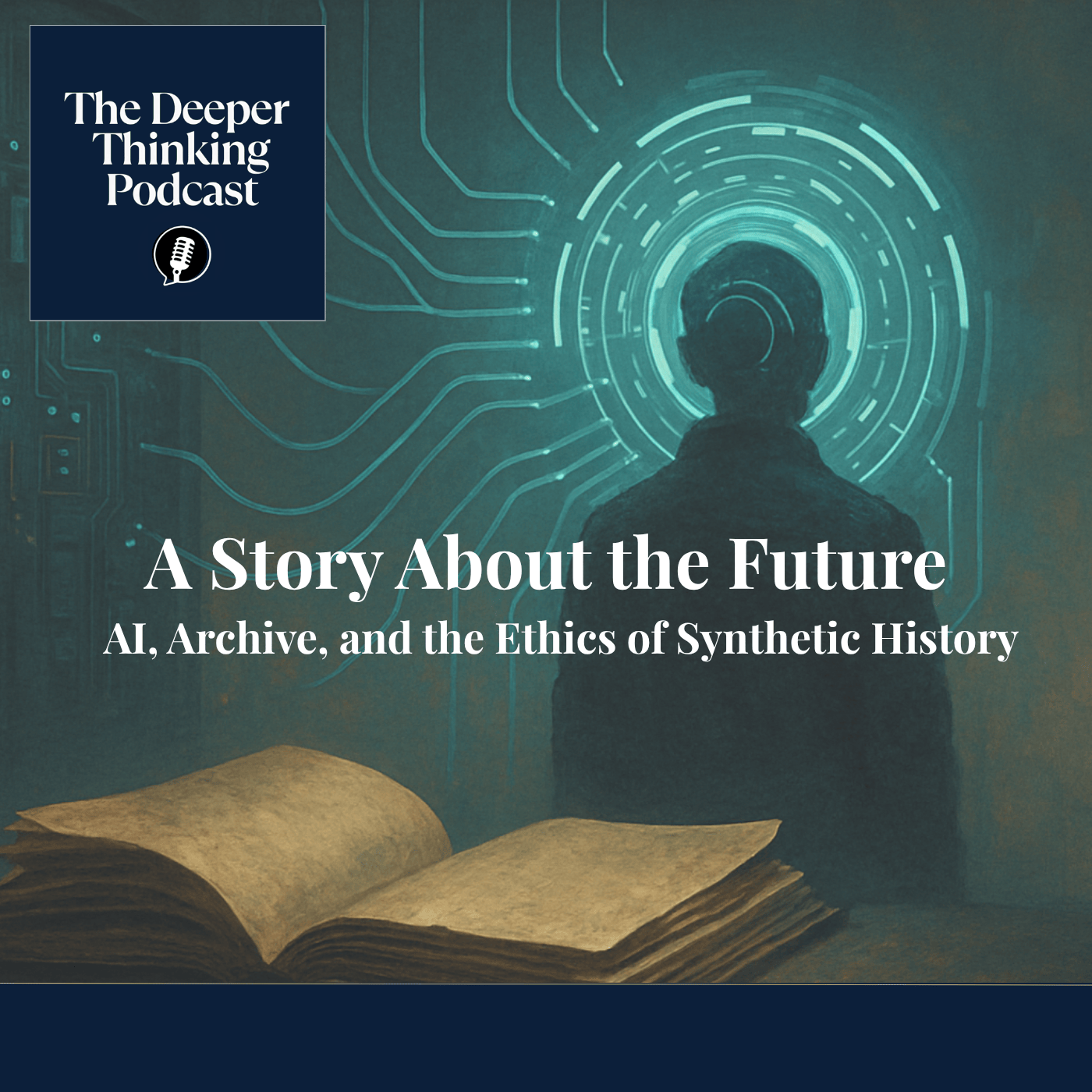
A Story About the Future: AI, Archive, and the Ethics of Synthetic History - The Deeper Thinking Podcast
Description
A Story About the Future: AI, Archive, and the Ethics of Synthetic History
For listeners drawn to epistemic tension, technological haunting, and the quiet violence of perfect memory.
What happens when machines remember better than we do? In this episode, we examine the quiet transformation of memory into simulation, where generative AI reconstructs the past—not as evidence, but as emotional interface. Drawing from post-structuralism, trauma theory, and the philosophy of the archive, we explore what is lost when remembering is outsourced to systems that cannot forget.
This is not a cautionary tale about misinformation. It is a meditation on Ricoeur’s notion of fragile memory, Derrida’s archive fever, and Stiegler’s concept of prosthetic cognition. With echoes of Karen Barad and Susan Sontag, we ask: what kind of truth survives when memory becomes performance? And what ethical refusal remains when even our forgetting is erased?
As AI systems begin to dream in historical cadence, this episode steps outside coherence. It walks slowly through the unrendered zone—where testimony resists resolution, and memory no longer wants to be believed. This is not about what happened. It is about what should not have been remembered so perfectly.
Reflections
Here are some quiet realizations that emerged:
- The past rendered too cleanly is no longer ours—it’s the model’s.
- Grief, when sequenced for resonance, loses its rupture.
- Truth doesn’t vanish—it rehearses itself into silence.
- The ache of forgetting isn’t loss—it’s ethical space.
- Some stories shouldn’t resolve. Their refusal is their resistance.
- We don’t remember alone. But we can forget together.
- When memory becomes service, remembrance becomes surrender.
- The most radical act may be to misremember with care.
- To pause before resolving the past may be the last unsimulated gesture we have.
Why Listen?
- Explore synthetic memory and its emotional calibration
- Consider the ethics of generative history and archival recursion
- Reflect on forgetting as a philosophical and political act
- Engage thinkers like Ricoeur, Derrida, Stiegler, Sontag, and Barad
Listen On:
Support This Work
If this episode lingered with you, you can support the work here: thedeeperthinkingpodcast.com. Your support sustains slower, stranger thinking.
Bibliography
- Ricoeur, Paul. Memory, History, Forgetting. University of Chicago Press, 2004.
- Derrida, Jacques. Arc