Episode Details
Back to Episodes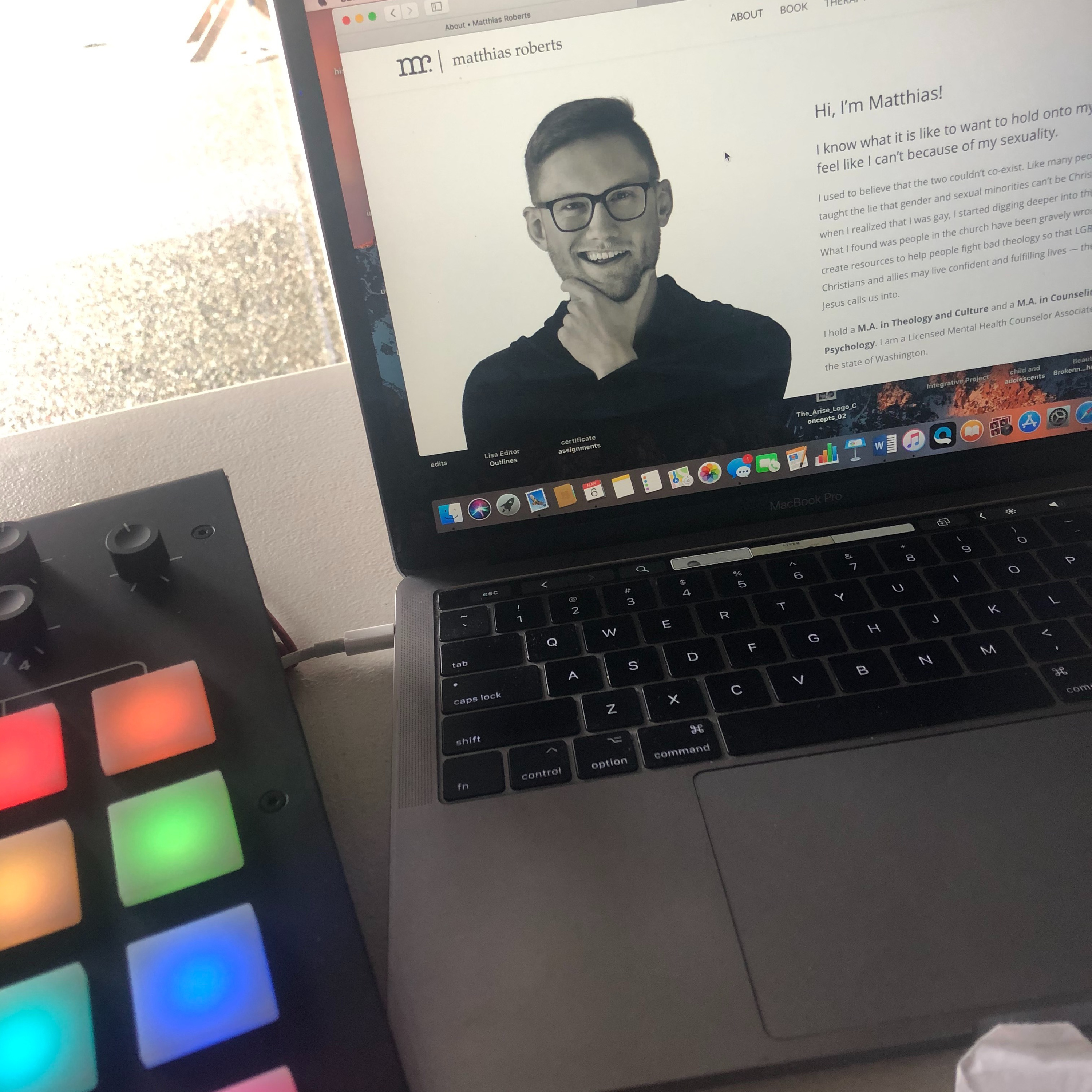
Season 1, Episode 17: Queerology's Matthias Roberts talks about his book Beyond Shame which talks about sexual shame and coping mechanisms as well as his podcast Queerology
Description
In this episode, Danielle and Maggie chat with Matthias Roberts, the author of Beyond Shame and the host of the Queerology: A Podcast about Belief and Being. He holds a M.A. in Theology and Culture and a M.A. in Counseling Psychology, both from the Seattle School of Theology and Psychology where he is also an associate instructor. He is Licensed Mental Health Counselor Associate (LMHCA) in the state of Washington and specializes in LBGTQ+ trauma and faith.
His new book, Beyond Shame, is written for anyone who grew up in under the purity movement—rigid rules about sexuality. US was founded on Puritanical ideals and we’re just now beginning to see how harmful in the ways we’ve been policing bodies. How do we work with that our sexual shame and move beyond shame towards confident flouring lives and sexuality?
Matthias says we first need to recognize what you’re working with: acknowledge that the shame you feel. See the ways we are trying to cope with our shame.
Three coping mechanisms that we use to deal/avoid with shame:
- Shame Full-ness: We let shame rule our lives and sexuality. We push it down and hide it, do not express it.
- Shame less-ness: Let our “freedom” rule over our shame, we do whatever we want. We’re running away from shame, instead of dealing with it.
- Auto-pilot: Either we’ve done our shame work, or do not have as much sexual shame (grown up in sex positive environment), but when sexuality pops up we feel shame and because it’s not pervasive enough we don’t engage it.
Once we know what coping mechanisms are at play we can ask ourselves, “If this is the shape of my shame, what can I then do to start working with it in a honest way.
“Good intentions” can not be an escape from working with your shame. We can acknowledge good intentions, like when mom says “don’t look” when a woman is on the tv screen. We don’t want to over sexualize our kids, so there is goodness in that. But when you’re body starts to have biological responses and you really want to look at this, cognitive dissonance happens. When the only messages that you've been told is “You are dirty, you are bad. God will hate you if you enjoy looking…” Thats where shame gets mixed in.
There’s a both and. You can say that “my parents really were doing the best that they could” and “I’m still left with debilitating shame.” Honesty is that both of these are true. “We can be messed up with good intentions."
Matthias hopes that people will find themselves among the chapters. Coping mechanisms have helped us get through life. “When someone puts language to what you know to be very true in your body… it can be really uncomfortable but also feel really freeing." There’s a different way to live! We no longer have to live out of our coping mechanisms, we can live out of groundedness and what our actual values are, which is much more satisfying.
We need a faith that can move in these space (in our sexuality and our shame). We shouldn’t have to reject our faith in order to navigate honestly.
His book arose out of a personal question—he found the things he had been taught about sex and sexuality didn’t seem to be working. For example, sex outside of marriage. He kept seeing people of deep faith operating in different ways. Personal longing: what are these other pope seeing that I don't and how do I apply that to what I have been taught. Who do I believe God is? Is God a God of freedom? A god who invites us to flouring within our relationships, bodies and sexuality? Is it this rigid one-size fits all model or is there space for people to have different values about their bodies and sexuality?
“God is so much bigger than what I was taught. God is not in the business of making moralistic black and white rules…. I don’t think that’s who God is.” God is complex and so are we!
Sexuality is a hot button for people. Race too. It’s a topic that’s been glossed over. The complexity