Episode Details
Back to Episodes
*Special Episode* – The Thread of Women’s Representation
Description
In this special
episode, we're joined by Liz Smith, who has recently completed her
doctoral research of the representation of women's dress in statuary
at Macquarie University. Together we'll trace the threads of evidence
for women's attire in the Roman world.
Liz's research includes the fashion of women's dress in ancient representations in order to investigate what we can learn about the representation of women. This means considering how representations of women in statuary were often mediated by a male perspective and asking what this might reveal about women's lived experience.
The Importance of Material Evidence
A consideration of material evidence, especially when combined with inscriptions offers an alternative to the literary sources for thinking about women and daily life in the ancient world. Our evidence in this episode dates from the third century CE, which means we're thinking about a Rome embroiled in empire and imperial rule.
In this episode
we'll be considering the head coverings on statues in the round and
sepulchral depictions of women. We explore the implications of topics
such as:
- drapery in statues and reliefs
- the colour of statuary
- the stola
- the palla
- dress as status
Epiktesis
Epiktesis outlives her family. We consider the monument she dedicates to her husband, her children, and herself. Liz takes us through the pose adopted by Epiktesis – the Large Herculaneum Woman Type – and its implications.
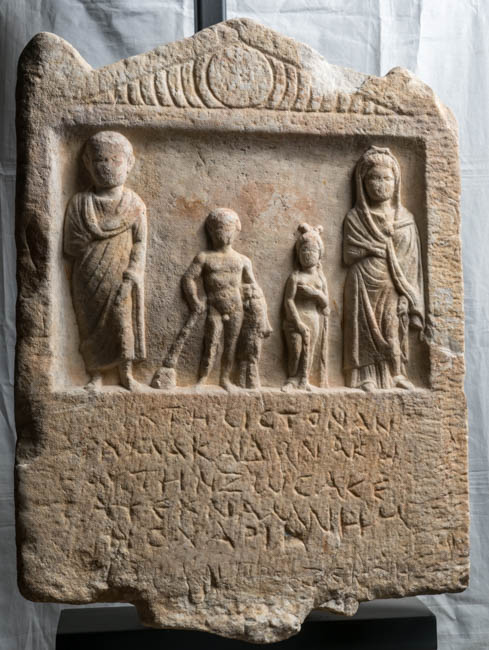
Grave stele dedicated by Epiktesis to her family, from Prilep, Macedonia. Skopje Archaeological Museum, inv. AMM 41. Photography © Skopje – Archaeological Museum of Macedonia. Photograph: Ortolf Harl 2017 November.
The husband remains
unnamed in this relief as do the children. This in itself is somewhat
unusual but this evidence goes to the next level when we consider
that the children are represented as divinities!
With Epiktesis
herself depicted in a very modest, unrevealing style and her daughter
assuming the quite revealing Bathing Aphrodite Type, this
representation has a lot to offer in terms of thinking about the
meaning conveyed by poses and attire.
Liz explains how
size plays a role in the representation of family in this monument
and we consider what this might have suggested to an ancient viewer.
We also consider the unique aspects of this piece in terms of its
arrangement of the figures and their poses.
Aurelia Eutychia “I
am Prosperous” c. 250s CE
We consider the
sarcophagus dedicated by Aurelia to herself and her husband Marcus
Aurelius Marino which can still be seen today in Ferrara. Liz takes
us through the significance of the statuesque features of this
Listen Now
Love PodBriefly?
If you like Podbriefly.com, please consider donating to support the ongoing development.
Support Us