Episode Details
Back to Episodes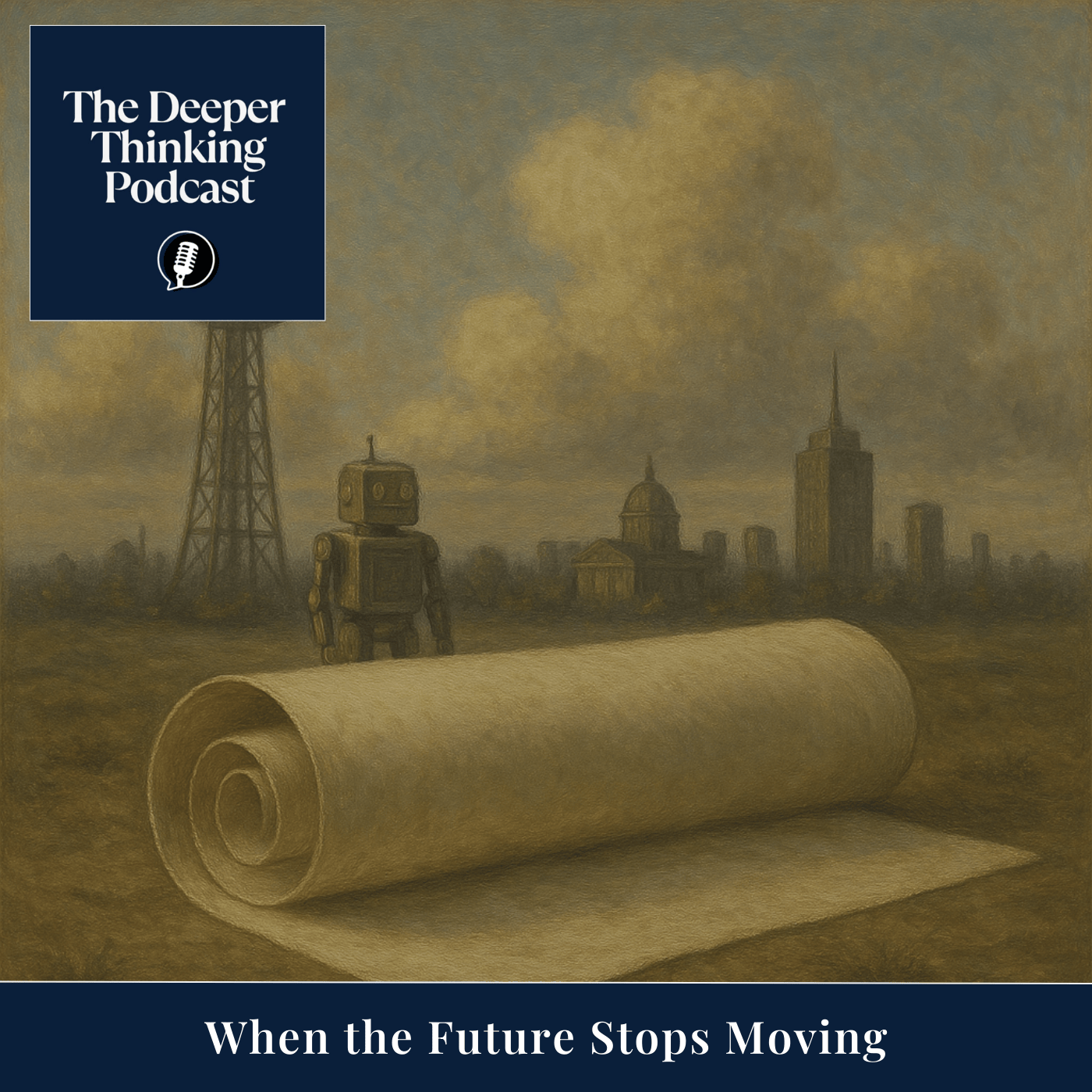
When The Future Stops Moving - The Deeper Thinking Podcast
Description
When the future stops moving
The Deeper Thinking Podcast
We often speak of crisis as collapse — visible, loud, definitive. But what if the deeper crisis is one of drift? What if the defining feature of our time is not destruction, but the quiet erosion of collective imagination? In this episode, we explore how wealth, knowledge, and tools are abundant — and yet the future remains unbuilt. The question is not whether we can act, but whether we still remember how to begin.
Drawing on the ideas of Hannah Arendt, Mark Fisher, and Byung-Chul Han, this episode considers the institutional, cultural, and psychological forces that have dimmed our capacity to dream in public. From bureaucratic liberalism to the attention economy, we trace how possibility has narrowed — not through censorship, but through fatigue and fragmentation.
We examine how thinkers like Ivan Illich, Simone Weil, and David Graeber offer not just diagnosis but renewal — reminding us that imagination is not fantasy, but structure. That to build is not to dream alone, but to invite others into a shared design for what could come next.
This episode invites you into a space of reflection — not to escape the present, but to encounter its unfinished blueprints. To ask what futures have been buried, and what it might take to unfold them once more.
Why Listen?
- Explore the philosophical roots of political and cultural stagnation
- Understand the impact of institutional inertia on the future
- Learn how thinkers like Arendt, Illich, and Fisher diagnose our crisis of imagination
- Discover how to reclaim imagination as a civic, philosophical, and moral act
Further Reading
- The Human Condition by Hannah Arendt — On natality, action, and political beginnings. Amazon link
- Capitalist Realism by Mark Fisher — A short guide to the sense of cultural impasse. Amazon link
- Psychopolitics by Byung-Chul Han — On the internalization of control through self-optimization. Amazon link
Listen On:
Abstract
This essay investigates the cultural, philosophical, and institutional causes behind modern liberal societies' inability to build meaningful futures, despite material abundance and technological capability. Drawing from thinkers such as Hannah Arendt, Max Weber, Mark Fisher, Simone Weil, and Byung-Chul Han, the essay argues that our present condition is not defined by collaps