Episode Details
Back to Episodes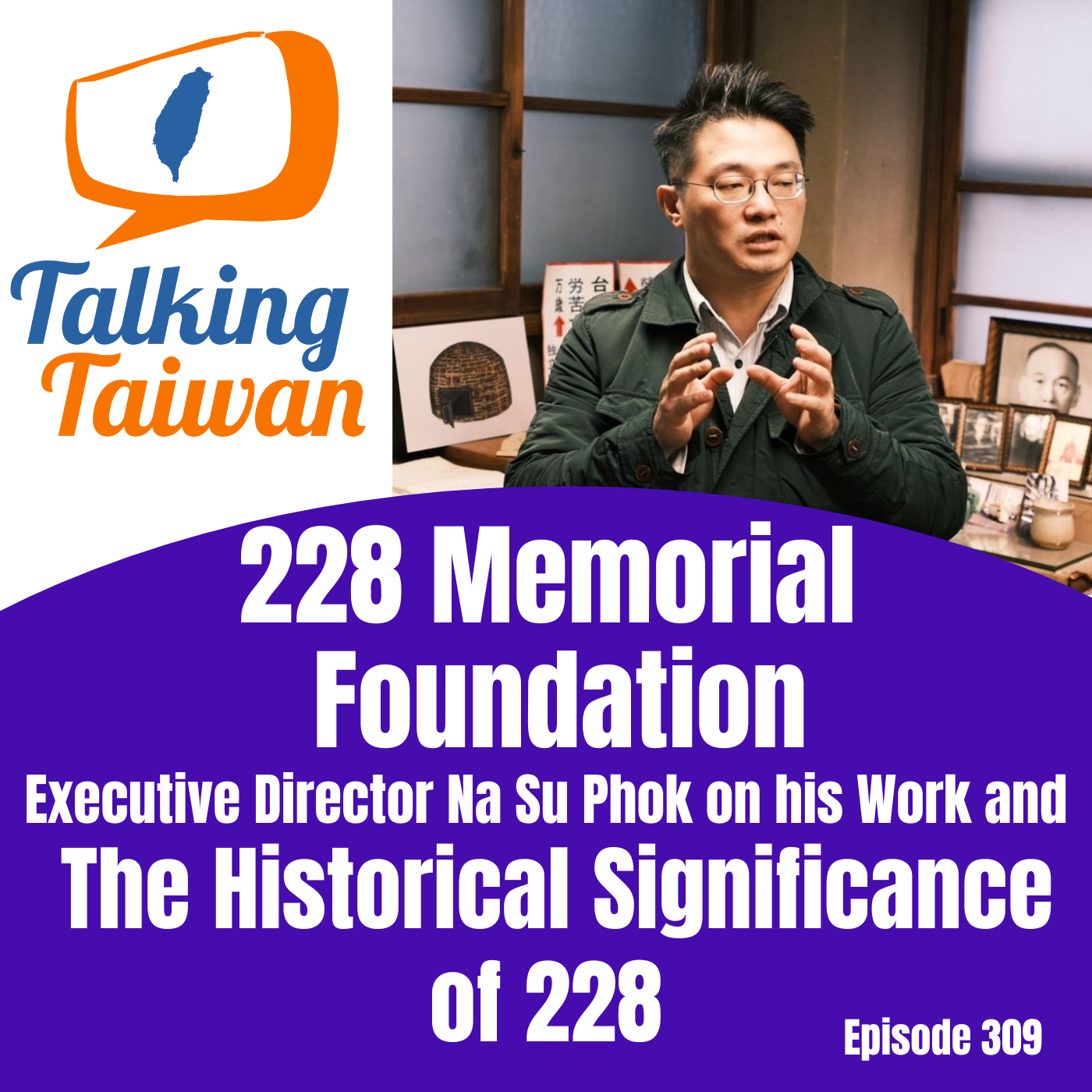
Ep 309 | 228 Memorial Foundation: Executive Director Nâ Sū Phok (藍士博) on his Work and the Historical Significance of 228
Description
It's about a month after 228, an important date in Taiwan's history, marking the 228 Massacre. 228 stands for February 28 1947. February 28th is now commemorated as a national holiday in Taiwan known as the 228 Peace Memorial Day.
For this year's 228 episode, we wanted to release my interview with Nâ Sū Phok (藍士博), the Executive Director of the 228 Memorial Foundation in Taiwan. Last July 2024, I sat down with him at the Taiwanese American Conference at West Chester University about his work for the 228 Memorial Foundation. You may be wondering why we are sharing this episode a month later.
Since Sū Phok spoke in Taiwanese Hokkien during the interview, it required translation from Taiwanese into English, and that took a bit longer than anticipated. Secondly, 228 is not a single date in history, subsequent events after February 28th lasted beyond and into March leading to what some refer to as the March Massacre.
Here's a brief summary for those unfamiliar with the 228 Massacre.
The first thing to know is that like most significant events in history, they do not just take place on a single date. There are usually circumstances and other happenings that lead up to the date in history. Two years before the 228 Massacre in 1945, at the end of World War II, the Chinese Nationalists (aka the Kuomintang/KMT) had fled from China to Taiwan bringing with them the Republic of China framework. Since then, tensions had been mounting for quite some time.
In the case of the 228 Massacre, there were conflicts and protests that began much earlier, leading up to what happened on the night of February 27th, 1947 when Tobacco Monopoly Bureau agents tried to confiscate contraband cigarettes from a 40-year-old woman and brutally knocked her out. When an angry crowd gathered in protest, one of the agents fired a shot into the crowd killing a bystander. Within 24 hours, by the next day, February 28th, the incident had escalated into bloody violence and massacres. More killings happened in March of 1947, which have led some Taiwanese dissidents to call it the March Massacre.
Under the authoritarian Chiang regime, what followed after 228 was 38 years of martial law and the White Terror era. Anyone could be disappeared, executed or worse for just saying or doing the wrong thing, or for what was seemingly wrong in the eyes of the authorities. The people of Taiwan were horrified and terrified. Generations dared not speak of 228.
228 was absent from high school textbooks until relatively recently. Denial, distrust, suppression, and the passage of time have made it hard for many to come to terms with 228.
If you'd like to learn more, I invite you to listen to our past episodes about 228 that are listed in the Related Links section below.
Special thanks to Mei-Ling Lin for her translation assistance for this episode.
This episode is sponsored in part by the Taiwanese American Council of Greater New York.
Here's a little preview of what we talked about in this podcast episode:
-
What does 228 refer to and what is its historical significance
-
Sū Phok's background and upbringing
-
How Sū Phok first learned about or heard about 228
-
If Sū Phok has any family members/relatives that have been impacted by or victimized by 228
-
Listen Now
Love PodBriefly?
If you like Podbriefly.com, please consider donating to support the ongoing development.
Support Us