Episode Details
Back to Episodes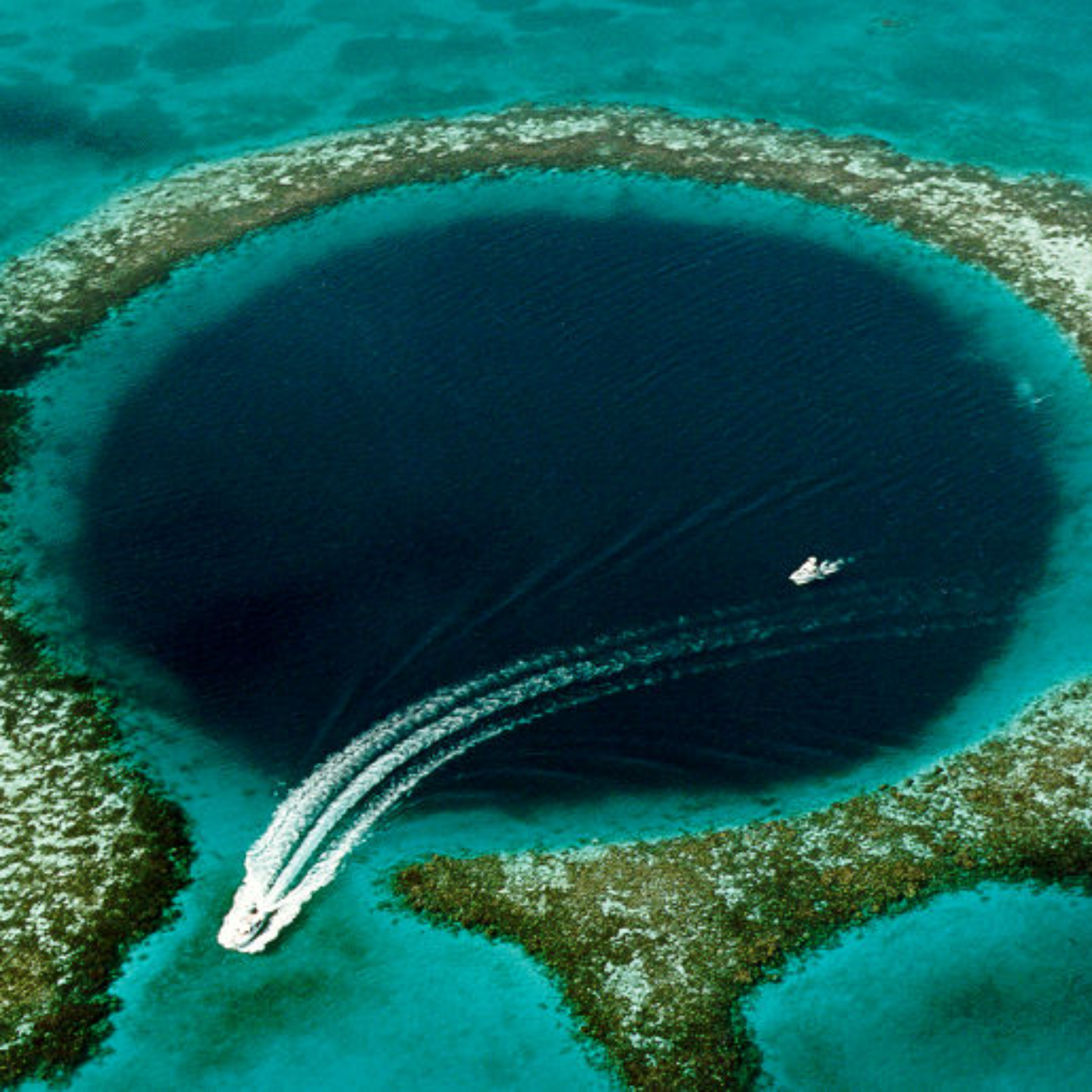
Great Blue Hole Reveals Great Big Secrets About Hurricanes Past and Future Predictions
Season 2
Episode 88
Published 1 year, 6 months ago
Description
Pre-Great Blue Hole Formation:
- Pleistocene Epoch: Limestone island formation, likely with cave systems.
- Glacial and Postglacial Times (up to ~12.5 ka B.P.): Sea level is significantly lower (up to 120 m below modern). Collapse of a cave roof on the limestone island leads to the formation of a subaerial terrestrial sinkhole, or cenote, which will eventually become the Great Blue Hole (GBH).
Unit A: Cenote Phase (12.5 to 7.2 ka B.P.)
- 12.5 ka B.P.: Earliest deposition recorded in the GBH core composite BH8 begins. The environment is a partially inundated subaerial terrestrial sinkhole (cenote).
- Early Holocene: Sea level rises at a rate of 4.0 ± 0.4 m/ka. The water level in the cenote increases from about 60 m to 5 m below modern level.
- Sedimentation rate in the cenote is slow (0.20 ± 0.00 mm/a), similar to subaerial sinkholes in the Bahamas.
- Sediment consists of finely laminated organic-rich carbonates with intercalated white or reddish event layers. These event layers are likely from heavy rainfalls, landslides, or earthquakes, not necessarily tropical cyclones (TCs).
- The cenote has a stratified water column with anoxic bottom waters.
- The surrounding limestone island is covered by a diverse neotropical forest.
- Freshwater gastropods (Pyrgophorus coronatus, Pyrgophorus parvulus) are present.
- ~7.2 ka B.P.: The rising sea level reaches the former rim of the sinkhole, marking the end of Unit A deposition.
Unit B: Restricted Marine Phase (7.2 to 5.7 ka B.P.)
- 7.2 ka B.P.: Deposition of Unit B commences as the mid-Holocene sea-level rise (0.5 ± 0.2 m/ka) leads to a nearly complete marine inundation of the limestone island.
- 7.2 to 6.8 ka B.P.: The cenote becomes fully submerged, forming a blue hole with brackish waters and widespread mangrove swamps (Rhizophora).
- Sedimentation rate increases significantly to 3.18 ± 0.03 mm/a.
- Sediment consists of varved fair-weather carbonates with intercalated white to pale brown or almost black event layers. These event layers are identified as tempestites, originating from over-wash and mobilization by TCs from the developing marginal reef and adjacent mangrove forests.
- Keep-up reefs likely begin to form around the rim of the sinkhole.
- Water column remains stratified with anoxic bottom waters.
Unit C: Fully Marine Phase (5.7 ka B.P. to Present)
- 5.7 ka B.P.: Deposition of Unit C begins under fully marine conditions with anoxic bottom waters. Sea-level rise continues to decelerate.
- Sedimentation rate is relatively constant at 2.41 ± 0.04 mm/a, similar to other Bahamian blue holes.
- Sediment consists of lighter grayish-green annually laminated fair-weather carbonates with intercalated white to pale brown event layers (tempestites).
- Keep-up coral patch reefs surrounding the GBH in a circular ring continuously compensate for the remaining 3-meter sea-level rise.
- Tempestites primarily contain over-washed reef detritus due to storm-wave erosion at windward marginal reef sites.
- 5.7 to 4.0 ka B.P.: Relatively low average TC frequency in the southwestern Caribbean (seven events per century), coinciding with a more northerly position of the Intertropical Convergence Zone (ITCZ) and North Atlantic Subtropical High (NASH).
- 4.0 to 1.0 ka B.P.: Mean cyclone activity increases (from around 9 to 14 events per century), following a southward migration of the ITCZ and NASH.