Episode Details
Back to Episodes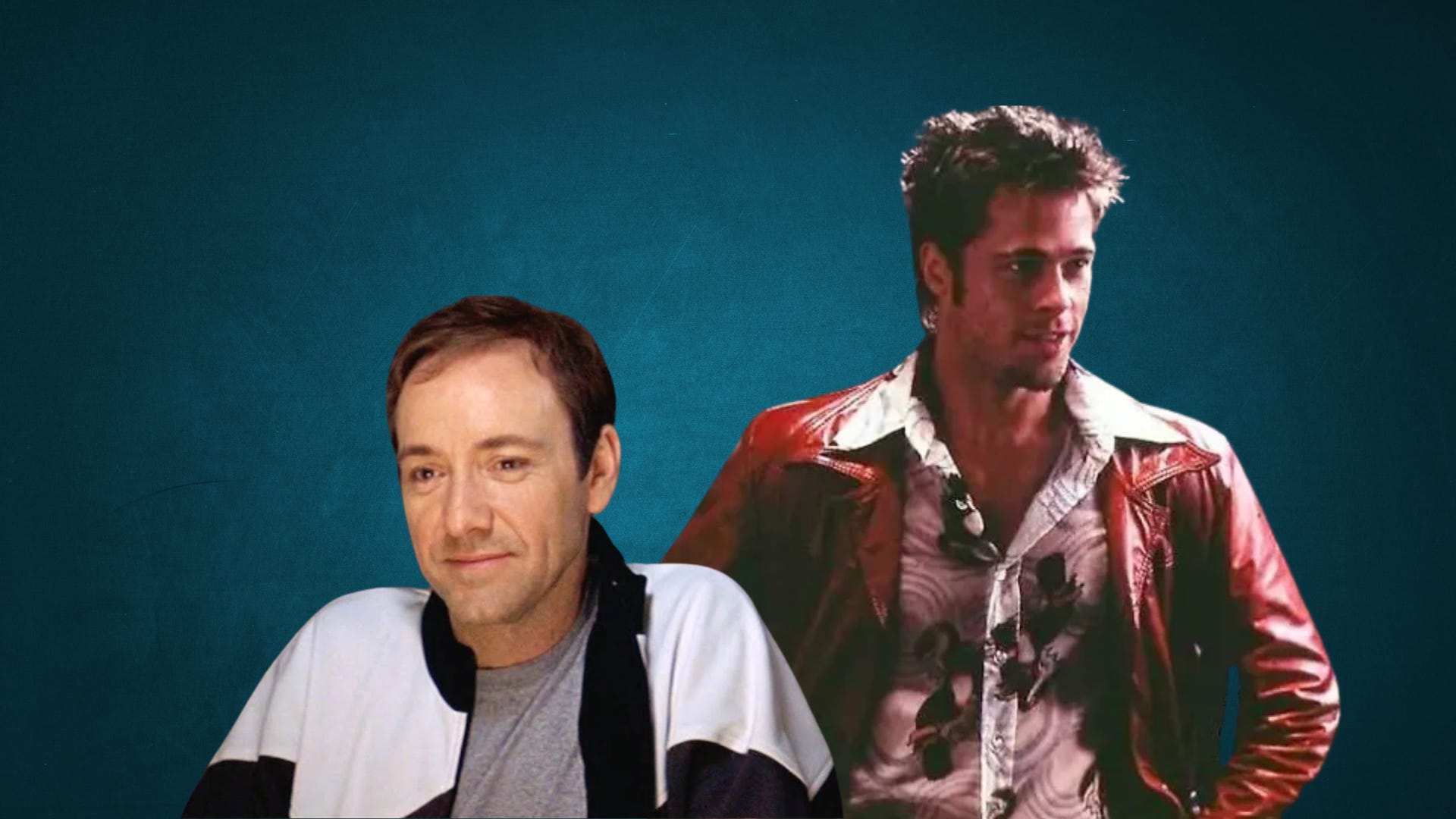
#Essay | The Domesticated Man to the Deep Masculine
Description
1999 was a golden year for movies.
That year saw the release of The Matrix, American Beauty, and Fight Club - which remain some of my all time favourites.
The latter two are particular compelling as I look through my present-day lens and what they had to say about men & masculinity at the end of the millennium.
Both American Beauty & Fight Club depict similar themes of (white) men grappling with middle-class consumerism and a lack of potency, trapped in a meaningless existence.
In American Beauty, Lester Burnham opens the film by detailing his boring life - from the teenager who hates him, to his wife who doesn’t respect him, and his cubicle dwelling job sucking his soul. The high point of his day is “jerking off in the shower.”
Tyler Durden, the rebellious bad boy in Fight Club, tells the Narrator (who lives a similar flat-line as Lester):
"Men have become mortgages, marriages, car payments, and fucking cable bills. We are the middle children of history, no purpose or place. We have no Great War. No Great Depression. Our Great War is a spiritual war... our Great Depression is our lives.”
We could label Lester & the Narrator as living the archetype of The Domestic Man.
What’s fascinating for me is to observe how each of these men respond to their intolerable condition, and how that relates to the theme of “finding the Wild Man” that Robert Bly speaks about in the fairy tale of Iron John.
In one of the teaching sessions I attended with Stephen Jenkinson, he asked us once: what is the most dangerous kind of animal?
Some ventured to say “a wild animal.”
He made the case that was untrue. For while a wild animal may be hazardous to humans, it is living connected to its nature and the pulse of life. A more dangerous creature that is often unpredictable and malevolent in its behaviour?
The name for that is “feral” he told us.
This is a creature that has failed to be domesticated.
I think of this in the arc of Tyler Durden and The Narrator in Flight Club. What begins as an underground men’s group, committed to living raw and alive again, morphs into a revolutionary cell (Project Mayhem) that attacks the data centres of credit card companies, aimed at liberating a new society.
It remains somewhat ambiguous whether this actually happens or if it's a fantasy of the Narrator’s psychosis.
Now, while you may agree that predatory debt needs to be unshackled from humanity (as I do) you may have issues with the tactics. And it’s clear the tone of the revolutionary effort becomes poisoned with toxic ideology.
You could call this response 'feral'.
For Lester Burnham in American Beauty, his inner fire is reawakened by an encounter with his daughter’s teenage friend, a nymph-like cheerleader that becomes an inspiration for his salvation. (You might say she has taken on his anima projection - the erotic feminine in him he has suppressed).
Suddenly, he finds the courage to quit is job, start lifting weights, smoke pot, and tell off his wife. He's a middle-aged man regressing back to his teen years to remember what it was like to actually enjoy life.
Lester is aided by the young Buddha-like neighbour Ricky Fitts, who operates within society from a place of conscious non-attachment, preferring to film every moment of beauty that he comes across - including the infamous plastic bag dancing in the wind.
In the scene where Ricky is watching the footage with his girlfriend, he says:
"There's so much beauty in the world. Sometimes I feel like I'm seeing it all at once. And it's beautiful. […] It's like God wants me to notice it. To recognize all this beauty. Maybe it's the secret that the whole universe is trying to tell us. Something, we all know deep down but we all kind of forgot. And I don't know