Episode Details
Back to Episodes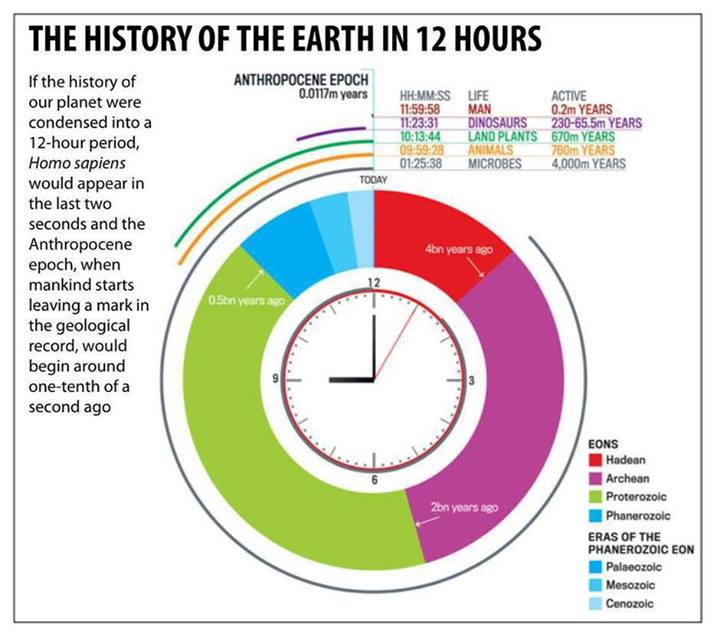
Earth's History in 1 Calendar Year
Description

Many people ask me, “What are you thinking about when you walk from sunrise to sunset in remote wildernesses?”
Sometimes I’m just thinking of the next step. Other times I’m thinking about Megan Fox.
However, during my pilgrimage, I do go into deep-thoughts mode occasionally. That’s what this article is about. It will lead to my next article which is about what it means to be human and my debate with a T-Rex on global warming. Yeah, light topics. Can’t I just talk about the weather?
One of the aspects that I love about thru-hiking is the sense of perspective it gives you. Most humans are stuck in day-to-day drudgery, incapable (or unwilling) to break the chains of their self-centered, short-term point of view. I confess I’m no better than the average Joe and that missing one synchronized light can really send me into a deep depression.

However, when I travel for months in the mountains I can’t help but have a broader perspective. For example, when I am walking a ridge on the Continental Divide, its history is etched into the landscape.
Although the Earth is 4.5 billion years old, the planet didn’t really start to settle down until it was a billion years old. And life didn’t really get going until the Pre-Cambrian era (over half a billion years ago). However, it is nearly impossible for my puny human brain to relate to that much time. Actually, a million years is too hard to imagine, even if I compare it with how long my bank puts me on hold.
Therefore, to crunch world history into a timescale that I can fathom let’s squeeze it into one calendar year. And I’ll focus on the development of the Continental Divide Trail (CDT). Here’s what we get.
Earth's history compressed into one year
January and February would be good months to stay in your cabin. The Earth’s environment was chaotic. Incessant wind and rain would erode away barren mountains faster than a plastic surgeon can erode away Michael Jackson’s nose.
Still, on February 25 (or is it February 30?), life would spring forth! Sure, these single-celled organisms would be stuck in the warm coastal waters and by the thermal vents, but we’ll take what we can get.
March 20: Stromatolites would pop up.
July 17: Multicellular life, those cells with nuclei, were strutting their stuff.
Trilobites (hard-shelled creatures) would start feeding on all the multi-cellular life. By the end of the month, small vertebrates would start feeding on the Trilobites. All you can eat restaurants were invented.

Most of the year would go by and still no life on the land.
Where would the Continental Divide be in October?
It wouldn’t be a thrusting mass of mountains that I walked. Quite the opposite! It would be a broad channel of water. You could ride your kayak down the channel!
In fact, if you flew over North America in June, you’d see that 60 percent of the land is underwater.
Would you see forests of trees on the land? Nope, you wouldn’t even see moss clinging to the ubiquitous rocks. Zero plant life. However, it wouldn’t be a static boring rock-filled landscape. It would be constantly eroding, pummeled by endless torrential rains that make the south-east Asian monsoons seem like a drizzle.
The Continental Divide would be impossible to recognize in early November. Instead of the Rocky Mountains stretching out as far as the eye can see, you’d see a massive sea that stretched from the Arctic to the Gulf of Mexico!
In early November, the first plants would gai