Episode Details
Back to Episodes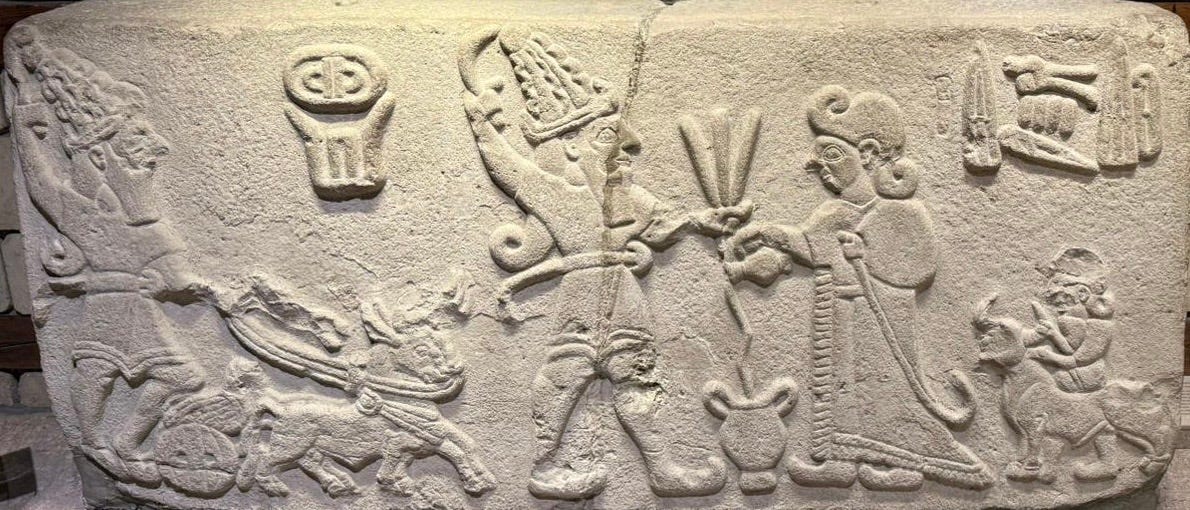
Ten Reasons Why Finding Manuland Matters - Vol. 1 - Episode XXXIII
Description
Today, we’re looking at how the Finding Manuland iterative method of discovery works. And, we look at the first two of ten reasons why Finding Manuland matters.
I'm Decoding Trolls and I'm welcoming you to Finding Manuland. And this is our first recording, which is on the road, as it were. I am on the road. I am in Turkey and I am here in Ankara, here to visit the Museum for Anatolian Civilizations. We will get to this again in the future.
It does take me quite a bit of time to to process what I see. But I wanted to talk to you quickly before we get to the 10 reasons about why finding Manuland matters. I want to quickly talk about methods. So I had this vision for my life in October/ November 2021.
You might remember, you might have read one of the first episodes of Finding Manuland where I describe it being in this village called Maine in eastern France and in being in a hotel room that night and thinking:
“Look, I've always wondered why is it that the first man in Indian culture is Manu and the first in Germanic culture is Mannus and in Ireland Manannán. Instead of just wondering about this stuff, why don't I try and find an answer to it and see if there is a connection between all of these MN sounding place names, and I was in one that day, and this phenomenon which I had noticed of MN sounds also in almost every sentence we speak.
So we have this questioning about geography, about mythology, early pre-Christian religion, and also about our everyday language. And as I had this revelation that perhaps I could investigate this and see if I could come up with an answer, I passed by a warehouse in eastern France called Manuland.”
There was this Manuland writing on it. And it's basically an agricultural machinery company in eastern France. And I thought, wow, that is a bit of a sign. That's a moniker and a sign. And so I will start investigating this. And I was on my way back to my diplomatic posting in Dnipro in eastern Ukraine.
This was a few months before the full-scale invasion. And I was rushing back there after a couple of weeks vacation in Ireland. And I decided, well, why don't I take my time and just kind of wander around and test this to see if I can come up with anything interesting and to see if finally Manuland is a goer. And so I got in touch with my boss and he said, that's fine, take your time. And which was great. And I spent a couple of days wandering around, but I had this vision for my life…
And this vision I've now realized to some extent. And the vision for my life was I would just arrive in a town, maybe with an MN sound in its moniker, in its name, and I would look for a method of exploring life. And I don't know what I'm looking for. And this is how all innovation happens.
This idea of serendipity. So serendipity isn't accidentally uncovering something. It's putting yourself into a position where if you do see signs of something interesting... along a vague theme that you you will spot them you're looking for them you're scanning for them you're looking for these weak signals and you're chasing those weak signals and that realization of that that chasing of that weak signal then leads you to further.
And I learned all about this and how you institutionalize innovation as a MBA student at Oxford University a few years ago. And how do you institutionalize innovation in companies? You try to keep the explore-exploit ratio in business. sync.
So exploit is I had this idea of an MN sound in mythology, in language and in place names. And I could explore just one of those. So that would be exploiting this idea. But exploring necessitates also moving forward. And where we're at now from that moment in Maine village in France, where I arrive and I just have this vague idea of what I'm going to, what am I going to do there? Okay. I go to the center of the town. It's a church. Then I decided to go run in circles, in ever increasing circles. And