Episode Details
Back to Episodes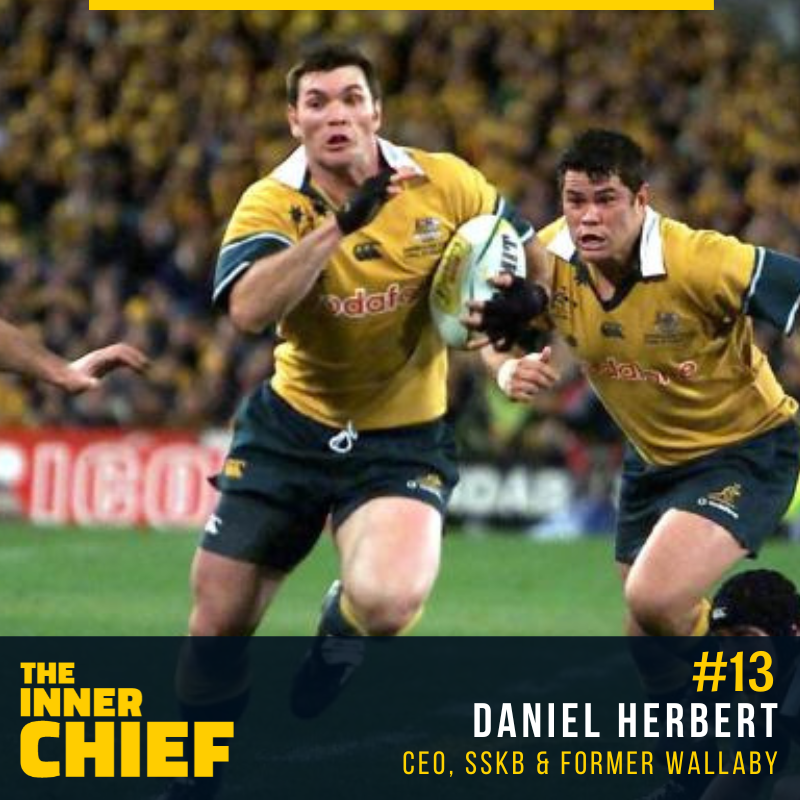
#13 Daniel Herbert, CEO of SSKB and Former Wallaby
Description
In this episode you'll hear from Daniel Herbert, CEO of SSKB.
We are going to be covering some powerful strategies that he learnt through 67 tests for the Wallabies. He was apart of the glory era of Australian Rugby, won the RWC in 1999, the Bledisloe Cup and beat the British and Irish Lions in 2001. He Captained the QLD Reds and was world player of the year in 1999.
Critically he has now gone to a successful corporate career with the commercial side of the QLD Reds and is now CEO of SSKB.
We cover what executives can learn from elite sport (and what doesn't translate), about what made him stand out from the pack and how to be indispensible to an organisation. The lessons here are vital.
Subscribe on iTunes here:
Subscribe on Android:
http://tunein.com/radio/The-Inner-Chief-p1004701/
http://www.stitcher.com/s?fid=141429
Key Points:
"My only message to the next generation is, you have to impress. You have to still do the work, you have to still stand out from the crowd because there is a lot more people coming around, there is lots of competition, don't rest on your laurels. By in large, I think they are smarter than what we were at that age."
Daniel's top messages include:
- I think you have to go through some lows to get the highs
- What people forget is the great era of Australian rugby came from something that wasn't so great.
- I think I made the most of what I had. I look back and I think, I played with numerous people who were more talented than me. I got to where I got from graft and I had to look for opportunities, take the opportunities and I had to work harder than others did to get there. So that became part of my mantra, I would work when I knew people weren't working. I would deliberately go running at midnight when I knew everyone else would be in bed. I would go on Christmas and kick some goals down the local park because I knew everyone else was sitting at the dinner table and that gave me this confidence that I know no one else is out there working today, I'm out here working, that's going to put me in a good place.
- Hard work will beat talent when talent doesn't work hard.
- I've seen a lot of people who were far better, were more talented, had natural abilities that I didn't have. And the only way I could convince myself that I had the right to actually be on the field or in the team ahead of these people was by working harder than them.
- There will always be weaknesses and yes, you try to improve your weaknesses but I tend to spend more time on my strengths than I do on fixing up the weaknesses, because what I would take into the business environment now is I can get people to fill in my weaknesses but, I can't necessarily get people who have better strengths than me where I think I'm particularly good.
- Don't be threatened by people who are really good, you've just got to get the best people around you and as long as they are not a real cultural risk to it
- As a CEO or a senior manager, you have to be a generalist, so you have to be across a lot of different things, but you still have to have something that you focus on, that's my unique point.
- I worked on the fact that, what I did as a rugby player, I love contact, I love the aggression, I love breaking a line and I love the physical side of it and that was going into the way that Rod MacQueen wanted to play the game when he came in. I knew that he wanted a line-breaking centre, somewhere and he needed someone who could bend the line, break the line. So I got in the gym, I got bigger, I worked on my footwork to get through a tackle and I thought, if I can be that guy, where he builds his game around me, or build