Episode Details
Back to Episodes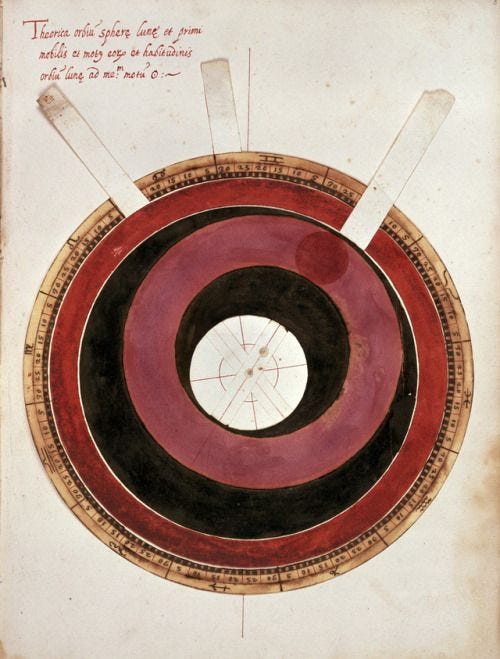
Contemplation
Description
The original meaning of Latin contemplari was "to mark out a space for observing auguries or omens," and the temple was a holy space reserved for this purpose.
Latin contemplatus, past participle of contemplari "to gaze attentively, observe," from the prefix com- "together" plus templum "temple."
“The Self (God) is a circle whose centre is everywhere, whose circumference is nowhere.”
C.G. Jung and Herman Hesse:A Record of Two FriendshipsMiguel Serrano (Schocken 1968).
“It may be that universal history is the history of a handful of metaphors. The purpose of this note will be to sketch a chapter of that history.”
~Jorge Luis Borges, The Fearful Sphere of Pascal. Translated by Anthony Kerrigan
The Fearful Sphere of Pascal
In “The Fearful Sphere of Pascal," Jorge Luis Borges explores the history of a metaphor that has evolved over centuries. The essay traces the concept of a divine and infinite sphere, with its center everywhere and circumference nowhere, through various philosophers and thinkers.
The journey begins with Xenophanes of Colophon, who proposed a single God in the form of an eternal sphere. Parmenides and Empedocles later elaborated on this idea, and it resurfaces in different forms, such as in the Hermetic books and medieval texts, where the divine is likened to an intelligible sphere.
Dante's cosmology, rooted in astronomy, also plays a significant role, with Earth positioned at the center of a complex system of concentric spheres. However, during the Renaissance, Giordano Bruno embraced the idea of an infinite universe with a center everywhere.
As time progresses, particularly in the 17th century, there is a perceptual shift. Borges delves into the transformation of the metaphor by Pascal, who, overwhelmed by dread and abhorrence towards the universe, characterizes it as a "fearful sphere."
Borges suggests that universal history may be a narrative of different interpretations of a few fundamental metaphors. The evolution of the metaphor of the sphere reflects changing philosophical and cultural perspectives throughout history.
Dante's poem preserved the Ptolemaic astronomy which for 1,400 years reigned in the imagination of mankind. The earth occupies the center of the universe. It is an immobile sphere; around it circle nine concentric spheres. The first seven are "planetary" skies (the firmaments of the Moon, Mercury, Venus, the Sun, Mars, Jupiter, Saturn); the eighth, the firmament of the fixed stars; the ninth, the crystal firmament which is also called the Primum mobile. This in turn is surrounded by the Empyrean, which is composed of light. All this elaborate apparatus of hollow, transparent and gyrating spheres (one system required 55 of them) had come to be an intellectual necessity; De hypothesibus motuum coelestium commentariolus is the timid title which Copernicus, denier of Aristotle, placed at the head of the manuscript that transformed our vision of the cosmos.
[…]
"An Aristotle was but the fragment of an Adam, and Athens the rudiments of Paradise." In that dispirited century, the absolute space which had inspired the hexameters of Lucretius, the absolute space which had meant liberation to Bruno, became a labyrinth and an abyss for Pascal.
He abhorred the universe and would have liked to adore God; but God, for him, was less real than the abhorred universe. He deplored the fact that the firmament did not speak, and he compared our life with that of castaways on a desert island. He felt the incessant weight of the physical world, he experienced vertigo, fright and solitude, and he put his feelings into these words:
"Nature is an infinite sphere, whose center is everywhere and whose circumference is no