Episode Details
Back to Episodes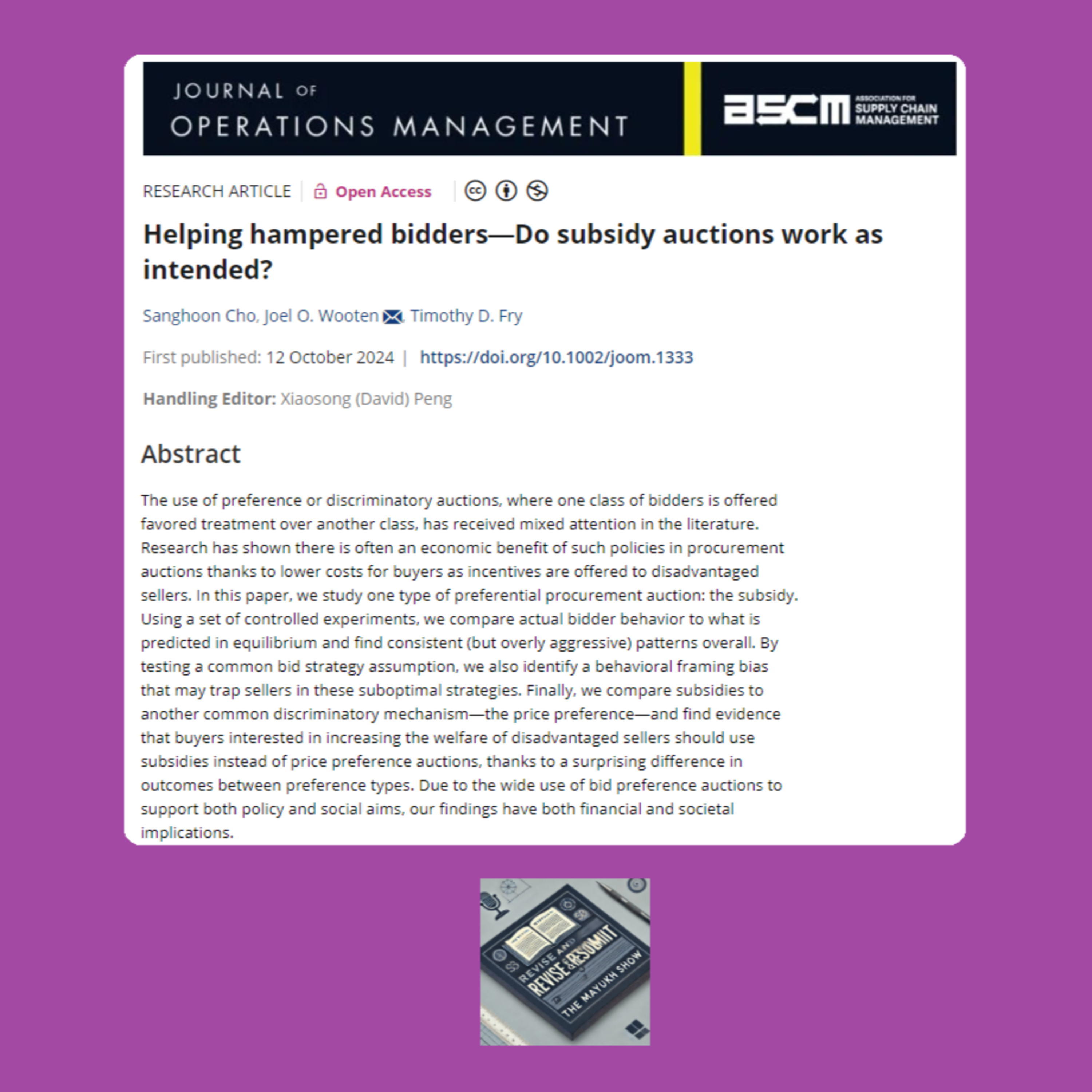
Helping hampered bidders: Do subsidy auctions work as intended? (Cho et al., 2024)
Description
Welcome to Revise and Resubmit, the podcast where research meets real-world relevance. Today, we’re stepping into the world of auctions and subsidies, exploring how governments and organizations try to level the playing field for disadvantaged bidders—and whether it works as intended.
Our focus today is the paper “Helping hampered bidders: Do subsidy auctions work as intended?” authored by Sanghoon Cho, Joel O. Wooten, and Timothy D. Fry. This insightful study was published in the prestigious Journal of Operations Management, one of the elite FT50 journals, renowned for setting the gold standard in business research.
Subsidy auctions are designed to boost competition by giving disadvantaged bidders a leg up. But here’s the twist: through controlled experiments, the authors discovered that bidders often behave more aggressively than theory predicts. They also found that framing biases can trap sellers in suboptimal bidding strategies. Interestingly, when subsidies are compared with price preference mechanisms, the outcomes diverge in surprising ways—subsidies end up being the better tool for promoting welfare.
Thanks to Sanghoon Cho, Joel O. Wooten, Timothy D. Fry, and Wiley Periodicals LLC, this research is open access and free for all to explore.
But here’s the burning question: If subsidies work better than price preferences in theory, why do real-world bidders keep falling into behavioral traps? Stick around as we unpack this fascinating study and explore the hidden dynamics of procurement auctions.
Reference
Cho, S., Wooten, J. O., & Fry, T. D. (2024). Helping hampered bidders—Do subsidy auctions work as intended? Journal of Operations Management. https://doi.org/10.1002/joom.1333