Episode Details
Back to EpisodesVlad the Impaler
Description
A figure of mythic proportions during his lifetime, Vlad the Impaler’s notoriety receded over the centuries only to be resurrected in the 1970s, when a pair of Boston University scholars went public with theories connecting him to Bram Stoker’s Count Dracula.
We begin with snippet of Francis Ford Coppola’s 1992 film, Bram Stoker’s Dracula, the first film to connect the literary vampire with the Eastern European prince — a rather ironic departure from Stoker’s novel, which references the historic figure only in passing.
Vlad’s 15th-century notoriety was sparked by two German texts both published around 1463, or shortly thereafter. Probably the earliest of these,written anonymously and published in Vienna, was titled, The History of Voivode Dracula, is sometimes called “the St. Gallen manuscript” named for the Swiss city where it is preserved. (“Voivode,” is a Slavic term, used in this context to mean, essentially, “Prince.”) The second is a rhymed narrative written by Michel Beheim, a poet associated with the Meistersinger tradition and a performer at the court of the King Friedrich III. About three decades later, in 1490, Vlad’s story appeared in northwestern Russia. We don’t know its author but the monk who copied it from a lost original, mentions that his source was written in 1486.
All three of these narratives provide plenty of gruesome anecdotes detailing the voivode’s cruelties. Before going further into Vlad’s history, and as a quick appetizer, Mrs. Karswell reads a description by Beheim of a ghastly picnic said to have been enjoyed by the voivode.
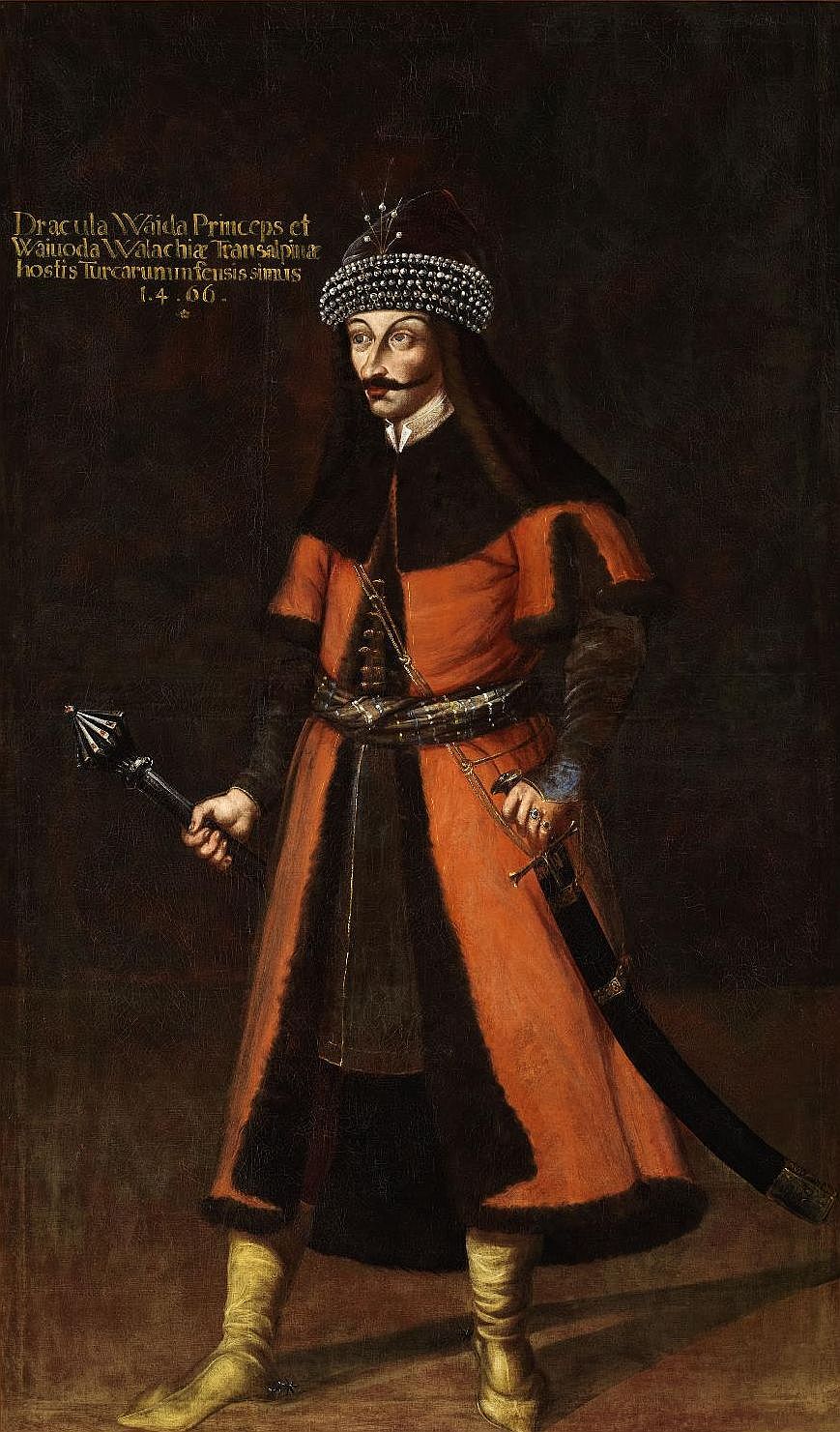
Next, we clear away some misconceptions regarding Vlad the Impaler, the first having to do with his name. Called “Vlad Țepeș” (Vlad the Impaler) in Romanian, he is less dramatically referred to as Vlad III. His father, Vlad II, was also known as “Vlad Dracul.” His son, using the Slavonic possessive form of that was referred to as Vlad Drăculea (that is, “of – the son of – Vlad Dracul). The father’s epitaph means “Vlad the Dragon,” referencing Vlad II’s (and later Vlad III’s) membership in The Order of the Dragon, a society of Christian knights dedicated to staving off incursions of the Muslim Turks into Christendom.
We then have a look at Vlad III’s over-emphasized association with Transylvania, one of the three historical regions (along with Moldavia and Wallachia) that would later become Romania. In fact, it was not Transylvania but Wallachia over which both Vlad II and Vlad III served as voivodes. While Transylvania was his birthplace, at the age of 4, he and his family departed for Wallachia, and Vlad’s historical relationship with Transylvania was later anything but friendly.
We then look at Wallachia’s role as a buffer between Ottoman regions to the south and Hungarian/German controlled