Episode Details
Back to Episodes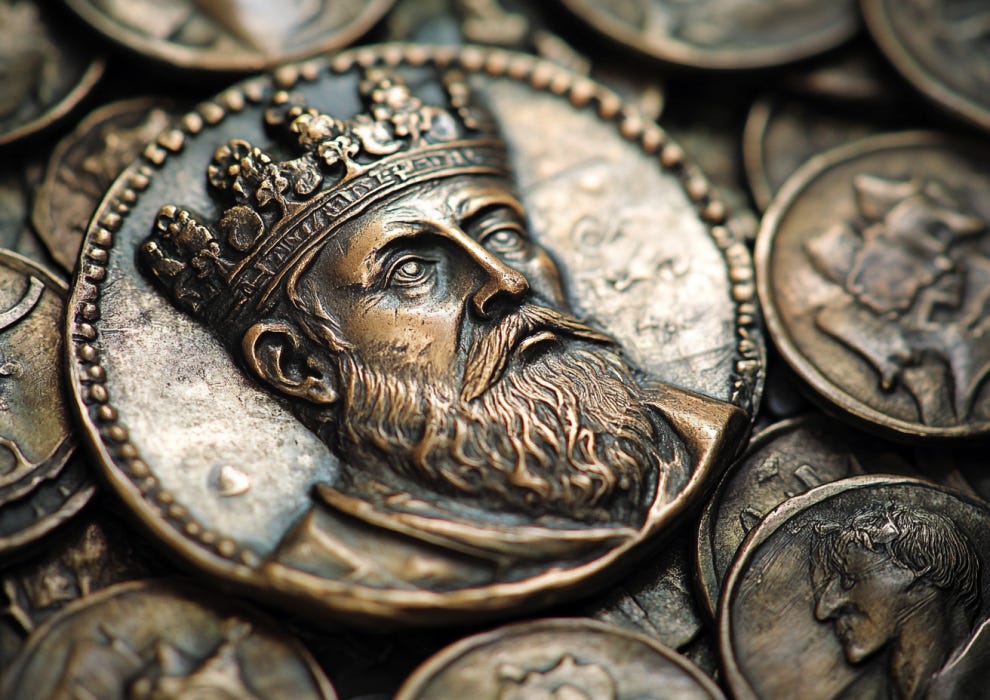
Danes, Dykes, and Denarii: How Did The Pound Come About?
Description
“If once you have paid him the Dane-geld, You never get rid of the Dane.”Rudyard Kipling
The winter of 406-407 was bitterly cold across Europe. The Rhine froze over, enabling hordes of Vandals, Alans - I love the fact that there was a tribe of Alans - and Suebi to make their way across the river, and into the Roman empire. They were violent with hunger, from the cold and greedy for what they had admired for so long on the other side.
The response from Rome was slow, weak and inadequate.
In Britain, Rome had already lost the north and west to warlords. The Roman armies in Britain, who, at best, had been paid with debased money, feared these Germanic tribes would cross into Britain next, so, led by Constantine III, who declared himself “Western Roman Emperor”, they made their way across the Channel and into Gaul, leaving ‘Britannia’ to fend for itself. We do not really know if it was Rome that gave up Britain, or Britain that gave up Rome, but, either way, the Dark Ages had well and truly begun.
Gold , silver and bronze coins had been widespread under the Romans. They were used to pay taxes, and often re-minted to pay the army and the civil service. But after Constantine III’s departure, few coins were either minted or imported. Judging by the numerous hoards found from the period, many people buried their money - presumably to keep it safe in this unruly new environment of no military protection and merciless invasion from Angles, Saxons and other tribes from the continent. With the lack of new supply, existing coins were re-used. Clipping - cutting off the edges to steal metal - became widespread. The previously vigorous late Roman monetary system crumbled. It was not for another 200 years that minting properly started up again.
The Anglo-Saxon invaders initially used gold more for adornment rather than as currency. Though there are examples of earlier Anglo-Saxon coins, King Eadbald of Kent was the first Anglo-Saxon whose name we actually know to mint coins. This was around 625AD - small, gold coins called scillingas (shillings), modelled on coins from France. Numismatists now call them thrymsas.
As the century progressed, these coins grew increasingly pale, until there was very little gold in them at all. From about 675, small, thick, silver coins known as sceattas came into use in all the countries around the North Sea, and the gold shilling was superseded by the silver penning, or penny. As money, gold fell out of use almost altogether, though silver had something of a boom.
It is thought the word ‘penny’, like the German ‘pfennig’ derives from the pans into which the molten metal for making them was poured. ‘Pfanne’ is the German for ‘pan’. Another theory is that it derives somehow from the denarius, as the symbol for the penny used to be the d. Likely a bit of both.
The Mercian King Offa, he of dyke fame, who reigned for almost 40 years from 757 to 796, must be one of the greatest Anglo-Saxon kings, certainly the greatest of the 8th century. As well as his dyke, which protected his kingdom from Welsh invaders, and provided a barrier by which he could collect duties, he is credited for the widespread adoption of the silver penny and pound as a unit of account (though the pound was in use before his reign, he still gets the credit). His coins,